7:22 PM
Nearly three decades of Republican dominance may be coming to an end:
The central con of the political coalition assembled by Ronald Reagan and maintained by his successors was that government was a common enemy. Middle-class social conservatives loathed the government for legalizing abortion, forbidding prayer in schools, and coddling minorities through welfare and affirmative action. Upper-class libertarian conservatives loathed the government for soaking the rich through the income tax and weakening businesses through burdensome regulation. The only useful function of the federal government was to provide for the common defense. This was a con for two reasons.
First, the middle and upper classes were both dependent on the federal government for a variety of benefits, including Social Security, trade protection, scientific research, and assorted localized spending (termed "pork barrel" by those who don't receive it and "economic development" by those who do).
Second, the distribution of this government largesse greatly favored the rich. In the April 1992 Atlantic, Neil Howe and Philip Longman, citing unpublished data from the Congressional Budget Office, reported that U.S. households with incomes above $100,000 received, on average, slightly more in federal cash and in-kind benefits ($5,690) than households with incomes below $10,000 ($5,560). This was four years before the Clinton administration eliminated Aid to Families With Dependent Children, the principal income-support program for the poor. When tax breaks were added to the tally, households with incomes above $100,000 received considerably more ($9,280) than households with incomes below $10,000 ($5,690). Clinton subsequently expanded tax subsidies to the poor through the Earned Income Tax Credit, but not enough to undo this disparity. "[I]f the federal government wanted to flatten the nation's income distribution," Howe and Longman concluded, "it would do better to mail all its checks to random addresses."
11:53 PM
7:22 PM
5:11 PM
4:21 PM
Feingold Bill Would Limit Searches of Travelers' Laptops - September 30, 2008 - The New York Sun:
Under a 29-page bill Mr. Feingold introduced on Friday, customs agents at airports and borders would need to document a "reasonable suspicion" before inspecting a computer or similar device carried by an American resident and could only hold on to the device for 24 hours before starting the process of seeking a warrant from a judge.
"Requiring citizens and other legal residents of the United States to submit to a government review and analysis of thousands of pages of their most personal information without any suspicion of wrongdoing is incompatible with the values of liberty and personal freedom on which the United States was founded," a preamble to the bill declares.
2:36 PM
11:50 AM
Financial crisis: Western world will become significantly less wealthy - Telegraph:
The free market can be very creative but it can also be immensely destructive. This is one of those points where the scale of destruction is potentially so great that it could set the economy back years.
This is why so many people – and not just the politicians putting the deal together – are warning that if the deal fails entirely we could be facing a second Great Depression.
The big mistake policymakers made in the 1930s was to allow too many banks to fail. This caused such a financial earthquake that it led to a decade of hardship.
The Troubled Asset Relief Program was not a perfect template for dealing with struggling banks. However, to dangle it in front of markets and then snatch it back again was an improbably unwise move.
11:14 AM
11:12 AM
Commentary: Bankruptcy, not bailout, is the right answer - CNN.com:
The obvious alternative to a bailout is letting troubled financial institutions declare bankruptcy. Bankruptcy means that shareholders typically get wiped out and the creditors own the company.
Bankruptcy does not mean the company disappears; it is just owned by someone new (as has occurred with several airlines). Bankruptcy punishes those who took excessive risks while preserving those aspects of a businesses that remain profitable.
In contrast, a bailout transfers enormous wealth from taxpayers to those who knowingly engaged in risky subprime lending. Thus, the bailout encourages companies to take large, imprudent risks and count on getting bailed out by government. This "moral hazard" generates enormous distortions in an economy's allocation of its financial resources.
11:06 AM
2:03 AM
Please Keep Your Voice Down, My Poor Retarded Child Is Sleeping:
Shhhh!
Could you please stop tearing apart my record so loudly? I just put my special needs child down for a nap. You remember my poor, Down syndrome baby, don't you? The developmentally disabled child I carried to term despite knowing that he had special needs? The child who would be helpless without my constant care and attention? Well, he's just nodded off, and if you continue to provide such damning evidence of my inexperience in both foreign and domestic policy, you'll wake him.
You wouldn't want him to start crying, would you?
12:23 AM
10:44 PM
10:43 PM
10:34 PM
10:05 PM
From a bathroom at Microsoft:
10:04 PM
Ross Douthat (September 29, 2008) - Three Scenarios (Politics):
The most likely scenario, as of 3 PM this afternoon: The stock market continues to drop. Some version of the bailout passes in the next week. The American economy staggers into a recession, but passes through the storm without 1930s-style suffering; the Republican Party is not so fortunate. Even though most Americans claim to oppose the bailout [update: not anymore], the House GOP's obstructionism is widely viewed as having worsened the economic situation; the fact that these are contradictory positions does not faze an electorate that wraps all of the country's current troubles up, ties them with a bow, and lays them at the feet of the Bush-led GOP. John McCain loses by a landslide in November. The Democratic Party regains years or even decades worth of ground among the white working class, consolidates the Hispanic vote, and locks up a large chunk of highly-educated voters who might otherwise lean conservative. The much-discussed liberal realignment happens. And a politician running on a Ron Paul-style economic platform does very, very well in the GOP primaries of 2012.
7:59 PM
6:31 PM
4:58 PM
Renting Makes More Financial Sense Than Homeownership - Yahoo! Real Estate:
I have something un-American to confess: I rent an apartment, despite having enough money to buy a house. I plan to keep renting for as long as I can. I'm not just holding out for better prices. Renting will make me richer.
I normally write about stocks for SmartMoney.com, but the boss asked me to explain to readers my reason for renting. Here goes: Businesses are great investments while houses are poor ones, so I'd rather rent the latter and own the former.
4:27 PM
4:27 PM
Actor wears 10 hats in play about gentrification in Williamsburg:
Danny Hoch - actor, playwright, Williamsburg resident and founder of the Hip-Hop Theater Festival - is giving a free performance of his one-man show, "Taking Over," in his own backyard - and at other spots around the city.
Hoch will give free performances in Queens and the Bronx, before the show's Nov. 7 opening at the Public Theater in Manhattan.
"To have the show be successful in the Public Theater, I know I have to get the support of people in the boroughs first," said Hoch, 37. "Tourists won't be my bread and butter, but [it's the] New Yorkers, who feel their stories are being told on stage."
4:18 PM
4:17 PM
The Paul Newman Scene I Can't Get Out of My Head:
But the scene I kept coming back to sets up the whole film. It's hardly noticeable. Newman is intent on bedding a fellow barfly played by Charlotte Rampling. He buys her dinner the night before voir dire, and for the first time in the film, we come up close to Newman's face. The deep-set mask of middle-aged failure softens. Watch Newman here, ye who would be actors; study him. Where does this come from? "See, the jury believes. The jury wants to believe." The lines are almost inconsequential. But Newman is giving us evidence that Galvin is still alive. "It is something to see. I have to go down there tomorrow and pick out 12 of them. All of them—all their lives—say, 'It's a sham, it's rigged, you can't fight city hall. But when they step into that jury box … you just barely see it in their eyes. Maybe, maybe …" Rampling leans imperceptibly forward. "Maybe what?" And Newman exhales—just a little—putting a lifetime of defeat into that exhale, and suddenly Frank Galvin is talking about himself. "Maybe I could do something right."
4:12 PM
4:10 PM
Steve Jobs and the Portal to the Invisible - Esquire:
The thing is, nobody should have been surprised. Steve Jobs has been saying that Steve Jobs is dying for years. From the beginning, death has been the hellhound on his trail; from the beginning, he has based his claim on immortality on the knowledge that he isn't going to make it. In the commencement speech he gave to the graduates of Stanford University a year after his cancer surgery, he diagnosed himself as "fine now," and hopeful to live "a few more decades." At the same time, he spoke of death as though it were a new Apple product -- that is, as "very likely the single best invention of life." He said that since he was seventeen, "I've looked in the mirror every morning and asked myself, If today were the last day of my life, would I want to do what I'm about to do today?"
Okay, people say things like that all the time in commencement speeches. But there's no doubt Jobs meant it; he has spoken this way often and since he was a young man, and his awareness of mortality has informed not just his life but every product his company has ever made. The aesthetics that he has demanded of his machines are not the frippery of corporate identity; they are the aesthetics he's demanded of himself. They are a response to something -- something deeply personal -- which is why they remain mysterious and impossible to duplicate.
3:50 PM
3:43 PM
The Lies And Lies And Lies Of Sarah Palin:
I'm posting this because none of the direct, indisputably proven, factual untruths that Palin has uttered has yet to be retracted by this candidate or her running mate. When you have a leading politician running on a record of outright lies, and those lies are deemed irrelevant, you have a problem. Each one has been fact-checked to near-death. They are not the usual political lie - hyperbole, parsing, exaggeration, spin. They are factual, checkable, indisputable untruths.
Palin could not have asked her girls for permission to accept McCain's veep offer if she also says she accepted the offer unblinkingly and right away. Palin did fire a police chief even as she insisted to a reporter she hadn't. She did violate the confidential medical records of Mike Wooten. She hasn't met with any trade missions from Russia. She does not have any gay friends that anyone can find. She did not oppose the Bridge to Nowhere. She did not sell that plane on eBay. Her Teleprompter did not fail in her convention speech. Alaska's state scientists did not conclude that polar bears were in no danger. She did deny publicly that humans had anything to do with climate change.
Alaska does not provide "nearly 20 percent of the U.S. domestic supply of energy," as she claimed. The gas pipeline she touts as her major "mission accomplished" has not broken ground and may never do so. She did not take a pay-cut as mayor of Wasilla. And on and on. Anyone with Google can check all of these out. Including reporters.
These are all documented, bald-faced factually irrefutable lies.
3:43 PM
3:27 PM
3:26 PM
The City Visible - A New Generation of Lolitas Makes a Fashion Statement - NYTimes.com:
The Lolitas are here and in full bloom. Theirs is a world in which the childhood fantasy of Alice in Wonderland seems to collide full force with the Addams Family. Its myriad influences include Victorian children’s wear, the French Rococo period, goth-inspired darkness and Japanese anime. Many Lolitas make their own clothes or have them specially commissioned.
Nancy Ramos, a 22-year-old photographer’s assistant who lives in Co-op City in the Bronx, was first drawn to Lolitas at Genericon, an anime convention in Troy, N.Y.
“I saw a girl dressed as a Lolita and thought it was the most beautiful thing I had ever seen,” Ms. Ramos said. “She was wearing a pair of rocking-horse ballerina shoes, and I had never seen anything like them before. I was fascinated that you could walk with your heel missing.”
10:43 AM
10:37 AM
1:39 AM
12:53 AM
Business & Technology | Back to My Mac needs to go back for improvements | Seattle Times Newspaper:
Any two Leopard computers with Back to My Mac activated and logged in to the same MobileMe account can connect for file sharing, remote screen sharing and any other Mac service that can advertise its ability over a local network using Apple's Bonjour.
After nearly a year of using Back to My Mac, writing and revising a long electronic book on the topic, and answering several hundred e-mails about the service from readers of this newspaper and my book, I have to conclude Back to My Mac isn't a solution for most users.
I don't have a single colleague who uses it to reach any of their machines remotely.
4:51 PM
Five minutes before the first presidential debate.
4:47 PM
4:38 PM
12:19 PM
I finally got to read "How Theatre Saved America, Part 2" in this month's American Theatre Magazine, which features Sheila and Itamar on the cover—Sheila looks a little like she's in a very intense Pinter play, and Itamar looks like he just got expelled from the seminary.
I kid. They both look great.
Anyway, if I seem light it's because I have little to discuss. You'll all recall the sturm und drang of my response to Part 1...so I've been wondering what Part 2 would have in store.
The answer: not much. It's about nothing that even remotely has to do with the topics of my show anymore—one suspects that once Ms. Eyring was bitten for her illogic and poor judgment by both me and a number of other folks, she simply shifted gears.
We'll never know. What I do know is that the second part bears no resemblance or connection to the first, and is substantially about how art allows us to humanize one another, and can allow people from different cultures to communicate. It also posits that touching a few people deeply is more significant than many lightly, though it doesn't do anything with this idea beyond stating it.
I agree with it, but it's pablum. I won't argue with it, because it is a waste of time and energy, and because I agree with much of it—that's the point of pablum, to find the things absolutely everyone agrees about and repeat them. Peace is good. War is bad. Art is warm. Socks are nice.
The article ends with this:
"A few small international gestures that make a big impact lead to more such gestures and more such impact. And it builds exponentially over time, all contributing to how theatre has saved and can save America."
The only thing missing is a PS that reads:
"Also unicorns are awesome, and rainbows, and these are also contributing to saving America."
2:31 AM
2:01 AM
10:54 PM
The Price of Garden Access in Brooklyn, Part I:
You can break up a party: make like a sitcom housewife and bang on the ceiling with a broom, then walk upstairs in your bathrobe, and say, “listen, I don’t mean to be a bitch, but it’s 3 a.m.” If all else fails, you can call the police. They won’t show up for an hour or more, but at least you’ll feel you’re taking action.
An orgasm, however, is a different matter, an entitlement with which you cannot interfere. These are the truths I pondered last May as I lay beneath a 4 a.m. sex marathon that earplugs wouldn’t block out. I knew because I was wearing some.
The man cried, “oh yeah, baby. Like that, baby.” Shoes clomped. Springs clink-clanked. The girl let out shrieks the likes of which I hadn’t heard since I lived under the same roof as a Moluccan cockatoo back in Miami. I thought about the bird as I drifted back to sleep: the way she raised her crest and danced back and forth on the perch, screaming, “Ah, ah, ah, ah,” as the sun came up every morning.
10:32 PM
10:11 PM
7:44 PM
7:04 PM
6:53 PM
6:23 PM
Read:
"We're very careful not to throw words around like 'meltdown' and 'free fall,' " CNN correspondent Ali Velshi, who is getting mucho face time thanks to the meltdown and free fall, told the New York Times. The Rupert Murdoch-owned Wall Street Journal is engaging in un-Murdochian restraint, banishing words like crash and pandemonium.
Maybe I have a limited vocabulary, but I'm not sure how else to characterize a month in which the country's largest financial institutions, Fannie Mae and Freddie Mac, had to be nationalized; Lehman Bros., the fourth-largest investment bank, filed for Chapter 11; AIG, a component of the Dow Jones Indsutrial Average, had to turn over most of its stock to the government in exchange for an $85 billion loan; the government had to guarantee money-market funds to stop people from hoarding cash under their mattresses; the nation's largest savings and loan, Washington Mutual, failed; and the nation's greatest financial minds declare that a bailout the size of the Netherlands' GDP is needed to stop the bleeding.
Yes, we have to be careful about crying fire in a crowded theater. But calling Wall Street's a meltdown a meltdown is more like crying fire in a crowded inferno.
6:21 PM
6:20 PM
He used his fame to give away his fortune:
Newman loved those stories. He loved to talk about the little kids who had no clue who he was, this friendly old guy who kept showing up at camp to take them fishing. While their counselors stammered, star-struck, the campers indulged Newman the way they'd have indulged a particularly friendly hospital blood technician. It took me years to understand why Newman loved being at the Hole in the Wall Gang Camp. It was for precisely the same reason these kids did. When the campers showed up, they became regular kids, despite the catheters and wheelchairs and prosthetic legs. And when Newman showed up, he was a regular guy with blue eyes, despite the Oscar and the racecars and the burgeoning marinara empire. The most striking thing about Paul Newman was that a man who could have blasted through his life demanding "Have you any idea who I am?" invariably wanted to hang out with folks—often little ones—who neither knew nor cared.
3:53 PM
Mini-Microsoft: Compensatory Arrangements of Certain (Microsoft) Officers:
Given the feckless vote of confidence that a bunch of screw-ups like Yahoo! got at their recent shareholder's meeting, I don't have much confidence in our shareholders challenging our leadership. Stock price? Don't care, got mine. What kind of performance targets must the company reach to achieve the rewards? Not gonna tell you.
First SPSA. Now this. Microsoft is dying from the inside, and the folks sucking it dry have zero motivation to change things. It's working out pretty damn well for them.
3:45 PM
3:30 PM
2:34 AM
The class of 2012 is super wired:
Out of 438 incoming freshman students at Amherst College, 432 of them are on Facebook and only 5 have landlines.
6. Number of students in the class of 2012 who brought desktop computers to campus: 14.
7. Number that brought iPhones/iTouches: 93.
8. Likelihood that a student with an iPhone/iTouch is in the class of 2012: approximately 1 in 2.
2:33 AM
1:45 AM
Poetry Bailout Will Restore Confidence of Readers—By Charles Bernstein (Harper's Magazine):
Chairman Lehman, Secretary Polito, distinguished poets and readers—I regret having to interrupt the celebrations tonight with an important announcement. As you know, the glut of illiquid, insolvent, and troubled poems is clogging the literary arteries of the West. These debt-ridden poems threaten to infect other areas of the literary sector and ultimately to topple our culture industry.
Cultural leaders have come together to announce a massive poetry buyout: leveraged and unsecured poems, poetry derivatives, delinquent poems, and subprime poems will be removed from circulation in the biggest poetry bailout since the Victorian era. We believe the plan is a comprehensive approach to relieving the stresses on our literary institutions and markets.
Let there be no mistake: the fundamentals of our poetry are sound. The problem is not poetry but poems. The crisis has been precipitated by the escalation of poetry debt—poems that circulate in the market at an economic loss due to their difficulty, incompetence, or irrelevance.
1:42 AM
1:35 AM
The Blindness Of David Brooks:
Brooks: McCain is "a humble man". Is Brooks really saying that a humble man would come back from Vietnam and among his first actions write a massive piece about his heroism in US News and then "write" five memoirs detailing his own heroism? Does a humble man bring up the Hanoi Hilton even when discussing his own many houses today? Real heroes never talk about their war records. McCain has milked and milked and milked his shamelessly for political advantage from the minute he got home. Men of the Greatest Generation wouldn't dream of this disgusting exploitation.
Brooks cites his legislative achevements but omits the fact that this torture victim was critical in putting into American law the first legalization of torture of prisoners by the American government in 2006, a betrayal of ancient principles so deep only a man without any integrity at all could have agreed to it. Someone somewhere is being tortured right now because John McCain made it happen. Standing over the shoulder of the torturer is the presence of McCain, as the pain and terror of the torture victim is milked for false confessions, then used for political purposes. That is integrity?
And Brooks, of course, omits Palin: the worst act of political judgment in my lifetime. She is indefensible. By any standards and by any reasonable person. No candidate with an ounce of concern for his own country would have selected her with such insouciance, cynicism and incompetence.
1:15 AM
8:43 PM
2:09 PM
2:09 PM
Britain will make foreigners carry RFID identity cards and will put us in a huge, Orwellian database: the rest of Britain will be next - Boing Boing:
Now, it seems, I will become one of the first people in Britain to be forced to carry a mandatory biometric RFID card in a pilot programme being deployed first to foreign students and we spousal visa holders (government is looking to curtail spousal visas altogether, capping all visas at 20,000 per year, including spousal visas, denying Britons the right to bring their spouses into the country once the quota has been filled). The card will be eventually linked to all of the national databases -- credit, health, driving, spending. These are the same databases that the government has been repeatedly losing and haemmorhaging by the tens of million (literally).
My family fled the Soviet Union after the war. They were displaced people (my father was born in a refugee camp in Azerbaijan) who destroyed their papers to protect themselves from the draconian authorities who sought to limit their travel and migration. I used to think it was ironic that my family had gone from Europe to Canada and back to Europe again in a generation, but now I don't know how long the Doctorows will be staying in Europe -- or at least in the UK. The green and pleasant land has suspended habeas corpus, instituted street searches without particularlized suspicion, encourages its citizens to spy and snitch on each other, and now has issued mandatory universal papers that will track we dirty immigrants as we move around our adopted "home," as part of a xenophobic campaign to arouse fear and resentment against migrants.
To my friends, I say this: your Labour Party has taken my biometrics and will force me to carry the papers my grandparents destroyed when they fled the Soviet Union. In living memory, my family has been chased from its home by governments whose policies and justification the Labour Party has aped. Your Labour Party has made me afraid in Britain, and has made me seriously reconsider my settlement here. I am the father of a British citizen and the husband of a British citizen. I pay my tax. I am a natural-born citizen of the Commonwealth. The Labour Party ought not to treat me -- nor any other migrant -- in a way that violates our fundamental liberties. The Labour Party is unmaking Britain, turning it into the surveillance society that Britain's foremost prophet of doom, George Orwell, warned against. Labour admits that we migrants are only the first step, and that every indignity that they visit upon us will be visited upon you, too. If you want to live and thrive in a free country, you must defend us too: we must all hang together, or we will surely hang separately.
2:06 PM
1:47 PM
1:16 PM
12:29 PM
Fresh Intelligence : Radar Online : Claymates Deal With Their Gay Grief:
High-pitched shrieks and excited OMGs could be heard all through America's suburbs yesterday as Clay Aiken admitted that he's gay, on the cover of People. Aiken's rabid fanbase, who call themselves Claymates, have taken to the message boards to deal with this shocking (to them) news. Many professed their undying support for the man they find talented, kind, and yes, sexy. But others are having trouble reconciling the news with comments Aiken made to Rolling Stone in 2004, when he denied having homosexual leanings. Nearly all Claymates are at one stage or another of the Kubler-Ross Grief Cycle, whether they're denying the truth of the story, raging at their hero himself, or coming to accept that he's a sinner. Examples follow:
5:21 AM
5:21 AM
Alan Moore on 'Watchmen' movie: 'I will be spitting venom all over it' | Hero Complex | Los Angeles Times:
Moore said that with "Watchmen," he told the epic tale of a large number of characters over decades of history with "a range of techniques" that cannot be translated to the movie screen, among them the "book within a book" technique, which took readers through a second, interior story as well as documents and the writings of characters. He also said he was offended by the amount of money and resources that go into the Hollywood projects. "They take an idea, bowdlerize it, blow it up, make it infantile and spend $100 million to give people a brief escape from their boring and often demeaning lives at work. It's obscene and it's offensive. This is not the culture I signed up for. I'm sure I sound like Bobby Fischer talking about chess "
4:49 AM
4:05 AM
Playbill News: RSC Announces New Three-Year Acting Ensemble Plus an Emphasis on New Work:
Royal Shakespeare Company artistic director Michael Boyd has announced the formation of a brand-new ensemble – who are being contracted to work together for 30 months and will work on a balanced combination of Shakespeare and new work (the latter being presented in the temporary Courtyard Theatre for the first time) — with embedded writers also being taken on to work closely with and write specially for a company of actors, as Shakespeare did.
3:30 AM
3:30 AM
EXCLUSIVE: LETTERMAN MOCKS MCCAIN CANCELLATION
Wed Sep 24 2008 17:41:58 ET
David Letterman tells audience that McCain called him today to tell him he had to rush back to DC to deal with the economy.
Then in the middle of the taping Dave got word that McCain was, in fact just down the street being interviewed by Katie Couric. Dave even cut over to the live video of the interview, and said, "Hey Senator, can I give you a ride home?"
Earlier in the show, Dave kept saying, "You don't suspend your campaign. This doesn't smell right. This isn't the way a tested hero behaves." And he joked: "I think someone's putting something in his metamucil."
"He can't run the campaign because the economy is cratering? Fine, put in your second string quarterback, Sara Palin. Where is she?"
"What are you going to do if you're elected and things get tough? Suspend being president? We've got a guy like that now!"
6:19 PM
5:53 PM
Seattle Yoga Bitch@Re-bar - Events:
Alternately side-splitting and stomach-curdling, writer/actress Suzanne Morrison’s autobiographical monologue is savagely funny. Narrating her decision to quit her job, drain her bank account, and put her relationship on hold while she trains as a yoga instructor in Bali, Yoga Bitch is the story of a career move which, it turns out, makes pursuing ambitions of solo theater look sane and pragmatic by comparison. Morrison introduces a cast of lunatic characters and leads them through a host of eccentric practices, from the exorcism of kitchen appliances to “urine therapy,” with candor, humor, and a flair for a punchline. Through sheer force of talent and personality, she is able to shock and horrify patrons without sacrificing their implicit faith in the complete and total logic of each decision that she makes. Ambitious, ballsy, and hilarious, Yoga Bitch is surely the best one-woman show I’ve seen all year.
5:51 PM
5:51 PM
Breaking: McCain Bails on First Debate:
John McCain has asked that this Friday's first presidential debate be postponed. He says it needs to be put off in order for him to "focus on the financial crisis," and he needs that time to fix this mess in his position as a Senator without any authority over any of it. Wtf. According to MSNBC, he's returning to Washington right now to personally solve this bailout thing. So—"country first," right? No time for debating, because Senator McCain—who is not on the Joint Economic Committee btw!—is asking Obama to join him in Washington. Jesus Christ. We're thinking this will very quickly come off as a "political stunt," and also make McCain look like a moron next time he trots out the "I lie about Obama because he wouldn't debate me 100 times from now until the election" line.
5:19 PM
Pinhole skull-camera - Boing Boing:
Wayne Martin Belger makes pinhole cameras using a variety of materials including precious stones, metals, human organs, and bone. This piece, entitled Third Eye, features many of these materials, all constructed around the 150 year-old skull of a 13 year-old girl. The film is exposed to light through titular ocular cavity making a Polaroid momento mori. The photos taken with this camera (one of which is after the jump) stay with the theme, their blurriness and patina making them look as if they were snatched from the memories of the dead.
1:29 PM
12:24 PM
Get Your Cowboy On:
Every day you see stuff in Mongolia that screams cowboy. In the morning, cowboys on horseback herd yaks, sheep, or camels out for grazing, and in the evening, the women go out and milk the beasts. Now and then, you may see men breaking in a bucking wild horse. In the small towns—often just a few buildings set out on the plains—you run into old cowboys wandering around drunk, as if you're in Tombstone, Ariz., and they've just come back from boozing with Doc Holliday.
That said, I'll admit that being in Central Asia does require certain adjustments. The horse saddles are generally made of wood. You don't pound whisky in the saloon; instead, you drink fermented horse milk in a ger. And the guns you'll see are old Soviet bolt-action models, not Winchester repeaters.
Traveling through deeper Mongolia is also a chance in this life to see what it is about the "endless plains" that once inspired so much writing and thought. There are places in America that are pretty empty. But endlessly empty is different. It means land free of any road or fence as far as the eye can see, and then beyond that, and then beyond that. The plains begin to feel more like ocean than land, open to being crossed in any way you'd like, free and unending. You start to realize how much your daily decisions are driven by paths, streets, and fences. Forget about the road less traveled and think no road at all.
After about a week of driving mixed with riding, we'd reached that mountain we spotted on the map back in Ulan Bator. We had reached the edge of the Altai range, just out of the Gobi desert, near the Chinese border. There we camped in a high plateau next to a single family's gers, sheep, and horses. We were their first foreign visitors in 17 years—the last was a Japanese fellow who lived in a tent for a year to study marmots.
12:14 PM
12:14 PM
inessential.com: ‘Beneath Apple’:
When I read that Apple’s solution to the problem of the negative press around apps being rejected from the App Store was to add an NDA warning, I thought it was satire. It couldn’t be true.
But it appears to be true. If so, then someone is making a mistake. This behavior is definitely beneath the company that makes the software and hardware I adore and love developing for.
11:46 AM
11:37 AM
Lifetime Achievement Award for Barney Rosset, Grove Press’s Uninhibited Publisher, Who Battled for His Books - NYTimes.com:
In its heyday during the 1960s, Grove Press was famous for publishing books nobody else would touch. The Grove list included writers like Samuel Beckett, Jean Genet, William S. Burroughs, Che Guevara and Malcolm X, and the books, with their distinctive black-and-white covers, were reliably ahead of their time and often fascinated by sex.
The same was, and is, true of Grove’s maverick publisher, Barney Rosset, who loved highbrow literature but also brought out a very profitable line of Victorian spanking porn.
On Nov. 19 Mr. Rosset will receive a lifetime achievement award from the National Book Foundation in honor of his many contributions to American publishing, especially his groundbreaking legal battles to print uncensored versions of “Lady Chatterley’s Lover” and Henry Miller’s “Tropic of Cancer.” He is also the subject of “Obscene,” a documentary by Neil Ortenberg and Daniel O’Connor, which opens on Friday at Cinema Village.
11:37 AM
'That Wild Mercury Sound': Tangled Up in Bob Again | The New York Observer:
"I always hear other instruments, how they should sound. The closest I ever got to the sound I hear in my mind was on individual bands in the Blonde on Blonde album. It's that thin, that wild mercury sound. It's metallic and bright gold with whatever that conjures up. That's my particular sound. I haven't been able to succeed in getting it all the time. Mostly I've been driving at a combination of guitar, harmonica and organ, but now I find myself going into territory that has more percussion in it and [pause] rhythms of the soul."
Me: "Was that wild mercury sound in 'I Want You'?"
Dylan: "Yeah, it was in 'I Want You,' it was in the album before that too …."
Me: " Highway 61 Revisited ?"
Dylan: "Yeah. Also in Bringing It Back Home . That's the sound I've always heard."
The sound he's "always heard": It suggests a kind of visionary experience (well, auditory vision, if you will)–a Muse-like musical visitation , almost, that came to him as sound rather than song.
What I'd forgotten, what I rediscovered rereading the interview, was that Mr. Dylan goes on to elaborate upon that sound, to give it a local habitation and a name. And to describe it with the kind of synesthesia characteristic of visionary experiences. Synesthesia because he begins by defining that sound he was searching for as a kind of light :
"It was the sound of the streets," he said. "That ethereal twilight light, you know. It's the sound of the street with the sunrays, the light shining down at a particular time, on a particular type of building. A particular type of people on a particular type of street. It's an outdoor sound that drifts even into open windows …. The sound of bells and distant railroad trains and arguments in apartments and the clinking of silverware and knives and forks … usually it's the crack of dawn. Music filters out to me in the crack of dawn."
11:23 PM
11:23 PM
The Associated Press: Palin lawyer meets with investigator in probe:
ANCHORAGE, Alaska (AP) — Less than a week after balking at the Alaska Legislature's investigation into her alleged abuse of power, Gov. Sarah Palin on Monday indicated she will cooperate with a separate probe run by people she can fire.
10:26 PM
8:30 PM
Playbill News: Daisey's The Moon Is a Dead World to Premiere in Seattle:
Seattle's Annex Theatre will stage the world premiere of monologist Mike Daisey's first play, The Moon Is a Dead World, which begins performances Oct. 17.
Under the direction of Christopher Comte, the production will kick off the theatre company's 22nd season. Performances will continue through Nov. 15.
The cast includes Zach Robinson, Jack Hamblin, Pamala Mijatov and Clayton Weller.
Press notes for The Moon read: "Mike Daisey weaves a vision of the brutal history of the Soviet space program with an unbelievable premise: a dead cosmonaut is called back down to Earth on a radio wave when Americans in a remote Arctic base hear the beating of his dying heart. A dark and hilarious fairy tale set against the Cold War, it asks what we risk in the struggle between will and humanity, and what it means to love beyond death itself."
The Moon Is a Dead World marks the playwriting debut for Daisey, who is known for his pointed monologues, which include How Theater Failed America and Invincible Summer.
8:14 PM
3:33 PM
What A Real Media Revolt Would Look Like | Slog | The Stranger | Seattle's Only Newspaper:
Maybe it’s time for the media to pull all reporters—print and television, photographers and videographers—off the McCain campaign. Entirely. Press coverage of a campaign is supposed to be a two-way street. The candidate wants to get his mug on television, he wants his rallies and speeches broadcast and written up, he wants to use the media to reach the voters. In exchange for allowing themselves to be used, the candidate is supposed to make himself available to reporters and anchors, answer questions, hold press conferences. The McCain campaign isn’t holding up its end of the deal. It’s using the media to reach voters without making Palin and, increasingly, McCain available for questioning.
Why should the media play along? The media should pull reporters off the McCain campaign and refuse to cover rallies or speeches until McCain and Palin start holding press conferences. Period. You want to reach our viewers and readers? Start answering our questions. Don’t want to answer our questions? We’ll ignore you and your campaign.
2:50 PM
2:24 PM
3:07 AM
Sen. Bernie Sanders, Robert Scheer and Dean Baker on the Proposed $700 Billion Bailout of Wall Street, the Largest Government Bailout of Private Industry in US History:
For years now, they’ve told us that we can’t afford—that the government providing healthcare to all people is just unimaginable; it can’t be done. We don’t have the money to rebuild our infrastructure. We don’t have the money to wipe out poverty. We can’t do it. But all of a sudden, yeah, we do have $700 billion for a bailout of Wall Street.
1:46 AM
1:33 AM
5:07 PM
Hiding in Plain Sight - washingtonpost.com:
JOHN McCAIN selected Alaska Gov. Sarah Palin to be his running mate 23 days ago. Since then, Ms. Palin has not held a single news conference with the national media. She has answered only a handful of questions from voters and reporters. She sat down for a lengthy discussion with one nonpartisan interviewer, ABC's Charles Gibson, and granted another interview to conservative Sean Hannity of Fox News, as well as a sit-down with People magazine and some interviews with Alaska media. Where Dick Cheney made the rounds of five news shows the weekend after he was tapped by George W. Bush, Ms. Palin has not turned up on a single Sunday program.
Mr. McCain's selection of an inexperienced and relatively unknown figure was unsettling, and the campaign's decision to keep her sequestered from serious interchanges with reporters and voters serves only to deepen the unease. Mr. McCain is entitled to choose the person he thinks would be best for the job. He is not entitled to keep the public from being able to make an informed assessment of that judgment.
4:33 PM
4:32 PM
Monologuist Mike Daisey looks at homeland security:
Mike Daisey likes to tell stories. On stage.
His latest monologue, "If You See Something Say Something," takes a look at the Department of Homeland Security, its history and what it means to be safe.
The production, directed by Jean-Michele Gregory, opens Oct. 27 at the Public Theater with preview performances beginning Oct. 15.
Daisey has built a reputation on these monologues, which include "21 Dog Years" and "How Theater Failed America," which has performed in theaters throughout the United States.
For tickets to "If You See Something Say Something," which runs through Nov. 30, call 212-967-7555, or visit the Web site, www.publictheater.org.
3:13 PM
3:13 PM
Scrappy Jack's World-Wide Theatricals and Dime Museum: first day of the paulson administration:
We now live in a socialist state. And I'm all for socialism, I just prefer the kind that takes care of the young and the sick and the old over the kind that emphasizes state control of the economic sector.
But that's just me.
Milton Friedman's policies (popularly know around here as Reaganomics or trickle-down theory), have, once again, when strictly applied in a real market-place, failed spectacularly. Just as they did in Chile, in Poland, in Russia and everywhere else they've been tried. They call for complete deregulation of industry, destruction of the unions, elimination of the minimum wage, etc.
And they don't work.
It's not a credible theory anymore. It's not something that anyone can honestly and with any intellectual integrity argue for anymore. It has to go sit in the corner with the Flat Earth theory and get laughed at whenever the class wants to feel better about itself.
So, the GOP has to go out and find itself a brand-new domestic policy real quick and the rest of us have to get used to calling each other "comrade", or at least "citizen".
2:36 PM
2:36 PM
Slashdot | Obama Significantly Revises Technology Positions:
"Barack Obama has edited his official website on many issues, including a huge revision on the technology page. Strangely it seems net neutrality is no longer as important as it was a few months ago, and the swaths of detail have been removed and replaced with fairly vague rhetoric. Many technologists were alarmed with the choice of Joe Biden before, and now it appears their fears might have been well founded."
2:07 PM
2:07 PM
Star Simpson, one year after Boston airport terror-scare: unedited BBtv interview transcript - Boing Boing:
XENI: What were you accused of, and what was it decided that you'd done? Were you convicted of a crime?
STAR: I was not. The other part of the deal was that MA dropped the "hoax device" charge, finally, after a year.
XENI: Can you explain what that was?
STAR: A "hoax device" is defined as an "infernal machine," any device intended to cause anxiety or fear. I think I read a case where the last person charged with this actually had explosives and was using them to clear land on his own private property and didn't have anything to ignite the explosives. But I didn't have anything like that. Another key part of the charge is that you have to intend to cause fear, anxiety, and I did not have that intention. So after the many months, MA finally dropped the "hoax device" charge. They claimed I'd been a disorderly person instead, because you don't have to intend to be a disorderly person. You can charge anyone with that. And if I don't complete the community service, I would be charged with that. It's a totally fascinating thing. If you watch the press report on that day, Major Scott Pare says it's lucky I cooperated with the police because otherwise I would have ended up in the morgue instead of a cell.
XENI: Star, how do you feel when you hear that quote?
STAR: Terrified. Completely terrified. I was almost killed on that day. The police could kill me, and I would never have been able to ask what was going on. It's hard to believe they mean me.
1:59 PM
1:27 PM
12:38 PM
Matthew Yglesias » The Crisis:
Simply put, if congressional Democrats manage to acquiesce in a plan that spends $700 billion on a bailout while doing nothing for average working people and giving the taxpayer virtually no upside in a way that guarantees that even electoral victory would give an Obama administration no resources with which to implement a progressive domestic agenda in 2009 then everyone’s going to have to give serious consideration to becoming a pretty hard-core libertarian.
It’d be one thing for a bunch of conservative politicians to ram a terrible policy through. Then we could say “well, if some progressives win the next election things will be different.” But if this comes through an allegedly progressive congress then the whole enterprise starts looking pretty hollow.
11:28 AM
11:28 AM
Why the world needs cheap loans at insanely high interest rates:
What the world needs right now is more subprime lending—a lot more of it. Yes, I know that in the public imagination, subprime lending is the scourge responsible for crippling the U.S. financial system. The massive extension of credit to people who lacked extensive credit histories and documented wages seems, in hindsight, supremely stupid. But far from the madding, depressed crowds of Wall Street, billions of people are starving for credit.
Lending tiny sums to people who live on a few dollars a day—street vendors in New Delhi, goatherds in Kenya—doesn't carry the glamour or financial rewards of haute banque. And compared with efforts to vaccinate children or build dams, it seems like an exercise comparable to shooting pellets at a runaway rhinoceros. But in an era when a great deal of foreign aid has been wasted or has fallen into the hands of corrupt officials, microlending has built a track record of effective poverty relief. Microcredit pioneer Muhammad Yunus, who founded Bangladesh's Grameen Bank in 1983, won the 2006 Nobel Peace Prize. And microfinance, which now touches the lives of more than 100 million people, is one of the few bright spots in the troubled financial sector. "We've helped about 80,000 entrepreneurs, and the repayment rate is about 98 percent, which is a better performance than consumer credit-card portfolios in the U.S.," says Premal Shah, president of Kiva.org, an online microcredit organization that allows computer programmers in Seattle to lend sums as low as $25 directly to small-scale grocers in Uganda.
8:10 PM
2:49 AM
Doctor Manhattan - Wikipedia, the free encyclopedia:
After his transformation, Jon begins to experience time in a non-linear, "quantum" fashion, and it is implied that he is aware of and experiencing all the moments of his life simultaneously. Jon is not omniscient; he remains reliant on his intellect and sensory experience to reach conclusions, but his range of sensory data has been abruptly extended, in proportion to the lessening of his emotional capacities. This often leads him to arrive at conclusions greatly different from those available to normal humans. His already weak will (marked by his apparent submission to his father's career plans, whatever they might be) becomes sublimated further during this time. He increasingly has difficulty acting in what those around him consider the present moment, leading to many accusations and even the public perception that he is emotionless and uninterested in human affairs. For instance, he does nothing to prevent the assassination of President John F. Kennedy, even though he is aware it is going to happen as he meets the President. However, during the course of Watchmen he displays powerful emotion several times. His apparent lack of sentiment is more a matter of radically altered priorities, owing to a colossal, unbridgeable gap of perception between Jon and the rest of humanity.
He subscribes to a deterministic view of events (at one point remarking "We're all puppets, Laurie. I'm just a puppet who can see the strings."). Throughout most of Watchmen, Doctor Manhattan appears to exert an effort of choice, and his actions often seemed governed by a rigidly utilitarian code of ethics in which the correct course of action must be the one that benefits the most. In some sense, unlimited power has come at the cost of the total absence of responsibility, and his growing detachment, if not apathy, is juxtaposed with his apparent ability to do anything. During the period in which Doctor Manhattan is a crime-fighter (at the behest of the government), he states that the morality of such activities escapes him. From his radically altered perspective, almost all human concerns appear pointless and without obvious merit.
11:16 PM
11:16 PM
Products Placed: How Companies Pay Artists to Include Brands in Lyrics | Listening Post from Wired.com:
Songs that refer to products and brands have been with us for years, from Simon and Garfunkel singing "Mama don't take my Kodachrome away" to Janis Joplin's plea for a new car in "Mercedes Benz" and beyond. Conscious of the branding value such mentions can bring, some artists have gone so far as to approach companies with offers to include brand and product names in their song lyrics.
A e-mail from the Kluger Agency, which performs such product placements, mistakenly sent to Jeff Crouse of the Anti-Advertising Agency and Double Happiness Jeans, provides a rare glimpse into the secretive market for song lyric product placement.
"I'm writing because we feel you may be a good company to participate in a brand integration campaign within the actual lyrics of one of the worlds most famous recording artists upcoming song/album," begins the opening e-mail in the eventual salvo between the two.
11:03 PM
11:03 PM
Online Literacy Is a Lesser Kind - ChronicleReview.com:
In the eye-tracking test, only one in six subjects read Web pages linearly, sentence by sentence. The rest jumped around chasing keywords, bullet points, visuals, and color and typeface variations. In another experiment on how people read e-newsletters, informational e-mail messages, and news feeds, Nielsen exclaimed, "'Reading' is not even the right word." The subjects usually read only the first two words in headlines, and they ignored the introductory sections. They wanted the "nut" and nothing else. A 2003 Nielsen warning asserted that a PDF file strikes users as a "content blob," and they won't read it unless they print it out. A "booklike" page on screen, it seems, turns them off and sends them away.
6:06 PM
6:06 PM
Mike Daisey,
I'm Cabel Sasser's father. His mother, Lyn and I briefly met both you and
Jean-Michele after Saturdays monologue in Portland.
We thoroughly enjoyed and were moved by both of the monologues that we
attended. We owe Cabel a debt of gratitude for introducing us to your art.
Today, I want to share something with you.
I've always believed that, we can't judge the social attitudes of the
past, using today's standards. After all, the gentlemen who wrote "We hold
these truths to be self-evident, that all men are created equal . . .",
for the most part, were slave holders. And, I find it disturbing, when
viewing a Marx Brothers' film with an audience, that everyone laughs at
the boy tenor when he sings a romantic ballad.
But, after Saturday's monologue, I remembered an item from our personal
collection that I've never been able to wrap my head around. It may
demonstrate America's attitude towards Japan in 1945, or it may have been
a misguided attempt to appeal to the toy-buying public. I've never seen
another one like it and I'm attaching a photo for you to examine.
It is a 1940s vintage, hand-held game of skill, where the player
tries to land two transparent capsules that each contain a single
ball-bearing, "a-bombs" if you will, into indentations located at
Hiroshima and Nagasaki.
Sincerely,
Stephen Sasser
6:02 PM
3:24 PM
Dispatches from the Culture Wars: Palin the Young Earth Creationist:
This is hardly a shock, since most Pentecostals are YECs, but a Wasila resident says that Palin has told him she believes the earth is only a few thousand years old and that humans and dinosaurs lived together:
Another valley activist, Philip Munger, says that Palin also helped push the evangelical drive to take over the Mat-Su Borough school board. "She wanted to get people who believed in creationism on the board," said Munger, a music composer and teacher. "I bumped into her once after my band played at a graduation ceremony at the Assembly of God. I said, 'Sarah, how can you believe in creationism -- your father's a science teacher.' And she said, 'We don't have to agree on everything.'
"I pushed her on the earth's creation, whether it was really less than 7,000 years old and whether dinosaurs and humans walked the earth at the same time. And she said yes, she'd seen images somewhere of dinosaur fossils with human footprints in them."
3:24 PM
3:18 PM
I liked Microsoft better when they were assholes - (37signals):
I actually liked Microsoft better when they stood for something. Even when that something was being a ruthless corporation hell-bent on world domination. Batman needs the Joker too.
It’s hard to imagine that the once mighty 800-pound gorilla in the room has been reduced to a mere monkey. A monkey with a $230B market cap, but a monkey no less.
I pity the marketers working the Microsoft account. There’s no way to win. If they go vague, they get people_ready. If they go edgy, they get panic and push back. Talk about a set of golden handcuffs.
3:14 PM
3:14 PM
Sinking Ship - Features - The Stranger, Seattle's Only Newspaper:
So it was with fairly unmixed feelings that I went to say good-bye to you. I waited for a long time. Finally I was granted an audience with you, as represented by a slightly wild-eyed assistant manager. I told you that I would like to close my account. You asked me why. I said that I was concerned about the health of the institution. You asked me why. I said that I'd been keeping abreast of the situation in the media and that I'd been advised by two people whose financial expertise I respected to close my account. I also said that I was pressed for time. You asked me who these two people were, which I did not feel was any of your business, but I answered. You told me that that the media was acting irresponsibly and reporting things that were "just untrue," and that word-of-mouth was causing people to make "emotional decisions." I said, "This is not an emotional decision." I said that I was sorry for your predicament; I said that surely you could understand that I wanted my money in the safest possible place. You told me (at length) that my money was safe. I said that I understood what "FDIC insured" meant, and that I also understood there might be a gap when my money might be unavailable. You said that this was not true. I took your business card from the holder on your desk and began making notes on it.
This went on for a long time. I began to hate you, Washington Mutual. I said that I would like to close my account and that I was pressed for time three separate times. I said that I did not want to continue this conversation. You became increasingly agitated, and you browbeat me, intimating that I did not understand financial matters and saying that I was being "rash." I did not say, "Would you say that to a man?" But would you, Washington Mutual? You did not say it to Tim Keck, the publisher of this paper, when he closed his account the day before I did. Mr. Keck was neither rash nor emotional: He was merely a man who wanted his money.
2:56 PM
2:45 PM
Op-Ed Columnist - Need a Job? $17,000 an Hour. No Success Required. - Op-Ed - NYTimes.com:
As Warren Buffett has said, “in judging whether corporate America is serious about reforming itself, C.E.O. pay remains the acid test.” It’s a test that corporate America is failing.
These Brobdingnagian paychecks are partly the result of taxpayer subsidies. A study released a few weeks ago by the Institute for Policy Studies in Washington found five major elements in the tax code that encourage overpaying executives. These cost taxpayers more than $20 billion a year.
That’s enough money to deworm every child in the world, cut maternal mortality around the globe by two-thirds and also provide iodized salt to prevent tens of millions of children from suffering mild retardation or worse. Alternatively, it could pay for health care for most uninsured children in America.
Do we truly believe that C.E.O.’s like Mr. Fuld are more deserving of tax dollars than sick children?
2:44 PM
3:48 PM
Tickets on Sale for 'If You See Something Say Something' at the Public Theater (BroadwayWorld.com):
Tickets for IF YOU SEE SOMETHING SAY SOMETHING, created and Performed by Mike Daisey and directed by JEAN-MICHELE GREGORY at the Public Theater are now on sale.
1:49 PM
7:40 PM
12:33 PM
Rough Type: Nicholas Carr's Blog: The Omnigoogle:
Google differs from Microsoft in at least one very important way. The ends that Microsoft has pursued are commercial ends. It's been in it for the money. Google, by contrast, has a strong messianic bent. The Omnigoogle is not just out to make oodles of money; it's on a crusade - to liberate information for the masses - and is convinced of its righteousness in pursuing its cause. Depending on your point of view as you look forward to the next ten years, you'll find that either comforting or discomforting.
4:43 AM
4:22 AM
4:20 AM
Daring Fireball Linked List: Microsoft Aims to Redefine ‘I’m a PC’:
This Microsoft advertising story just gets weirder. Now they’re rolling out a commercial with a John Hodgman lookalike who declares, “Hello, I’m a PC, and I’ve been made into a stereotype.”
Directly responding to Apple’s campaign is weak. It’s playing Pepsi to Apple’s Coke, Burger King to Apple’s McDonald’s. It’s an explicit acknowledgement that Microsoft is the second-place brand.
4:19 AM
4:19 AM
Breaking: Microsoft to announce Jerry Seinfeld ads cancelled tomorrow:
Remember those awful Microsoft ads with Jerry Seinfeld and Bill Gates? Well, now you can forget them. Microsoft flacks are desperately dialing reporters to spin them about "phase two" of the ad campaign — a phase, due to be announced tomorrow, which will drop the aging comic altogether. Microsoft's version of the story: Redmond had always planned to drop Seinfeld. The awkward reality: The ads only reminded us how out of touch with consumers Microsoft is — and that Bill Gates's company has millions of dollars to waste on hiring a has-been funnyman to keep him company.
7:46 PM
7:46 PM
Six Questions for Bart Gellman, Author of Angler—By Scott Horton (Harper's Magazine):
There’s no venality here. Cheney was not trying to aggrandize himself, to steer money to friends, or to set himself up for higher office. He simply believed that the stakes were high and he was more capable than others. He saw the world, he believed, as it truly is and was prepared to do the “unpleasant” things that had to be done to safeguard us. Cheney is a rare combination: a zealot in principle and a subtle, skillful tactician in practice.
A lot of critics call Cheney and Addington contemptuous of the Constitution. I think that’s completely wrong–a cartoon that misses something important, because it fails to take them seriously. The vice president has an unyielding conviction, to which he has devoted substantial thought, about what the Constitution means. He occupies an extreme position in the usual separation-of-powers debate, sometimes beginning with widely accepted tenets but carrying them beyond the bounds of accepted scholarship. In his own frame of reference, the Constitution not only permits but compels him to help Bush break free of restraints on his prerogatives as commander in chief and leader of the unitary executive branch. But where Cheney does show contempt is for public opinion, the capacity of the citizenry at large to make rational decisions.
4:13 PM
4:13 PM
The Daily Dish | By Andrew Sullivan:
For real! The candidate for vice-president of the United States actually responded to a question from the press! Amazing:
Though she has been on the campaign trail for nearly three weeks, Palin has yet to hold a press conference, and this morning’s stop marked the first time she answered a question from the press on the fly, prompting concerned looks from staffers.
What twilight zone are we in?
4:10 PM
4:10 PM
Homeland Security Department Oversaw $15 Billion in Failed Contracts:
Since it was created in 2003, the Department of Homeland Security has overseen about $15 billion in failed contracts—a third of the agency’s contract spending—for a a wide-range of projects, according to documents and other data obtained by the House Committee on Homeland Security.
3:56 PM
3:55 PM
A bracing indictment from Theresa Rebeck here. I still haven't forgiven her for writing (and subsequently sending out into the world) this piece of shit, but this does help.
2:19 PM
1:39 PM
SHOUTS & MURMURS: My Gal:
So, when Barack Obama says he will put some lipstick on my pig, I am, like, Are you calling me a pig? If so, thanks! Pigs are the most non-Élite of all barnyard animals. And also, if you put lipstick on my pig, do you know what the difference will be between that pig and a pit bull? I’ll tell you: a pit bull can easily kill a pig. And, as the pig dies, guess what the Hockey Mom is doing? Going to her car, putting on more lipstick, so that, upon returning, finding that pig dead, she once again looks identical to that pit bull, which, staying on mission, the two of them step over the dead pig, looking exactly like twins, except the pit bull is scratching his lower ass with one frantic leg, whereas the Hockey Mom is carrying an extra hockey stick in case Todd breaks his again. But both are going, like, Ha ha, where’s that dumb pig now? Dead, that’s who, and also: not a smidge of lipstick.
A lose-lose for the pig.
There’s a lesson in that, I think.
1:39 PM
1:39 PM
Adam McKay: We're Gonna Frickin' Lose this Thing:
This race should be about whether the Republican Party is going to be dismantled or not after the borderline treason of the past eight years. But instead it is about making the word "community organizer" a dirty word and a beauty queen who shoots foxes from a plane. Someone is not in any way doing their job and it's the press. Or more specifically, that job no longer exists.
Probably the worst offenders are the pundits who take the position that it's all just a game and say phrases like "getting a post-convention bump" or "playing to the soccer Moms." This isn't a game of Monopoly or Survivor. There are real truths that exist outside of the spin they are given and have an effect on lives. 250,000 Iraqi civilians are dead because we let our reality be distorted by the most effective propaganda machine in fifty years, the corporate American press. Money and jobs are flying out of this country as our currency becomes worthless and we're talking about the fact that McCain is a veteran. If someone busted into your house and robbed you would you then forgive them if you found out they were a veteran? Of course not. So why are we forgiving McCain for selling out his country by supporting the Bush agenda?
1:30 PM
1:06 PM
Exploit and Click:
Photography tends to magnify and distort both deeds and misdeeds—more so than other art forms, and in fact more than almost any activity I can think of. The specter of exploitation hovers over it, and it's this, I think, that accounts for Hawk's disproportionate outrage. If Greenberg were making infants weep in the service of a psychological experiment, one might feel uneasy, but the dismay would no doubt be tempered by one's sense that a greater good was to come of it. If she were doing it because she wanted to, say, draw them, or write poems about them, many people might still find it objectionable, but not, I don't think, to quite the same degree. Indeed, if she were doing it just for the hell of it, we would consider her cruel and culpable; but the fact that she made them cry so that she could take their pictures somehow makes it worse.
The point becomes clearer, or at any rate starker, by comparison with pornography. In most states, the age of consent is 16 or 17, but federal law stipulates that you can only be photographed having sex if you're 18 or older. Two 17-year-olds can copulate to their hearts' content, and their friends can watch: However creepy it may be, no laws would be broken. But they can't be photographed in the act, nor can anyone, of any age, so much as look at such a photo. The picture has a legal status quite different from the thing it pictures.
5:23 AM
5:23 AM
Reality Sandwich | The Last Tree of the Sahara:
I'd dropped everything back home -- my job, my love life, my apartment, my dog -- with the idea that traveling sans possessions to the edge of the world should somehow bestow upon me an epiphany. And so I'd traveled deep into Africa to a country that by some accounts is the most desolate on the planet: Niger. The driest, most inhospitable of places; a country so inherently at odds with itself that it's named after a body of water.
From Agadez, I rode on the back of a motorcycle across a hard-packed, sandy landscape, cruising along a path that wasn't a path in any way I could discern, unless one were to say the entire desert was one wide path, in which case we were right on track.
3:17 AM
9:23 PM
War and Peace-grade traffic:
If you live and work in Los Angeles and have an average commute, you spend 72 hours a year in traffic. That's enough time to read War and Peace once, get through Wagner's The Ring Cycle almost five times, or watch the entire Lord of the Rings trilogy almost eight times. The page includes stats for other cities too.
Update: A closer read, a bit of arithmetic, and several emails have convinced me that the 72 hours is not the overall commute time but the time spent sitting motionless in traffic. (thx, everyone)
8:54 PM
8:54 PM
Today's a big day for Steve - The Unofficial Apple Weblog (TUAW):
Fun fact: September 16 is the day in 1985 that Steve Jobs left Apple, and also the same day in 1997 that he returned to Apple as then-iCEO.
Jobs first left after CEO John Sculley ousted him from Apple's board of directors after both had tried to be "co-CEOs."
Jobs also filed papers that same day in 1985 founding NeXT, the company that he intended to use as a weapon against Apple. Instead, Apple wound up acquiring NeXT for $400 million in 1996. Parts of the NeXT operating system, NeXTStep, eventually became the underpinnings of Mac OS X.
8:37 PM
8:37 PM
Monkey Disaster: On David Foster Wallace:
Robbed of Wallace's next book, his next explanation of the world we're all living in together. We were robbed of that portion of the beauty of insight. We were robbed of AHA moments by someone, one of the few people among all us billions, who can generate them, in his case seemingly at will. We live in a darker place without that book. We could live in a lighter place with new Nirvana records. We could be illuminated by what Spalding Gray can tell us but instead we were robbed of that light by his disease. We were robbed by medicine, by that person, by dumb luck, by society, by a lot of things but it was sure as hell a case of theft.
Hemingway robbed us. Virginia Woolf robbed us. Elliott Smith robbed us.
Ever been robbed? Like where your house is broken into and someone steals your stuff and you're just sitting there thinking about it? Your stuff is gone. Suddenly. Your goods, the things you acquired to make your life better, are just gone. You're angry, you're confused, and you're scared because that's the world you live in.
8:17 PM
7:52 PM
6:51 PM
Speechification: All Your Tommorows Today:
If you fancy some conspiracy theory this might provide handy fuel for your fire. It’s a Radio 3 Sunday feature by Ken Hollings about the RAND corporation, the first think tank, once dubbed the ‘malevolent university’ and influencer of presidents. Though it you look at their website now they seem to be successfully cloaking their malevolence with stock photography. It’s a good old listen, and many thanks to Simon for bringing it to our attention.
6:44 PM
6:44 PM
Virtual Hyperbole: McCain the heartbreaker:
I have not agreed with McCain much of the time since I started paying attention to him (in his failed bid for the White House), but he was someone that I learned to respect greatly. "There's a thinking man," I said to myself. "Goshdarnit, we may not agree, but he has integrity. He actually thinks. I think we'd be okay if he were elected." Oh, if wishes were horses ...
The current John McCain is a shell of the previous John McCain, and I am sad when I see him speak now. As I watched his acceptance speech at the RNC, I wanted SO BAD to see the McCain I'd come to admire. As much as I want this whole right-wing fiasco of a goverment to collapse under the weight of its own lies, I wished with all I had that the real John McCain, the one hiding deep down inside, would burst through and show what he used to made of.
I may have cried. At least I felt like it. I want Obama to win so badly it's stupid to even talk about, but I still want the aliens to return McCain.
6:44 PM
6:44 PM
McCain campaign's latest whopper: John McCain invented the Blackberry:
Not kidding. That techno-wizard John McCain doesn't really use technology. No, he just creates it:
Asked what work John McCain did as Chairman of the Senate Commerce Committee that helped him understand the financial markets, the candidate's top economic adviser wielded visual evidence: his BlackBerry.
"He did this," Douglas Holtz-Eakin told reporters this morning, holding up his BlackBerry. "Telecommunications of the United States is a premier innovation in the past 15 years, comes right through the Commerce committee so you're looking at the miracle John McCain helped create and that's what he did."
The McCain campaign has become so craven, so deranged, that no lie is beyond the pale.
3:06 PM
2:35 PM
2:25 PM
David Foster Wallace - Commencement Speech at Kenyon University:
As I'm sure you guys know by now, it is extremely difficult to stay alert and attentive, instead of getting hypnotized by the constant monologue inside your own head (may be happening right now). Twenty years after my own graduation, I have come gradually to understand that the liberal arts cliché about teaching you how to think is actually shorthand for a much deeper, more serious idea: learning how to think really means learning how to exercise some control over how and what you think. It means being conscious and aware enough to choose what you pay attention to and to choose how you construct meaning from experience. Because if you cannot exercise this kind of choice in adult life, you will be totally hosed. Think of the old cliché about quote the mind being an excellent servant but a terrible master.
This, like many clichés, so lame and unexciting on the surface, actually expresses a great and terrible truth. It is not the least bit coincidental that adults who commit suicide with firearms almost always shoot themselves in: the head. They shoot the terrible master. And the truth is that most of these suicides are actually dead long before they pull the trigger.
And I submit that this is what the real, no bullshit value of your liberal arts education is supposed to be about: how to keep from going through your comfortable, prosperous, respectable adult life dead, unconscious, a slave to your head and to your natural default setting of being uniquely, completely, imperially alone day in and day out.
2:24 PM
2:06 PM
Public Theater Announces NY Premiere of IF YOU SEE SOMETHING SAY SOMETHING:
The Public Theater (Artistic Director Oskar Eustis; Executive Director Andrew D. Hamingson) will present the New York premiere of IF YOU SEE SOMETHING SAY SOMETHING, a groundbreaking monologue about homeland security, created and performed by Mike Daisey and directed by Jean-Michele Gregory. IF YOU SEE SOMETHING SAY SOMETHING will begin previews on Wednesday, October 15 and run through Tuesday, November 30 with an official press opening on Monday, October 27. Tickets will go on-sale to the general public on Friday, September 19.
Following the success of How Theater Failed America at the Under the Radar Festival in January, Mike Daisey returns to The Public to tackle a story at the very core of our world today. With his signature style commentary, at once biting and hilarious, Daisey investigates the secret history of the Department of Homeland Security through the untold story of the father of the neutron bomb and a personal pilgrimage to the Trinity blast site. IF YOU SEE SOMETHING SAY SOMETHING takes us on a journey in search of what it means to be secure and the price we are willing to pay for it.
"Mike Daisey is funny, earnest, wonderful company and so smart he'd burn holes in the ground if he wasn't wearing shoes," said Public Theater Artistic Director Oskar Eustis. "If You See Something Say Something is a remarkable analysis of the state of our nation, and Mike Daisey is the kind of theatre artist who ennobles our profession."
1:48 PM
10:34 PM
If You See Something, Say Something - TBA Final Words | Portland Metblogs:
Daisey opened window into his work, his process and the art form of monologue. One of the key points Daisey emphasized is “there are no messages in good extemporaneous monologue”. This perhaps is the key to why Daisey’s pieces work so well. Daisey deals with incendiary topics in his work, rather than rant and rave, beating the audience over the head with messages, he deals with core themes and trusts his audience enough to process that material and make their own conclusions.
In the workshop, Daisey also emphasized the importance of imperfection in art, a concept which spoke to me. “If you smooth away the edges you leave no point of entry to your work,” Daisey remarked. “Hamlet is a truly fucked up play. If I submitted it to a MFA program without including who wrote it, they would smooth out the edges to make it ‘better’…I mean why doesn’t the ghost of Hamlet’s father come back, we need to have him come back… and what about these fucking Pirates?”
10:18 PM
10:18 PM
From Jean-Michele's blog:
travelmonkeys: Au Revoir and Ego Check
We've been festivaling for 10 days: performed 2 different monologues over 6 performances; Mike's also performed short improvised bits at 3 different late-night events; we've stayed up until 4 AM every night and then gotten up early to go to morning radio interviews and technical rehearsals and workshops and panels; and we've both got slight tattoos from all the stamps our right wrist has endured. It's been good. We are tired.
One thing I will not miss is being called The Wife. Even in painfully-politically-correct Portland, you wouldn't believe how many people have addressed me as such. Mike was quite the festival darling, earning reviews with ecstatic headlines like this one. Then at the festival after-party, people would surround Mike to bask in his greatness. More than one asked him "Is it hard being so amazing?" Seriously.
Whenever he introduced me he'd take care to call me his director and say my full name. And 9 times out of 10, the response was, "Oh! You're The Wife!" One woman even told me she'd assumed I was some kind of "clingy groupie" or maybe a handler hired by the festival to make sure Mike had everything he needed at all times.
In a more substantive conversation about the monologues with another woman who was actually quite lovely, she emitted a gasp of surprise and told me it had never occurred to her that I might be as invested in the work as Mike was.
Grrrr.
On to Seattle to work on Yoga Bitch, where no one will call me The Wife or be surprised that the director is deeply obsessed with the art.
1:28 PM
1:06 PM
12:46 PM
8:06 PM
David Foster Wallace, Postmodern Writer, Is Found Dead - NYTimes.com:
David Foster Wallace, whose darkly ironic novels, essays and short stories garnered him a large following and made him one of the most influential writers of his generation, was found dead in his California home on Friday, after apparently committing suicide, the authorities said.
Mr. Wallace, 46, best known for his sprawling 1,079-page novel “Infinite Jest,” was discovered by his wife, Karen Green, who returned home to find that he had hanged himself, a spokesman for the Claremont, Calif., police said Saturday evening.
2:47 PM
2:25 PM
2:25 PM
‘Alaska Women Reject Palin’ Rally is HUGE! « Mudflats:
So, if you’ve been doing the math… Yes. The Alaska Women Reject Palin rally was significantly bigger than Palin’s rally that got all the national media coverage! So take heart, sit back, and enjoy the photo gallery. Feel free to spread the pictures around (links are appreciated) to anyone who needs to know that Sarah Palin most definitely does not speak for all Alaskans. The citizens of Alaska, who know her best, have things to say.
2:15 PM
1:59 PM
2:16 AM
6:37 PM
Daring Fireball: The App Store's Exclusionary Policies:
If you only find out at the end of the development process that your app has been rejected — not for a technical problem that you can address but because Apple deems the entire concept to be out of bounds — then who is going to put serious time and talent into an iPhone app?
If there were other means of distributing iPhone apps — to put it in Paul Kafasis’s terms, if Apple’s were an App Store rather than the App Store — then it would be acceptable for Apple’s store to be exclusionary. But so long as it remains the sole means of distributing iPhone apps, then the policy for determining which apps get in must be inclusive, rather than exclusive, at least if there is to be a robust, innovative developer community for the iPhone like there exists for the Mac. An iPhone where you can’t compete against Apple’s own apps, or even where you can’t make fart jokes, isn’t much better than last year’s SDK-less iPhone but with games and to-do list apps.
6:33 PM
9:47 AM
Mike Daisey: If You See Something Say Something - PICA:
I almost cried twice tonight. The first was when we talked--yes, we talked, because Daisey's shows feel like dialogue, even if we, the audience, are non-verbal partners--of Nagasaki and Hiroshima, of the way that propaganda erases the victims. The second was when Daisey spoke to the significance of performing such a show on such a day, when the weight of that day returned, and reminded me that those are scars that maybe we joke about, but scars that still exist. Daisey reminded me of that scar, and it was good, a reminder that meant something, that made me feel riled up and ready for action.
9:47 AM
9:45 AM
Mike Daisey / If You See Something Say Something - PICA:
If Daisey is known for being loud, it is his quiet voice in between the gregarious moments that serve to accentuate his ravings. He portrays himself as an everyday slob in the monologues which serves the purpose of connecting himself to the audience. As he says in this piece, he hasn't read the patriot act. Bits of his act sound familiar. Often there are sentiments and jokes that have been rolling around the culture in defiance of a new security order for the past seven years. His real achievement is bringing these ideas together with the histories of our security apparatus and creating a new frame of reference. He doesn't do this to create an ideological statement or even to necessarily call the audience to action. Instead, he uses the new frame of reference to elicit our humanity. It is a gift to make people laugh for a couple of hours, but it is an art to revitalize them at the same time.
9:43 AM
9:35 AM
TBA '08: Mike Daisey's "If You See Something, Say Something" - Performance - Oregonlive.com:
How fitting that on the seventh anniversary of 9/11, monologist Mike Daisey culled all of these changes together -- and to great comic effect -- with "If You See Something, Say Something," the second show he's performed as part of this year's Time-Based Art Festival. He bookends his story by recalling a visit he made to the Trinity Site in New Mexico's White Sands Missile Range, where the first atomic bomb was tested in 1945. One day each year it is open to the public, and Daisey describes the surreal experience, from the contracted soldiers to the strange souvenirs, and one incredibly awful hamburger.
4:12 AM
4:11 AM
Portland Mercury | Blogs | TBA | Noontime Chat: Cognitive Dissonance:
A few minutes later, Daisey tells a story about going to Tajikistan and experiencing "cognitive dissonance" in realizing that our government is actually doing good work there.
Then... kerpow. Kahn takes a breath and says: "While you were talking, I was feeling some cognitive dissonance." Instead of responding to whatever it was specifically Daisey said that she found objectionable (which had to do with the fact that he was speaking "truths with a capital T"), she attempts to keep the subject on track by describing how she physically experienced this cognitive dissonance (it made her feel hot and prickly, if you were wondering).
At this point in my notes, the letters WTF??? are scrawled in big letters. Kahn goes on to tell us that there is no meaningful difference between Republicans and Democrats because system is fundamentally broken; that she identifies as anarchist but that her personal ideas haven't been shaped into an activist platform yet. Daisey leans back in his seat, having obviously concluded that the best thing he can do at this point is say nothing. (I would have paid good money for a chance to eavesdrop on THAT inner monologue.)
Dodge then suggests that "maybe cognitive dissonance is always a mistake. Maybe it doesn't exist. Maybe our cultural training is to go black and white, to ignore nuance. Maybe there's no such thing." Which, um, doesn't make any sense in this context, and I'm not sure why we started talking about binaries instead of the way the human mind processes new information.
This was such a fantastic mess of a panel, from the poorly defined subject to the open (and, I think, fully justified) hostility emanating from Daisey by the end. It almost could have passed as a deliberate attempt to induce a state of cognitive dissonance in the audience by, say, presenting two equally legitimate ways of constructing truth; but it wasn't. It was fascinating, though, listening to these artists fumble around the awkward topic, and try and play nice when some pretty fundamental disagreements emerged (I am fairly certain Daisey does in fact think that there's a difference between Democrats and Republicans, for example). As flawed as it was from the get-go, this panel probably would have been far less interesting had it been more "successful."
4:10 AM
4:09 AM
8:21 PM
Portland Mercury | Blogs | TBA | Saw Something, Saying Something:
After being exposed to Daisey's savaging of festival goers during Occurrence, at the Works last Tuesday night, and his current show, running until Sunday at the Winnigstad theater, I've become aware that he deals in hard truth. It's just that he does it with such humor and energy, you forget what he's saying is piecing you like a sharp needle. It's kind of like a doctor holding up a stuffed animal to distract the child receiving an inoculation. The kid walks out of the doctors office, just slightly upset, but thinking, "Hey, it wasn't that bad." But later, that little spot under the band-aid begins to ache.
Dr. Daisey isn't saying very nice things about our American experience over the last several decades. He talks about nuclear annihilation, the restlessness of standing armies, and the inefficacy of politicians who have been seduced by think tanks. Before long, there is a realization that you are learning some new things, and maybe those new things... Well, you didn't want to learn them.
7:18 PM
2:32 PM
James Fallows (September 12, 2008) - The Palin interview (Politics):
Mention a name or theme -- Brett Favre, the Patriots under Belichick, Lance Armstrong's comeback, Venus and Serena -- and anyone who cares about sports can have a very sophisticated discussion about the ins and outs and myth and realities and arguments and rebuttals.
People who don't like sports can't do that. It's not so much that they can't identify the names -- they've heard of Armstrong -- but they've never bothered to follow the flow of debate. I like sports -- and politics and tech and other topics -- so I like joining these debates. On a wide range of other topics -- fashion, antique furniture, the world of restaurants and fine dining, or (blush) opera -- I have not been interested enough to learn anything I can add to the discussion. So I embarrass myself if I have to express a view.
What Sarah Palin revealed is that she has not been interested enough in world affairs to become minimally conversant with the issues. Many people in our great land might have difficulty defining the "Bush Doctrine" exactly. But not to recognize the name, as obviously was the case for Palin, indicates not a failure of last-minute cramming but a lack of attention to any foreign-policy discussion whatsoever in the last seven years.
2:30 PM
2:26 PM
IN HIS OWN WORDS:
"I have had a strong and a long relationship on national security, I've been involved in every national crisis that this nation has faced since Beirut, I understand the issues, I understand and appreciate the enormity of the challenge we face from radical Islamic extremism. I am prepared. I am prepared. I need no on-the-job training. I wasn't a mayor for a short period of time. I wasn't a governor for a short period of time,"
- Senator John McCain, October, 2007.
2:23 PM
2:14 PM
unBLOGGED » Blog Archive » If You See Something Say Something:
This time around the larger-than-life monologuist discussed a resoundingly salient topic on this 9/11 evening - Homeland Security. His entire show was dedicated to probing deeper questions about our safety as a people, through ethical and socially political analysis and personal experience.
2:13 PM
2:13 PM
What small-town America is saying about Obama | Salon News:
For three months during this summer and early fall, I've been traveling across America, exploring the nation's small towns and rural areas and meeting the people there. From Michigan to New Mexico to North Carolina, I've conducted dozens of interviews with white working-class voters across 18 states, gauging, among other things, their thoughts and feelings about the first black man to have a serious shot at winning the White House. Beyond Obama's race, what I found was a more complicated set of concerns -- whether accurately informed or not -- about his religious faith, values and cultural and educational background. That is, many of these white rural voters expressed a discomfort that may have more to do with unfamiliarity about the type of person Barack Obama is, rather than with direct concerns about his race.
Although I encountered a scattering of openly racist views, they were among a small minority. (These voters would probably never vote for a Democrat for president anyway.) Many voters dismissed the notion that hesitancy about Obama is due to his race.
2:02 PM
Willamette Week | Thursday, September 11th, 2008:
Tim Crouch, in tandem with fellow performer Hannah Ringham, disrupted every game they appeared to be playing. By the end, unlike much performance art and theater—soulless, goofy rather than absurd, topheavy with concept—it was clear they weren't playing games at all. By the end, one of the gallery patrons had been reduced (as they say—though I disagree) to tears, and when I left she was still there weeping on the sidewalk, unable to stop, clinging to a small birch tree for support.
12:54 AM
12:54 AM
Thank you, Eleanor O'Brien for an amazing gift--would you please send me an email?
12:47 AM
9:33 PM
7:34 PM
5:14 PM
Right Brain Resource Blog » Blog Archive » TBA-Mike Daisey IF YOU SEE SOMETHING SAY SOMETHING:
I have been a big fan of Mike Daisey and I try and get out to see his performances when he comes to town. It has been fun to watch him rise from working small venues to where he is today. My friend Travis describes seeing mike like this. “Once you see a Mike Daisey show you leave wishing you could could have paid more- he’s that good.”
5:14 PM
1:15 AM
No Consensus on Who Was Behind Sept 11:
The survey of 16,063 people in 17 nations found majorities in only nine countries believe al Qaeda was behind the attacks on New York and Washington that killed about 3,000 people in 2001.
On average, 46 percent of those surveyed said al Qaeda was responsible, 15 percent said the U.S. government, 7 percent said Israel and 7 percent said some other perpetrator. One in four people said they did not know who was behind the attacks.
The poll was conducted by WorldPublicOpinion.org, a collaborative project of research centers in various countries managed by the Program on International Policy Attitudes at the University of Maryland in the United States.
In Europe, al Qaeda was cited by 56 percent of Britons and Italians, 63 percent of French and 64 percent of Germans. The U.S. government was to blame, according to 23 percent of Germans and 15 percent of Italians.
Respondents in the Middle East were especially likely to name a perpetrator other than al Qaeda, the poll found.
Israel was behind the attacks, said 43 percent of people in Egypt, 31 percent in Jordan and 19 percent in the Palestinian Territories. The U.S. government was blamed by 36 percent of Turks and 27 percent of Palestinians.
In Mexico, 30 percent cited the U.S. government and 33 percent named al Qaeda.
12:30 AM
12:30 AM
Hasselblad 500 c/m, 80mm f/2.8 Zeiss Planar T*, Kodak Ektachrome 100vs, cross processed
Taken on August at Southport Train Station.
As I took it, I had a run in with the train station manager.... When posed with the question, camera clearly in hand .... "Sir, can I ask what you're doing?", there is but one answer, right? So when I said "Er.. taking a photo. What does it look like?!" - he can't have been too surprised. He then said "Why are you taking pictures of the barriers? I'm the station manager and I need to know." and I said, "Because I'm a photographer." - and left that one hang in the air for a moment. It didn't go down too well. He said I was a hostile individual, that he could call the police over if I so desired and I could perhaps explain to them what I was doing. I continued to give him the briefest answers possible, as he got more annoyed with me. Oh, I'm bad.... It went on for a while like that, him adding that for all he knew I could be a terrorist scoping out the place, and that my vague answers weren't impressing him especially given the current climate.
I eventually explained to him, because he looked like he was about to pop a vein (and my train was about to leave), that I had bought the camera yesterday, that I was running a test roll of Kodak Ektachrome through the camera which saturates colour very nicely, and that the red lit up "X"'s on the rear of the barriers were the reason I was taking the photo. (I didn't feel it wise to tell him that I'd fully expected a confrontation and I was in fact taking the photograph as a visual representation of the U.K's increasingly restricted freedom.) I said to him that over zealous security guards, not knowing the law, pissed me off, that I was in fact in a public place - not the station itself - and that I could take photographs of whatever I liked within reason. I added that I understood he was only doing his job, but really.. do I look like a terrorist?, one with a 35 year old film camera?, and surely if I was on a mission to photograph the place for an evil purpose, wouldn't I be a lot more discrete about it? Asking for his photograph as part of my 100Strangers project would have been a stroke of genius, and it's a shame I only thought of this as I'd got on my train....
12:23 AM
12:19 AM
Portland Mercury | Blogs | TBA | Mike Daisey is Awesome!!!!:
The night's turning point was a scathing, hilarious monologue from Mike Daisey. "Art can't save you," he began. "If it could, it would have been commodified already." And with that, he launched into a refreshingly direct rant about artists stuck in the closed feedback loop of self-reflection ("the elaborate deception*, levels on levels, is to pretend you actually have the right to be onstage"), and audience members who uncritically embrace a performance ("it was awesome!!") simply because it's happening at this Important Art Festival and so must be Important and Meaningful. "If you don't like something, leave," he said at one point. "Do something!" Like for example, put your dick on the table, make a little cut, and see what comes out. It might be blood. It might be ghosts!
It was a really fantastic performance, with an immediacy that surpassed anything else onstage that night. Anyone who caught the show will understand why I feel a little shamefaced blogging about it: He had a lot to say about blogging, the compulsion to document an experience as you are having it--something about people liveblogging the show on rectally operated cellphones shoved up... well, you get it. (Knowing that Daisey has a blog does take some of the sting out of it).
12:18 AM
12:17 AM
7:58 PM
TBA 'O8: Occurrence hosted by Reggie Watts - Performance - Oregonlive.com:
Mike Daisey, who's performing at other shows during the festival, gave a blistering monologue, part comedy, part rant, part New York Times op-ed, that laid bare a culture of intermediation. See something, blog about it, rinse, repeat. The act of blogging becomes more important than the act that supposedly inspired it, and thus replaces it, supplanting the thing itself with the mediated experience of the thing... I think. He's intense, sharply intelligent, and as disquieting as he is funny. There was an extemporaneous quality to his delivery that gave him added urgency (as if his own fierceness weren't enough). And yeah, I get the irony of blogging a review of him, and I rather like it.
7:57 PM
7:00 PM
1:26 PM
12:56 PM
McCain's Integrity:
So far, he has let us all down. My guess is he will continue to do so. And that decision, for my part, ends whatever respect I once had for him. On core moral issues, where this man knew what the right thing was, and had to pick between good and evil, he chose evil. When he knew that George W. Bush's war in Iraq was a fiasco and catastrophe, and before Donald Rumsfeld quit, McCain endorsed George W. Bush against his fellow Vietnam vet, John Kerry in 2004. By that decision, McCain lost any credibility that he can ever put country first. He put party first and his own career first ahead of what he knew was best for the country.
And when the Senate and House voted overwhelmingly to condemn and end the torture regime of Bush and Cheney in 2006, McCain again had a clear choice between good and evil, and chose evil.
He capitulated and enshrined torture as the policy of the United States, by allowing the CIA to use techniques as bad as and worse than the torture inflicted on him in Vietnam. He gave the war criminals in the White House retroactive immunity against the prosecution they so richly deserve. The enormity of this moral betrayal, this betrayal of his country's honor, has yet to sink in. But for my part, it now makes much more sense. He is not the man I thought he was.
And when he had the chance to engage in a real and substantive debate against the most talented politician of the next generation in a fall campaign where vital issues are at stake, what did McCain do? He began his general campaign with a series of grotesque, trivial and absurd MTV-style attacks on Obama's virtues and implied disgusting things about his opponent's patriotism.
And then, because he could see he was going to lose, ten days ago, he threw caution to the wind and with no vetting whatsoever, picked a woman who, by her decision to endure her own eight-month pregnancy of a Down Syndrome child in public, that he was going to reignite the culture war as a last stand against Obama. That's all that is happening right now: a massive bump in the enthusiasm of the Christianist base. This is pure Rove.
Yes, McCain made a decision that revealed many appalling things about him. In the end, his final concern is not national security. No one who cares about national security would pick as vice-president someone who knows nothing about it as his replacement. No one who cares about this country's safety would gamble the security of the world on a total unknown because she polled well with the Christianist base. No person who truly believed that the surge was integral to this country's national security would pick as his veep candidate a woman who, so far as we can tell anything, opposed it at the time.
12:53 PM
12:36 PM
12:33 PM
Why aren't women furious about Sarah Palin? | Salon Life:
Palin may have been a boost of political Viagra for the limp, bloodless GOP (and according to an ABC/Washington Post poll she has created a boost in McCain's standing among white women to a 53 over Obama's 41). But ideologically, she is their hardcore pornographic centerfold spread, revealing the ugliest underside of Republican ambitions -- their insanely zealous and cynical drive to win power by any means necessary, even at the cost of actual leadership.
Sarah Palin is a bit comical, like one of those cutthroat Texas cheerleader stage moms. What her Down syndrome baby and pregnant teenage daughter unequivocally prove, however, is that her most beloved child is the antiabortion platform that ensures her own political ambitions with the conservative right. The throat she's so hot to cut is that of all American women.
I don't want Sarah Palin being the representative leader and custodian of my rights, my Constitution and my country any more than I want polygamist compound leader Warren Jeffs baby-sitting for my preteen goddaughters.
12:30 PM
10:54 PM
7:54 PM
Mike Daisey's MONOPOLY! - PICA:
Daisey has a great American voice that speaks of values to which we might aspire, but always remains populist and genuine enough as to never condescend. He personalizes obscure historical details and always portrays his characters with a vivid humanity. Each of the threads of Daisey's monologue have an incredible gravity - they pull the listener in until nothing exists outside of his current storyline. When he begins to speak about the birth of the board game, it becomes the only story you ever want to hear again. That is, until he returns to the tale of the Tesla/Edison rivalry, or the story of his family hometown, or that part about experimental theater in New York, or...
7:51 PM
7:47 PM
JEAN-MICHELE GREGORY works as a director, editor, and dramaturg, focusing on unscripted, extemporaneous theatrical works that live in the moment they are told. For the last decade she’s been engaged in a long-term collaboration with Mike Daisey, directing and conceiving their many monologues at venues across the globe, including the Barrow Street Theatre (How Theater Failed America), Yale Repertory Theatre (Invincible Summer), the Cherry Lane Theater (21 Dog Years), Berkeley Repertory Theatre (Great Men of Genius—winner of the Bay Area Critics Circle Award), Woolly Mammoth Theatre Company (If You See Something Say Something), the Noorderzon Festival (The Envoy’s Dilemma), American Repertory Theatre (Monopoly!—nominated for an Elliot Norton Award), the Under the Radar Festival (Invincible Summer), Performance Space 122 (All Stories Are Fiction), ACT Theatre (The Ugly American—winner of the Seattle Times Footlight Award), Portland Stage Company (Barring the Unforeseen), and many more. She recently directed Martin Dockery’s Wanderlust at the Barrow Group Theatre and Suzanne Morrison’s Yoga Bitch at London’s Theatre 503. Fascinated by storytelling in all its shapes and forms, she is at work on a memoir about her family’s exodus from eastern Poland and what it means to forgive.
7:11 PM
7:07 PM
The Arts | Fall Arts Guide | "Eurydice," "Spring Awakening" among Seattle fall theater highlights | Seattle Times Newspaper:
"The Moon Is a Dead World." Given how much we see of Mike Daisey, it is as if this hot writer-actor-raconteur never moved to New York. Seattle even gets the jump on Daisey's first produced multiactor play, premiering at Annex Theatre, about a dead Soviet cosmonaut called back to Earth during the Cold War. OK, Mike, we're game. Oct. 17-Nov. 15, Annex Theatre.
5:26 PM
5:26 PM
Biden gets mixed welcome in Northeast | Philadelphia Daily News | 09/06/2008:
In a corner booth, Biden sat down and, after a moment's conversation, planted a kiss on the forehead of Carolyn Bauer, age 89. Bauer explained afterward it wasn't such a friendly encounter.
"I told him I'm not going to vote for him," Bauer said. "Anybody who runs with a guy with a name like that is not going to get my vote. It'd be disgusting to get a man named Barack Obama as president of the United States. No way. I mean it . . . I'm going to vote for McCain and the lady."
"[Obama's] a Muslim," Bauer added. "He pretends to be a Christian, and he isn't, he's a Muslim."
3:44 PM
3:44 PM
TBA gets off to a winning start:
What the crowd got from the New York-based Daisey, who is like the funny, brainy love child of Garrison Keillor and Chris Farley, was a sobering critique of corporate America and its ability to shape lives.
But what they enjoyed along the way were sidesplitting stories from Daisey's early life in small-town Maine, his struggles as an artist and his starring role opposite Bill Gates in a Microsoft industrial film.
Daisey showed himself to be an impressive scholar as well, threading into the mix a scintillating bio of inventor Nikola Tesla, the turn of the century visionary who ran afoul of Thomas Edison and forever struggled to harness his genius.
It was truly a powerhouse display, one that drew a standing ovation in the Brewery Blocks and no doubt whetted appetites for Daisey's next run, which begins Thursday with the first of four performances of his newest monologue, “If You See Something, Say Something,” about America's security apparatus.
3:40 PM
3:37 PM
The Accidental Particle:
The story of the Higgs boson goes back almost 50 years, to when the theories that would ultimately be combined into the Standard Model were first developed. At that time, physicists were aware of three apparently distinct forces that could influence the motion of particles: the electromagnetic force, responsible for familiar phenomena like thunderstorms and televisions, and two other forces that were important in nuclear processes, known as the strong and weak forces. They knew of a fourth force, too—gravity—but it was far too weak to be important in these experiments.
The Higgs saga begins in 1960 with a physicist named Sheldon Glashow, who had just wrapped up his Ph.D. at Harvard and was working in Copenhagen, waiting for a visa to come through so he could begin his postdoctoral work in Russia. Glashow had a hunch that two of the three forces—electromagnetism and the weak force—were actually manifestations of the same thing, an "electroweak" force. In 1961, he published a paper that tried to describe both forces with a single mathematical framework.
11:37 AM
4:44 AM
4:42 AM
Emily Magazine » Blog Archive » Winning and losing some:
While I’m being peevish: today I was in the car with my cousin Kaylie, who’s in middle school, and her iPod was playing ‘I Kissed A Girl’ by Katy Perry. I guess I am late to the party of hating on this, but in the entire world history of pseudo-lesbian pop things — Britney and Madonna’s VMA kiss, t.A.T.u., every sweeps-week episode of every desperate tv show featuring “a shocking kiss” that will shock absolutely no one who’s ever seen a sweeps-week episode of a desperate tv show before — it is by far the lamest. It’s lame not just because it is a lame, lame, lame-ass song (”the taste of her cherry chapstick” — ok, so Katy is ripping off not only Jill Sobule but also Yo La Tengo), it is also lame because it makes me feel ancient that someone can have a hit song that has the exact same title and theme as a hit song from 1996 and no one will care because no one who’s listening to Katy Perry is old enough to remember 1996. They probably weren’t even born in 1996. One of the things that’s worst about how much faster pop culture is cannibalizing itself these days is how old it makes relatively young people feel. Jill Sobule herself is pretty blase about the whole thing: “Maybe I’ll write a third ‘I Kissed a Girl’ for fun. It will be about how I kissed her, Ieft the dull boyfriend, got gay-married in California, and really no one gave a shit.”
4:42 AM
1:09 AM
unBLOGGED » Blog Archive » Two Single Men On Stage:
In the form of a monologue, Monopoly! is a raucous rant meets slapstick meets non-fiction piece about power (literal and figurative). Daisey blends stories about the honorous relations ‘tween Nikola Tesla and Edison, the conceptual patent and foundations (worth $500 evidentally) of a famous board game, fear and loathing at Microsoft, and the inversion of society via Walmart in his smalltown boy Maine. For nearly two hours this hulk of a man fearlessly speaks to us in charming tones and expletives a plenty, without warning or provocation. His voice is passionately broken at times, believable as if having an open discussion about random shit on a caffeine buzz. He sweats all the way through but doesn’t stop but to take perhaps only two sips of water. And as he sits at a simple table, looking out to the crowd, he completes each vignette with a dramatic turn of a page. What he shares is astute and terribly funny, not Chris Farley funny as I heard remarked in the crowd, but something more about the human condition and how we are trapped in a world of those who unleash their ideas upon the passive majority. A bell went off loud and clear.
7:39 PM
7:20 PM
The Stage / Shenton's View / Ken Campbell, RIP....:
But alongside the epic and improvisatory works for which he became best known - including Illuminatus!, an eight-hour work that was the first show to play in the National’s Cottesloe auditorium in 1976 and the 10-hour The Warp — he was also a noted actor (appearing in films like A Fish Called Wanda and Derek Jarman’s version of The Tempest, as well as onstage in Art in the West End in 2000), and even more notable mischief maker.
According to Coveney, he pulled off a magnificent hoax when “the theatre world was flooded with invitations from Trevor Nunn to come aboard the newly formed Royal Dickens Company in the wake of the RSC’s hugely successful Nicholas Nickleby”. As Coveney writes, “Shakespeare was being dropped for Dickens, and offers were made on meticulously reproduced company notepaper, all apparently signed by Nunn (“Love, Trev”). Nunn’s embarrassment was compounded by the fact that a lot of people had written back to him refusing, or even more disconcertingly, accepting his gushing ‘offers’ of work on Snoo Wilson’s Little Dorrit or Michael Bogdanov’s equally specious Sketches By Boz. After a couple of weeks of panic and speculation in the press, Campbell owned up.”
7:19 PM
7:19 PM
Portland Mercury | Blogs | TBA | The Electric Mike Daisey in Monopoly:
One gets the feeling Daisey could sit there and talk about any topic you gave him (cat litter, broomsticks, plastic forks) and be entertaining; but Monopoly is also the work of a true writer, an inspiring and compassionate activist, and a relentlessly curious historian. Daisey finds the theme of "monopoly" in corners of life you'd never expect, and thus are surprised, delighted, and sometimes shocked to be informed of. His monologue explores the history of the game of Monopoly itself, the tight-fisted control its distributor Parker Brothers had on the board game market, the exploitation they inflicted on its original creator (an entirely innocent Quaker woman who simply wanted a fun way to educate children about capitalism), and the lies they have printed on the box ever since. It explores the sad and amazing life of Nikola Tesla, a visionary inventor whose ideas met with a lifetime of resistance from the corrupt monopolizer Thomas Edison, who didn't want anyone moving in on his electricity shit. And it explores Daisey's own encounters with monopolies, his awed chagrin at the takeover of his small Maine hometown by Wal-Mart, and his early experience acting with Bill Gates in an industrial video for Microsoft. Each individual story thread is fascinating in its own right and could be served by an entire monologue by itself. Daisey's feat of weaving them together creates, as was the plan, I'm sure, a whole much greater than the sum of its parts. A rich tapestry of historical research, personal memoir, and social commentary that creates the illusion of past and present, of timelessness.
6:48 PM
1:33 PM
Black Death - Wikipedia, the free encyclopedia:
About 10 percent of Europeans have a gene mutation known as CCR5 delta 32 that disables a protein the Human Immunodeficiency Virus (HIV-1) uses to slip into immune system cells. Those with one copy of this gene have some immunity to HIV and those with two copies are virtually immune to the virus.[59] This genetic mutation arose about 700 years ago and it has been suggested by some researchers that survivors of bubonic plague may have selected for the mutation. However, work published in 2003 suggests that smallpox was a more likely driver for the rise of the mutation.
1:32 PM
12:56 PM
Wile E. Coyote and Road Runner - Wikipedia, the free encyclopedia:
In "Chuck Amuck: The Life and Times Of An Animated Cartoonist", it is claimed that Chuck Jones and the artists behind the Road Runner and Wile E. cartoons adhered to some simple but strict rules:
1. Road Runner cannot harm the Coyote except by going "beep, beep".
2. No outside force can harm the Coyote -- only his own ineptitude or the failure of Acme products.
3. The Coyote could stop anytime -- IF he was not a fanatic. (Repeat: "A fanatic is one who redoubles his effort when he has forgotten his aim." —George Santayana).
4. No dialogue ever, except "beep, beep".
5. Road Runner must stay on the road -- for no other reason than that he's a roadrunner.
6. All action must be confined to the natural environment of the two characters -- the southwest American desert.
7. All tools, weapons, or mechanical conveniences must be obtained from the Acme Corporation.
8. Whenever possible, make gravity the Coyote's greatest enemy.
9. The Coyote is always more humiliated than harmed by his failures.
10. The audience's sympathy must remain with the Coyote.
12:56 PM
Daydreaming is important business:
Every time we slip effortlessly into a daydream, a distinct pattern of brain areas is activated, which is known as the default network. Studies show that this network is most engaged when people are performing tasks that require little conscious attention, such as routine driving on the highway or reading a tedious text. Although such mental trances are often seen as a sign of lethargy -- we are staring haplessly into space -- the cortex is actually very active during this default state, as numerous brain regions interact. Instead of responding to the outside world, the brain starts to contemplate its internal landscape. This is when new and creative connections are made between seemingly unrelated ideas.
12:43 PM
"If they can get you asking the wrong questions, they don't have to worry about answers."- Thomas Pynchon
12:11 PM
12:10 PM
trillobite: French and Thai Movements:
The show was set up as an interview between the famous choreographer, Jerome Bel, and a Thai Khon dancer Pichet Kluchun. As the interview went on it became more and more intimate and exploratory of what performance lends to society. At the start it was a simple instruction of what Khon was and then it brought up all the little meanings and how over time it is lost because so much of Thai culture has been altered for the tourists. The dancing is slow and boring to those who do no understand what all the symbolic movement are. Performances that went for days now go for under an hour or however long the foreigners patience lasts. Pichet stated that he does not perform for tourists because of this change and instead teaches. Bel's choreography was more intended to bring in the audience.
12:04 PM
6:03 AM
Mike Daisey - MONOPOLY! - PICA:
Mike Daisey is incredibly funny and surprisingly touching, a synthesizing polymath who serpentines between history, science, business, and personal stories with wit and aplomb. Merging narratives about Microsoft, Wal-Mart, Edison and Tesla, Daisey incorporates his own family and work history into a personalized account of 20th century innovation. A sweaty, hysterical man, he has an ear for the telling detail, the complicating counterpoint, and the voice of the common shopper.
6:02 AM
10:25 PM
10:11 PM
9:31 PM
Anti-terrorism laws used to spy on noisy children - Telegraph:
An investigation by The Sunday Telegraph found that three quarters of local authorities have used the Regulation of Investigatory Powers Act (RIPA) 2000 over the past year.
The Act gives councils the right to place residents and businesses under surveillance, trace telephone and email accounts and even send staff on undercover missions.
The findings alarmed civil liberties campaigners. Shami Chakrabarti, the director of Liberty, said: "Councils do a grave disservice to professional policing by using serious surveillance against litterbugs instead of terrorists."
The RIPA was introduced to help fight terrorism and crime. But a series of extensions, first authorised by David Blunkett in 2003, mean that Britain's 474 councils can use the law to tackle minor misdemeanours.
Councils are using the Act to tackle dog fouling, the unauthorised sale of pizzas and the abuse of the blue badge scheme for disabled drivers.
2:48 PM
2:19 PM
TBA: Leesaar The Company & Mike Daisey - Simply Amazing | Portland Metblogs:
When Spalding Gray died I thought it was simply the end of an art form. Great monologists are few and far between and I doubted that anyone would ever really be able to follow in Gray’s footsteps. I was wrong. Mike Daisey is Gray’s heir apparent. His monologue MONOPOLY! is one of the smartest, funniest and well crafted piece I’ve seen on stage. Daisey’s mastery of which story to tell when and his deep understanding of metaphor as commentary echoes some of the very best work of Gray. But Daisey isn’t doing a Grey impersonation. His style, cadence and narrative are uniquely his own.
MONOPOLY! weaves several stories together including the history of Nikola Tesla, Daisey’s attempt to mount an avant-garde theater piece featuring a Tessla coil, the history of the Monopoly board game, his experience with a Microsoft industrial video shoot, his family in Maine and the impact of the local Walmart on the town. Daisey’s weaving of the stories is pitch perfect and he uses the interconnections of them to express the core themes of the piece.
MONOPOLY! is extremely entertaining and laugh out loud funny. It plays one more time at the festival (Sun Sept 7 8:30pm at Gerding Theater at the Armory) and then later in the festival he performs a new monologue If you See Something, Say Something that I will absolutely be seeing.
2:13 PM
5:50 AM
5:50 AM
Tim Crouch Workshop: No Audience, No Echo - PICA:
The bulk of this workshop was essentially Crouch explaining a few of his works, including An Oak Tree (in which one of the play's two actors has never read or seen the play before the night of the performance) and My Arm (a show about a boy who put his arm above his head and kept it there). In his playful explanation of these shows, Crouch outlined a belief in theater that lets the audience imagine the story rather than displaying it--or, as my girlfriend put it, theater that "is more a book than a film."
To Crouch, the magic in theater is when you can remove the actor from acting in order to liberate the audience. What a wonderful way to sum up that charmed segment of the theatrical world that breaks the fourth wall, that acknowledges, "hey, I am me, you are in the audience, and we are creating something here together."
5:47 AM
3:12 AM
9:40 PM
12:52 PM
12:42 PM
Op-Ed Contributor - Rich Man’s Burden - Op-Ed - NYTimes.com:
Americans working on holidays is not a new phenomenon: we have long been an industrious folk. A hundred years ago the German sociologist Max Weber described what he called the Protestant ethic. This was a religious imperative to work hard, spend little and find a calling in order to achieve spiritual assurance that one is among the saved.
Weber claimed that this ethic could be found in its most highly evolved form in the United States, where it was embodied by aphorisms like Ben Franklin’s “Industry gives comfort and plenty and respect.” The Protestant ethic is so deeply engrained in our culture you don’t need to be Protestant to embody it. You don’t even need to be religious.
But what’s different from Weber’s era is that it is now the rich who are the most stressed out and the most likely to be working the most. Perhaps for the first time since we’ve kept track of such things, higher-income folks work more hours than lower-wage earners do. Since 1980, the number of men in the bottom fifth of the income ladder who work long hours (over 49 hours per week) has dropped by half, according to a study by the economists Peter Kuhn and Fernando Lozano. But among the top fifth of earners, long weeks have increased by 80 percent.
12:41 PM
12:32 PM
4:33 AM
Republican vice presidential nominee Palin changes colleges 6 times in 6 years - Los Angeles Times:
Republican vice presidential candidate Sarah Palin seems to have switched colleges at least six times in six years, including two stints at the University of Idaho before graduating from there in 1987.
4:33 AM
Photographer Documents Secret Satellites -- All 189 of Them:
His shots of 189 secret spy satellites are the subject of a new exhibit -- despite the fact that, officially speaking, the satellites don't exist. The Other Night Sky, on display at the University of California at Berkeley Art Museum through September 14, is only a small selection from the 1,500 astrophotographs Paglen has taken thus far.
In taking these photos, Paglen is trying to draw a metaphorical connection between modern government secrecy and the doctrine of the Catholic Church in Galileo's time.
"What would it mean to find these secret moons in orbit around the earth in the same way that Galileo found these moons that shouldn't exist in orbit around Jupiter?" Paglen says.
Satellites are just the latest in Paglen's photography of supposedly nonexistent subjects. To date, he's snapped haunting images of various military sites in the Nevada deserts, "torture taxis" (private planes that whisk people off to secret prisons without judicial oversight) and uniform patches from various top-secret military programs.
4:16 AM
4:15 AM
Breaking: City Pages reporters maced, assaulted by police during protest - City Pages - The Blotter:
6:46 p.m. We just got assaulted by the cops. We're both fine. What happened was: the police at 12th and Cedar wanted to eject a small group of protesters, they surrounded the group and threatened tear gas. Andy Mannix and I were standing outside the circle, between the protesters and police, trying to take pictures and report. The police said we needed to leave, we showed them our press credentials. I said I was a reporter and that it was a public street. An officer struck me and knocked me backwards over a curb. I tried to get up, and three or four officers shoved me to the ground. Andy was maced. I got up, told them I was a member of the media, I asked them where to go. One of them struck me with his club. Eventually they jostled and threw me out of the circle.
The crowd is chanting "The whole world is watching." --Jeff Shaw
1:58 AM
3:41 PM
Japan's new professional seducers - Times Online:
Mr A, who has been married for 20 years and has a son of 19 at university, is prone to violence and beats his wife. She confided in a male friend, whom she then fell for, but when she suggested divorce to Mr A, he simply hit her. In desperation she turned to the internet, where she found Tomiya and his company, GNC.
Kyoko, of course, is not the girl’s real name. She did not meet Mr A by chance and does not work for a design company, as he thinks. She is an agent paid to seduce him. She regularly texts the team from her mobile and has a couple of GPS devices in case they lose her. Shimizu is her bodyguard and will move in if there are problems. And the whole operation is paid for by Mr A’s wife, who gets an amply illustrated report every time an encounter takes place. The aim is to have Mr A fall so completely for Kyoko that he wants to marry her and asks for a divorce. Failing that, his wife will have a sizable dossier with evidence of infidelity to confront him with.
In Japan, if you have the money you can sort out virtually any problem in your love life. If you want to get rid of an unwanted spouse, retrieve a straying one, get back with an ex or even get together with someone you’ve seen but don’t yet know, there are companies that will help you, using all the technology and expertise in human psychology at their disposal. Not so long ago Japanese wives put up with any amount of infidelity and abuse. A divorced woman was shunned and unlikely to marry again. But these days “people want to be happy”, says Tomiya. The result has been an enormous increase in divorces and in companies such as GNC.
3:41 PM
3:40 PM
TBA:08 • Mike Daisey:
There is an undeniably dark thread that runs through Daisey’s pieces, which he admits is a big part of his personal aesthetic. But he shrinks at calling it dystopian.
“The highest form of artistic expression, for me, the thing that pulls that audience together for catharsis, is when comedy and tragedy are close together without blurring the lines,” he says. “So they alternate in close proximity — much like life itself. At our best, if fulfilling our mandates as artists, we will reflect the universe as we see it.”
Some may argue that theater no longer matters because it doesn’t reach enough people. Daisey counters that the right kind of theater touches people deeply, and that matters more than many people touched lightly. He embraces the new technology to provide a human experience.
“We all spend a lot of time staring into screens and cell phones,” he observes, “the human experience of communication is lost. But rather than mourn it, I think we can use the tools of today to take the best parts for ourselves. We are still human, and we can still speak for one another. We can work at saying it, polishing it until we give it out as a gift.”
3:29 PM
3:29 PM
3:29 PM
Dennis Baker's blog posts that there is a response from Theresa Eyring in the ongoing sparring over HOW THEATER FAILED AMERICA and her response, HOW THEATER SAVED AMERICA, which I have previously eviscerated here.
Now that she has finally spoken, I do take issue with a number of further errors in Ms. Eyring's published response, as follows:
"In the beginning of his performance, he [Mike Daisey] talks about an artistic director who advised that the title wasn’t quite right. But oops…too late."
First, the scene in question occurs at the end of the performance, not at the beginning. Second the AD in question doesn't simply suggest that the title isn't "quite right"—he feels I should have called the show HOW THEATER BECAME AMERICA instead of HOW THEATER FAILED AMERICA, and I ruefully agree. This is in no way an admission that the title is inaccurate--if anything, it's a *more* damning indictment than the existing title. By distorting when this happens in the show and what is said it makes it appear I don't support my title and my work, which is far from the case, and as I previously proved, the existing title is entirely sound.
"In any event, I was intrigued by the idea that theater could be powerful enough to fail America (as opposed to failing a particular city or group of artists or students or its own values)."
This is weak sauce. If one is talking about the major theaters of America, which were intended to revitalize and represent theater in communities across the country, and we are talking about the FAILURE of those theaters to accomplish their vision, then we're talking about theater failing America. If it makes people feel better to play semantic games by claiming somehow that theaters can fail a city but not a country, or even more nebulously that a theater can fail it's own "values" I have no idea why it couldn't fail the people of its country, who in fact are the country itself. It's a pathetic dodge.
"And it inspired me to choose a similarly hyperbolic title for my coloumn in order to reflect the ways that theater has impacted American life to the positive."
That's nice that it inspired someone, though as I previously demonstrated Ms. Eyring's title (HOW THEATRE SAVED AMERICA) is deeply stupid--you can reread my statements to see why. I still believe it was a shallow attempt to play off of the work without any thought to what the words actually meant.
"I have also written about-and will continue to write about-the troubles and the failures in our system, such as the Feb. ‘08 (correction it is Jan. ‘08) coloumn on actors’ compensation and underemployment (which recieved exactly zero discussion in the blogosphere). "
Ms. Eyring would received more discussion in the blogosphere if she participated in some way--the fact that she's complaining here indicates that she reads, so if it bothers her that her thoughts have no weight here, I'd encourage her to do better marketing by actually publishing them to the web (this letter had to be typed in by Mr. Baker) and establishing a blog, commenting, conversing, and generally participating.
"My intention with this particular coloumn was not to dismantle Daisey’s entire premise, but rather shine a light on what is often neglected but very vibrant part of our ecosystem."
Since Ms. Eyring had done such a shitty job dismantling ANY of my premise, it's good to know that wasn't her goal.
Maybe next time she can avoid including me at all if she isn't going to address or engage with my ideas in any way--I would appreciate the intellectual honesty.
If she wants to write a nice article about ensemble theaters, go right ahead—just don't use me as your rhetorical stepping stone if you aren't willing to do the work of engaging openly and honestly with my arguments.
4:39 AM
4:08 AM
Angry Amateurs - Swampland - TIME:
There is a tendency in the media to kick ourselves, cringe and withdraw, when we are criticized. But I hope my colleagues stand strong in this case: it is important for the public to know that Palin raised taxes as governor, supported the Bridge to Nowhere before she opposed it, pursued pork-barrel projects as mayor, tried to ban books at the local library and thinks the war in Iraq is "a task from God." The attempts by the McCain campaign to bully us into not reporting such things are not only stupidly aggressive, but unprofessional in the extreme.
3:59 AM
4:07 PM
I'm on NPR's local affiliate this morning discussing the meaning of life, in preparation for the show I'll be performing this evening with the unstoppable Reggie Watts.
Weekday - Explain the Meaning of Life:
What is the meaning of life? It's an age old question that we'd like you to tackle this hour. Just what is your "reason" for being here? It could be a lofty reason, or one that is ever so small. A serious notion or a humorous take. Join us this hour as we have a little fun with life's big question. Email Weekday or call during the show 1.800.289.KUOW.
10:39 AM
6:39 PM
6:36 PM
6:17 PM
The Daily Dish | By Andrew Sullivan:
If you want to know why a once decent, honorable, if erratic figure like John McCain came to pick a total unknown with a Down Syndrome baby as his replacement as war-president, you have to understand the immense importance of the Christianist base. McCain isn't one of them, however much he tries to re-tell his life-story to make it so. They know it, he knows it, and he needed a religious running mate. He might have succeeded with Pawlenty, who is a solid pick that a mature and responsible campaign would have selected in a heartbeat.
Instead - partly out of insane cynicism (did he really believe Hillary's voters would switch over to vote for Palin?), partly out of a shallow liking for a shallow reading of Palin's record, and partly out of pure negligence - he picked Palin, barely knowing her. And so religious fundamentalism, as it always will, swamps the frontal cortex required for effective governance and gives us this reality show disgrace as serious politics. Has America really come to this?
Yes it has. The debate over whether the Republican party is now unfit for public office at a national level is now resolved. The longer, deeper explaination for this is in my book. One day, we will revive real conservatism. Right now, we have to ensure that this insane circus masquerading as a serious political party is defeated.
6:17 PM
6:10 PM
4:24 PM
Time-Based Art Festival: 10 picks to get you started - Performance - Oregonlive.com:
Mike Daisey: This witty monologist (see video above) offers two shows as part of this year's lineup. First, "Monopoly!" looks at the war between inventors Nikola Tesla and Thomas Edison and how their conflict applies to today's world of Wal-Mart and Microsoft. "If You See Something, Say Something," takes its title from the anti-terrorism slogan that's plastered all over the walls of New York's subway system, and looks at the impact that the Department of Homeland Security has had on our national psyche. "Monopoly!": 8:30 p.m. Saturday-Sunday, Gerding Theater at The Armory. "If You See Something ...": 6:30 p.m. Sept. 11-14, Winningstad Theatre.
4:23 PM
8:15 PM
This is a tumultuous week. I'm in Seattle, writing upstairs at Caffe Vita, one of my favorite haunts on Capitol Hill. I just turned in revisions to my first play, THE MOON IS A DEAD WORLD, which will be produced this fall at Annex Theater.
Tonight is the first meeting of the actors and staff, and we'll read the play for the first time with the cast--it's very exciting.
On Wednesday, I'll be performing with the inimitable Reggie Watts in this:
And on Thursday we drive down to Portland to open TBA with MONOPOLY!, which begins performances this Saturday.
Big week!
7:36 PM
12:57 PM
Dilettante Archives














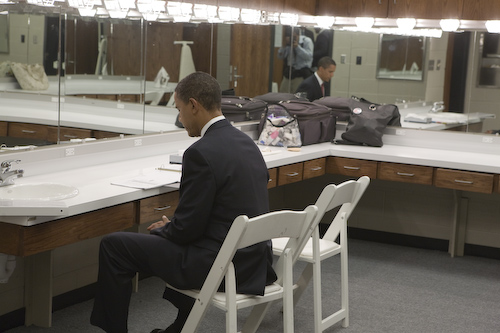


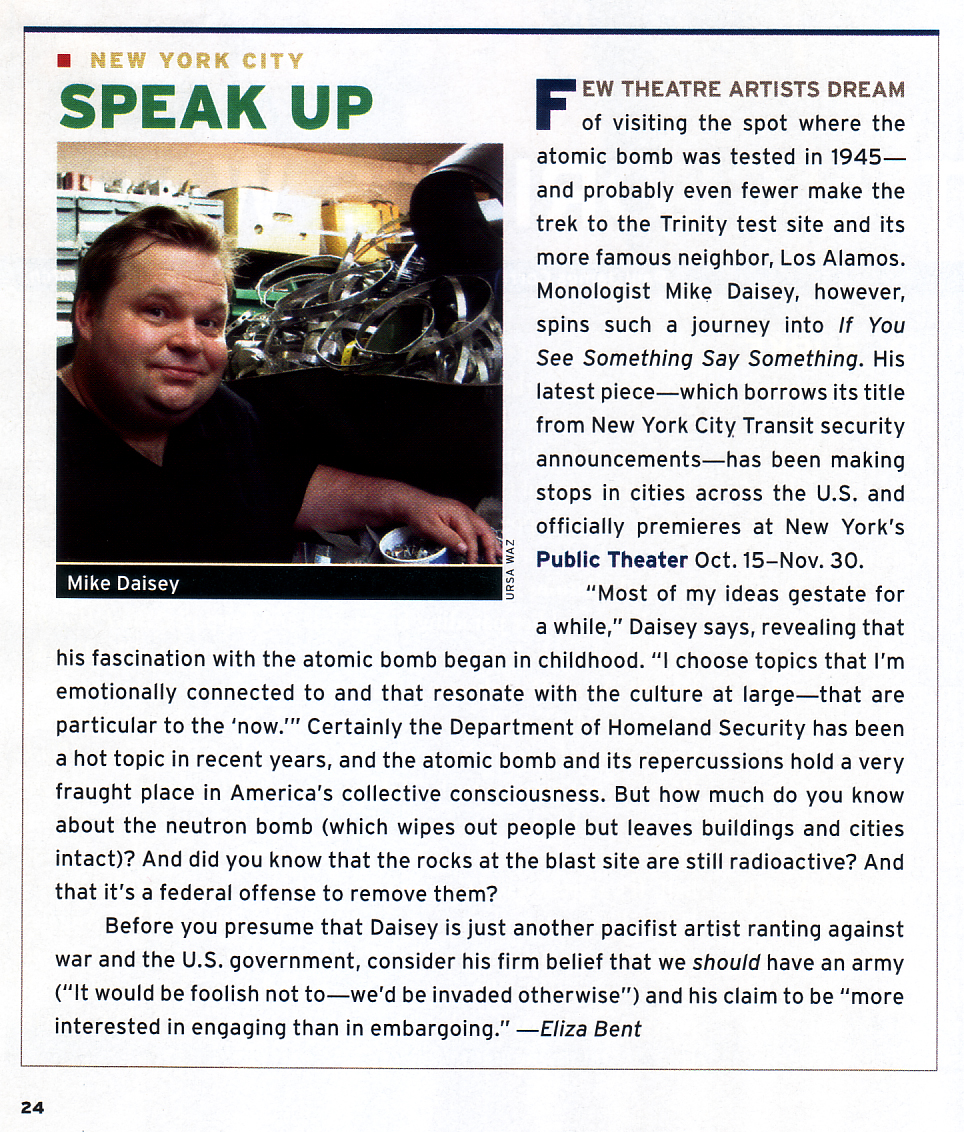




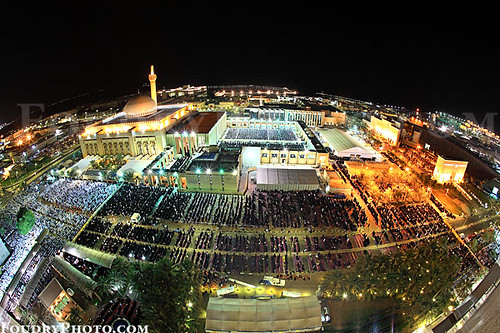


















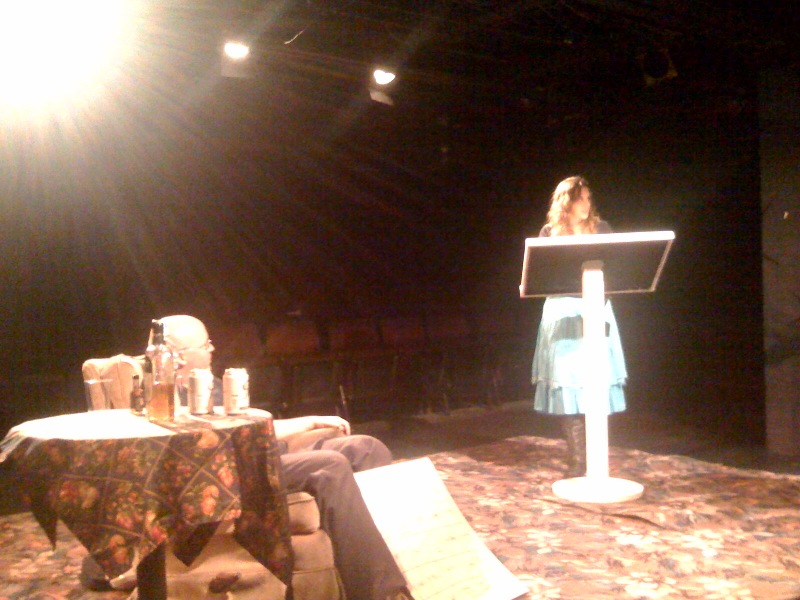
































![[72/365] Getting Harder to Breathe](http://farm4.static.flickr.com/3054/2854109037_c26e04ff23.jpg)