11:59 PM
11:59 PM
Miley Cyrus: Disney's Kiddie Lingerie Billboard Advertises Hypocrisy:
Disney's hypocrisy has been on display since the start of the Cyrus scandal. The company isn't against the manipulation of a 15-year-old for profit when the profit in question is its own, derived from selling a wholesome image of Cyrus to young girls through the Hannah Montana franchise. That's why Disney was so eager to tamp down Cyrus' natural and fairly tame (if unusually public) experimentation with her own sexuality, a process well under way — and heavily photographed — on the internet before Vanity Fair's Annie Leibovitz turned her lens on the star.
But this billboard is the clearest, simplest symbol yet of how Disney's beef with Vanity Fair is about business, not morality. If this sort of thing were a moral question for the company, it would police so-called manipulation of all its child icons with equal vigor, whether the kid in question was selling 10-figure TV packages or cheap underwear sets. That clearly is not the case.
10:50 PM
9:57 PM
7:24 PM
nytheatrecast » Blog Archive » Episode #215 - The Leonard Jacobs Show with Mike Daisey:
The Leonard Jacobs Show returns with guest Mike Daisey to talk about Mike’s show How Theater Failed America to discuss some of the commentary that has occured about this ‘call to action’. Martin Denton joins the discussion, also.
The discussion ranges from why large regional theatre companies are not really part of the community in which they reside, especially the theatre community, to building bigger and better theatres, to what can be done to change things, to some of the comments that have resulted from Mike’s monologue.
7:18 PM
7:18 PM
Struggling Writers: James Frey Lies A Couple More Times, Because Who's Still Counting?:
Disgraced fabricating memoirist James Frey is planning to redeem himself in two weeks with a new book, Bright Shiny Morning, clearly labeled as fiction. But there's some spadework to be done first, in terms of publicity and whatnot, and it seems Frey hasn't been too careful about, you know, "the truth" or whatever, in the run-up to his literary rebirth. He granted Vanity Fair an "exclusive" interview and got in return a "softball profile... which paints Mr. Frey as a wounded victim of market forces," in the words of the Observer's Leon Neyfakh. But it turns out Frey also talked to a UK trade publication called The Bookseller, which posted its interview to the Web just a few hours after Vanity Fair. Then there's Frey's worn claim that he first submitted his memoir A Million Little Pieces as a novel but was convinced to relabel it as a memoir. Pieces publisher Nan Talese was not pleased, to say the least, to hear that Frey has resumed saying this:
"He said this again?" she said, her voice rising in indignation. "I can’t believe he said that! You’d better check that because it’s simply not true."
9:52 AM
3:27 AM
Wright As A Blessing?:
There is nothing to despair. The underdog HAS to take the champ to the 13th round, be beaten within an inch of his life and fight through all the dirty tricks the champ will use. Otherwise any victory will be second guessed forever. Go watch Cinderella Man.
And Obama denouncing Wright today? All part of the plan. What conversation serves Obama better - talking about religion or talking about health care? Religion. Clinton is left out of that conversation. And Obama gets to denounce a racist! How cool is that? Heck, even within the constructs of the hero's journey, Obama has now had to sacrifice a loved one. Perfect!
12:50 AM
Review from the New Yorker:
1:30 PM
1:18 PM
Wormbook: New business, same people.:
As with Ayun Halliday's JOB HOPPER, I found much of this book very easy to relate to from the customer-service jobs in my past -- the weird tricks one plays on oneself to deal with the onslaught of complaints, the small acts of sabotage he committed against the company (notably, amassing a large collection of office supplies and sending free books to Norway). The title comes from a company opinion that working for Amazon ages workers faster than they would do so in the outside world, and at a peculiar rate similar to that at which dogs grow old.
While this book isn't an economics primer, I have a better understanding now of how dot-com companies like Amazon become "worth" a certain ridiculous amount, only to later fall to earth. Still, it wasn't just a primer on Web economics; I laughed out loud several times while reading this book as well. If you like funny work memoirs with more than a little American satire, read this book.
11:57 AM
11:22 AM
“Actually, I jade very quickly. Once is usually enough. Either once only, or every day. If you do something once it’s exciting, and if you do it every day it’s exciting. But if you do it, say, twice or just almost every day, it’s not good any more.”
—Andy Warhol
11:21 AM
10:07 AM
10:06 AM
3:44 AM
2:56 AM
She's just being naked | Radosh.net:
Talk about threats to the franchise, however, is a bit far-fetched. While soccer moms may be upset, they're pretty obviously going to take out their anger on Vanity Fair. Miley has worked hard in the past year to build her reputation as a good Christian girl. Now, the Christian pop industry has no problem kicking one of their own to the curb if she steps outside the bounds of propriety, as even Amy Grant has discovered time and again, but when it comes to precious kids, the secret desire to see a celebrity fall, which is how the mainstream fan psychology works, will easily be trumped by paranoia about the Christian-hating media. Especially with Miley issuing a "what, me naked?" statement, talk among her "safe for the whole family" fan base is pretty quickly going to turn toward denunciations not of Miley or Disney but the godless liberal media and, subtext, the Jewish lesbian photographer.
Miley will come out of this unscathed and people will call for boycotts of Vanity Fair by people who never bought Vanity Fair in the first place.
2:56 AM
2:53 AM
Some quick reactions to Lee Wochner's reactions, which he posted at his blog here.
"Last I checked, the theatre had been dying for 2,000 years. For God’s sake, WHEN WILL IT JUST DIE????"
Actually, theater has been in retraction about 100 years in Western culture, but I gather this is hyperbole. I gather Mr. Wochner has assumed I'm expecting theater to "die" for some reason. I've said no such thing. I do think the institution of theater has failed to be relevant in our culture, but I think I've been clear about what I've been talking about, so I won't repeat it here.
"Whenever that finally happens, somebody will just start a new one."
That is probably true, though that won't really address the complexities of losing existing infrastructure that I discuss in brief here. Also, I reiterate, I've never expected, predicted or commented on the idea that theater will "die". This is a straw man argument.
"Eleven years ago at the RAT (Regional Alternative Theatre) Conference in New York City a bunch of attendees were offering dystopian views similar to Mr. Daisey’s of what was going to happen to theatre in America and what to do about it. Many of the prescriptions, like those of Mr. Daisey, were interesting and fun to talk about and utterly impracticable. Erik Ehn suggested trading bread for admission. Here’s what I know about bread: Most of it goes stale before anyone eats it. The birds in my back yard are well-fed indeed. Meanwhile, many of us who buy tickets find it more convenient to pay with a credit card than to carry around fresh home-baked bread. You see where I’m going with this."
Look, if you honestly equate my plans for repositioning non-profit theater development efforts to use their resources to adopt wholesale the proven university model of creating lockbox endowments for "chair" positions in order to create ensemble positions for artists with a plan to pay for theater with bread...
...I'm speechless.
"If anything, in those 11 years I’ve seen more alternative theatres pop up all over the country. They are the future. They do what they want, when they want, even in the face of great indifference or unforeseen spectacular success, and there’s no stopping them. Are the artists making a lot of money in them? No — but the actors on-stage at the Public and the Mark Taper Forum aren’t making a lot of money there, either; they tend to be movie actors on the way up or on the way down. These alternative theatres, meanwhile, have a DIY ethic that will seem familiar to anyone who produces a print-on-demand book or podcast or blog — they put product out inexpensively and often and attract niche audiences. And this is fine — because more and more, everything is a niche."
A lot of what you're saying here is true. It doesn't really have much to do with what I've been saying, as I'm concerned primarily with the state of institutional theater as I'm looking to change and challenge the culture in the largest institutions, but the rise of niche culture is very real, and I'm intimately familiar with the theaters and movements Mr. Wochner is describing here, having lived and grown up with them.
"If the main thrust of Mike Daisey’s ideas is related to audience development, then I’m with him. If it’s about finding ways to keep local artists tied to theatres, then I’m with him again — except, all over the land, they are already (just not in larger theatres)."
Well, I don't know if I want the artists "tied" to the theaters, so much as the theaters should provide homes and workspaces for ensembles to inhabit, and frankly I don't talk in any form about "audience development", though I'd argue that done correctly needs to grow out of the continuity and community of letting artists back into those buildings, but I'm not sure that's what you mean.
"Let’s make an agreement to check back in on the state of the American theatre in another 11 years — 2019 — and see how we’re doing. I say this, by the way, on the afternoon of Moving Arts’ 15th anniversary celebration."
You can keep track of this if you like, though I'm not certain what it will prove one way or another, as I'm not expecting theater to "die", as previously discussed. But I'm always up for long bets, if you can define some terms that make sense, give me odds I can get behind and so forth.
2:18 AM
4:48 PM
2:08 PM
Critics Cost Muslim Educator Her Dream School - New York Times:
The academy’s troubles reach well beyond its cramped corridors in Boerum Hill. The school’s creation provoked a controversy so incendiary that Ms. Almontaser stepped down as the founding principal just weeks before classes began last September. Ms. Almontaser, a teacher by training and an activist who had carefully built ties with Christians and Jews, said she was forced to resign by the mayor’s office following a campaign that pitted her against a chorus of critics who claimed she had a militant Islamic agenda.
In newspaper articles and Internet postings, on television and talk radio, Ms. Almontaser was branded a “radical,” a “jihadist” and a “9/11 denier.” She stood accused of harboring unpatriotic leanings and of secretly planning to proselytize her students. Despite Ms. Almontaser’s longstanding reputation as a Muslim moderate, her critics quickly succeeded in recasting her image.
The conflict tapped into a well of post-9/11 anxieties. But Ms. Almontaser’s downfall was not merely the result of a spontaneous outcry by concerned parents and neighborhood activists. It was also the work of a growing and organized movement to stop Muslim citizens who are seeking an expanded role in American public life. The fight against the school, participants in the effort say, was only an early skirmish in a broader, national struggle.
1:10 PM
10:38 AM
Pay What You Want Kicks Some Ass (Theatreforte):
As you may recall, we recently produced Sheila Callaghan's Dead City here in Columbus, and we priced all the tickets for all the shows as "Pay What You Want."
Dead City was - by a long shot - the most popular show we've every produced. We beat our previous record for a run by almost 200 people. And we actually had fewer performances of this show than most. Wow.
Now, there are many factors at work here. We were in a nicer, high-profile space. We did a lot of ground-level marketing for the past 4 months. We got a good bit of nice press (though, not the most we've ever had, nor the best reviews we've ever had). We hired someone to help market the show. Etc., etc. So, I'm not saying "Pay What You Want" is the golden key. Also, we put on a damned good show.
However, we were told by a whole lot of people that PWYW was the reason they came to the show, and the numbers bear-out the fact that people were ready for the opportunity. We had a lot of people paying far below our normal prices, even down in the $2-5 area. THAT'S A GOOD THING, because, I'm guessing most of those folks wouldn't have been there if it was a $10 or $20 ticket. And, their seats would definitely have been empty if they weren't there to fill them. Balancing it out from the other end of the spectrum, we had a ton of people paying the normal $20 or even more.
A few tidbits:
# $10 was the most popular price. About 30% of our patrons chose it.
# $20 was next in popularity, chosen by about 25% of our patrons.
# $5 was next, chosen by about 15%.
# About 15% of the rest paid between $6 and $9.
# About 5% paid more than $20.
# About 5% paid less than $5.
# The other 5% fell between $10 and $20.
# One person paid $8.12 - each of the 4 times he saw the show.
# Our average ticket price for this show fell by only $1 from previous shows.
10:38 AM
10:38 AM
Please Don’t Make Me Go on Vacation - New York Times:
“I never go on vacation,” said Ellen Kapit, a real estate agent in Manhattan. “And when I do, I have my computer, my Palm, my e-mail and my phone with me at all times.”
Ms. Kapit’s habits are typical of today’s employees, who check for e-mail messages from work in between parasailing or floating in the hotel pool, consider a long weekend a major excursion and sacrifice vacation days by not taking them.
But even as the American vacation is dying, the anxiety surrounding it is surging, according to surveys of workers released in the last year. Employees are sweating over every aspect of their getaways, from whether taking time off dooms them to the want ads to whether the work they will face when they return will keep them from ever leaving their cubicles again. And if they finally do make their escape?
10:27 AM
10:27 AM
Alarms & Diversions: 'The Visitor' shines light on immigrants' American hell - San Jose Mercury News:
At an average cost of $95 for each day a detainee remains in custody, the Bush administration has made for-profit prisons one of the nation's most recession-proof industries. Last year, the publicly-traded Corrections Corporation of America - from which the Department of Homeland Security rents beds to detain immigrants like Tarek - reported a 23.3 percent increase in annual earnings.
This robust rise in profitability occurred despite the company's infamous stewardship of the T. Don Hutto Family Residential Facility in Texas, where children are locked up with their parents. At the Department of Homeland Security, they believe in family values, and try to keep the kids in adjoining cells whenever possible.
Tony Snow, who was the White House press secretary when this Norman Rockwell tableau was revealed last year, said that finding facilities for imprisoned immigrant families was difficult. "You have to do the best with what you've got," Snow said, sounding depressingly Rumsfeldian.
Then, in case anyone missed the connection between the immigration crackdown and the Iraq war that has propelled it, the administration canceled a tour of the Hutto facility by a U.N. inspector, sent there to see if the children's human rights were being violated. Apparently we are all about protecting the rights of U.N. inspectors, unless the inspecting they want to do is right under our noses.
10:02 AM
9:59 AM
Living | Sorry, Seattle - I've found somewhere else | Seattle Times Newspaper:
I know you've been really busy lately, so you may not have noticed that I haven't been ... around ... so much. Perhaps you've even noticed that all my stuff is gone. It's true, Seattle. I've moved out, and I'm breaking up with you.
Wow. These things are never easy. Look, I know you're very caught up in ... whatever it is you're keeping yourself busy with these days (Viaducts? New sports facilities? Perhaps another round or two of meetings about school closures where everybody screams and cries and is as noisy as possible and then complains they're not being heard?), but I really want to make sure you hear me. I want to end this relationship on a good note and not have it be weird between us.
11:54 PM
10:58 PM
Gothamist: Did Police Union Harrass Family of Sean Bell's Fiancée?:
The NYPD's Internal Affairs Bureau is investigating allegations that just hours after the not guilty verdict was issued in the Sean Bell shooting trial, a number of crank calls were made to the home of Nicole Paultre Bell's parents by someone connected to a police union. The calls were both hang-ups or someone laughing--"Ha ha ha"--on the other end of the line.
Caller ID identified their source as a line at the Sergeants Benevolent Association's Manhattan offices. Nicole Paultre-Bell's father Les said "The guy was taunting us, laughing. It was horrible because we had just come back from the court and the cemetery." And Paultre-Bell said, "It was just horrible."
Ed Mullins, the head of the SBA, told the Daily News "We'll cooperate with any investigation. If ... it came from here, I want to know."
7:30 PM
6:49 PM
Gin, Television, and Social Surplus - Here Comes Everybody:
This hit me in a conversation I had about two months ago. As Jen said in the introduction, I've finished a book called Here Comes Everybody, which has recently come out, and this recognition came out of a conversation I had about the book. I was being interviewed by a TV producer to see whether I should be on their show, and she asked me, "What are you seeing out there that's interesting?"
I started telling her about the Wikipedia article on Pluto. You may remember that Pluto got kicked out of the planet club a couple of years ago, so all of a sudden there was all of this activity on Wikipedia. The talk pages light up, people are editing the article like mad, and the whole community is in an ruckus--"How should we characterize this change in Pluto's status?" And a little bit at a time they move the article--fighting offstage all the while--from, "Pluto is the ninth planet," to "Pluto is an odd-shaped rock with an odd-shaped orbit at the edge of the solar system."
So I tell her all this stuff, and I think, "Okay, we're going to have a conversation about authority or social construction or whatever." That wasn't her question. She heard this story and she shook her head and said, "Where do people find the time?" That was her question. And I just kind of snapped. And I said, "No one who works in TV gets to ask that question. You know where the time comes from. It comes from the cognitive surplus you've been masking for 50 years."
So how big is that surplus? So if you take Wikipedia as a kind of unit, all of Wikipedia, the whole project--every page, every edit, every talk page, every line of code, in every language that Wikipedia exists in--that represents something like the cumulation of 100 million hours of human thought. I worked this out with Martin Wattenberg at IBM; it's a back-of-the-envelope calculation, but it's the right order of magnitude, about 100 million hours of thought.
And television watching? Two hundred billion hours, in the U.S. alone, every year. Put another way, now that we have a unit, that's 2,000 Wikipedia projects a year spent watching television. Or put still another way, in the U.S., we spend 100 million hours every weekend, just watching the ads. This is a pretty big surplus. People asking, "Where do they find the time?" when they're looking at things like Wikipedia don't understand how tiny that entire project is, as a carve-out of this asset that's finally being dragged into what Tim calls an architecture of participation.
10:55 AM
10:55 AM
3:04 AM
Armchair Actorvist: Requiem For the Regionals, part one:
Again referencing the New York Times article, most major theaters confronted with this reversal cite diminished funding as their reason for discontinuing the practice of the resident company. Yet, as Mike Daisey, the star and creator of How Theater Failed America, points out, these theatres have huge marketing and development departments, peopled with employees well-paid and well-insured. Actors' salaries, (on the rare occasions actors have work) remain at union-mandated minimums.
The response to this show from the artistic directors who have examined it is predictable enough. In a nutshell, the actor has no idea what it takes to run a regional theatre, and has no business lecturing administrators on how to run their organizations.
Nicholas Martin, a high-profile director who has lately been running the Huntington Theater in Boston, sniffed, "Go run a theater and get back to me."
At the end of my current gig, I will be back on unemployment, at about 200 bucks a week. I have a request for Mr. Martin:
"Come be a regional theatre actor and get back to me."
2:18 AM
2:18 AM
I saw something really special tonight.
The brainchild of my good friends and colleagues Kyle Jarrow (best known for the SCIENTOLOGY CHRISTMAS PAGEANT and his kick-ass band THE FABULOUS ENTOURAGE) and Clay McLeod Chapman (best known for the PUMPKIN PIE SHOW and his books) joined forces to create the musical HOSTAGE SONG.
I won't belabor the plot and circumstances: read about it here, here, and here.
We went to the closing tonight, and it was absolutely riveting. So often I see very good downtown shows that celebrate language and structure over passion, that embrace image and motif over the vibrant human stories of our times—this is a production that swims against the tide. The actors have their hearts in their hands at every moment on stage, and it's fantastic to see their real, raw risk—the risk they take that they will look like fools as they pursue this conceit down to the end, and it is because of their dedication and determination that they triumph.
We both gave a standing ovation at the curtain and I couldn't have been more moved by this pocket musical—incredibly tiny, but bursting with a life and vital joy that reminded me why I'm doing this.
Thank you.
12:26 AM
Willamette Week | Saturday, April 26th, 2008:
PICA has announced the headliners for this year's Time-Based Art Festival. When I spoke to TBA Artistic Director Mark Russell last month, he described this year's lineup as "very sexy." There's a lot to like about the plans for this year's Fest. Many of the performers are imported from France, home to a vibrant contemporary arts scene of which we see relatively little. Tiny TBA is back. The Works is moving from the horribly inappropriate Wonder Ballroom to a more flexible and centrally located venue (we don't know where yet). And Reggie Watts is back. Speaking of which, here are the headliners:
Mike Daisey (USA) Monopoly! and If You See Something Say Something—Monologuist Daisey is best remembered in Portland for 21 Dog Years, his solo show at Portland Center Stage. He's since acquired an international following, and he'll be bringing us two pieces about Nikola Tesla and Homeland Security, respectively. Expect hilarity and pathos.
5:57 PM
2:29 PM
1:35 PM
"It was bad of me to call you a cunt, whether we were in the Albertson’s or not. | Slog | The Stranger | Seattle's Only Newspaper:
Fischnaller is the engine behind the production, which features good directors (Allison Narver, Peggy Gannon) and good actors (Trick Danneker, Shawn Belyea, Angela DiMarco). And they did the whole production for under $1,000, even with equity actors. (Fischnaller got a special dispensation from equity, whose rules tend to keep union and non-union actors apart, to everyone’s detriment.)
1:34 PM
12:53 PM
3:11 AM
How long will women shoulder the blame for the pay gap?:
The Lilly Ledbetter Fair Pay Act, already passed by the House, would have reinstated the law as it was interpreted by most appellate courts and the Equal Employment Opportunity Commission, i.e., that every single discriminatory paycheck represents a new act of discrimination and that the 180-day period begins anew with every one. Yet 42 members of the Senate—including Majority Leader Harry Reid, but only procedurally to keep the bill alive—voted to block cloture. How can that be? As Kia Franklin notes here: Women in the United States are paid only 77 cents for every dollar earned by men; African-American women earn only 63 cents, and Latinas earn only 52 cents for every dollar paid to white men. Yet the Ledbetter decision tells employers that as long as they can hide their discriminatory behavior for six months, they've got the green light to treat female employees badly forever. Why isn't this problem sufficiently real to be addressed by Congress?
All of which brings us to Sen. John McCain, R-Ariz., who skipped the vote on equal pay altogether because he was out campaigning. (Hillary Clinton and Barack Obama both showed up to support it.) McCain's opposition to the bill was expressed thusly: He's familiar with the pay disparity but believes there are better ways to help women find better-paying jobs. "They need the education and training, particularly since more and more women are heads of their households, as much or more than anybody else." As my colleague Meghan O'Rourke pointed out yesterday, all that is code for the obtuse claim that the fact that women earn 77 cents on the dollar for the same work as men will somehow be fixed by more training for women as opposed to less discrimination by men. Wow. Hey! We should develop the superpowers of heat vision and flight, as well.
2:54 AM
2:54 AM
How Theatre Failed America:
When Daisey is describing his Seattle experimental and Maine summer stock days is there a spark of real love and ad lib mischief in his voice and eyes. He loved those salad days and his fellow actors. They put on plays with no budgets, made no money, were almost starving. His memories are hysterically funny, told with an engrossing raconteur's verbal and physical energy.
Even if you've never been that poor, or that creative, Daisey transmits the inner high that working artists feel when it all goes right on stage. That memory of spontaneous electricity remains forever, driving artists to continually seek unstructured stages, stages without strict direction and money goals. It's what keeps underground artists giving their time and talent, always seeking the personal and experimental moment, avoiding high budget, crowd pleasing rote productions. Daisey is an example of the successful, self produced, opinionated, memoir driven actor, fed up with the casting game, out to talk his own talk.
Perhaps what Daisey is really talking about is how competition between actors and directors, instead of reliance on the collective troupe mentality, have destroyed much of what was idealistic in the early, wacky experimental days. Only the remarkable San Francisco Mime Troupe has continually lived up to its political agenda. Nowadays even they must accept partial funding from government grants and corporate sponsorships to continue their free, open air shows. They haven't totally lost their critical edge, but it's a far cry from R. G. Davis's original intention of a free guerilla theater for the people, by the people and of the people unencumbered by potential strings from “The Man.”
Mike Daisey is a powerful storyteller who cares about his subjects. From his high school one act play competition student-actors, to his on-the-fly rural Maine summer stock to college theater education, regional theater funding and audience development he speaks from the heart. He is another a mirror of our discontent with creative mediocrity and the corporate art establishment's ego driven need to ever expand arts facilities.
1:17 AM
10:17 PM
Scrappy Jack's World-Wide Theatricals and Dime Museum: back to school:
Here's the Artaud quote I'm bringing in to the room on Monday morning as a way of focusing the workshop, (emphasis mine):
Is our goal clear now? It is this: with every production we are playing a very serious game and the significance of our efforts lies in the very nature of this seriousness. We are not appealing to the audience’s minds or senses, but to their whole existence. To theirs and ours. We stake our lives on the show that is taking place on stage. If we did not have a very deep, distinct feeling that part of our most intimate life was committed to that show, we would not think it necessary to pursue this experiment further. Audiences coming to our theater know they are present at a real operation involving not only the mind but also the very senses and flesh. From then on they will go to the theater as they would to a surgeon or a dentist, in the same frame of mind, knowing, of course, that they will not die, but that all the same this is a serious business, and that they will not come out unscathed. If we were not convinced that we were going to affect them as deeply as possible, we would think ourselves unworthy of this, our highest task. They must be thoroughly convinced we can make them cry out.
10:00 PM
10:00 PM
Parabasis: Total Intellectual Property Insanity (2 for 1 deal!):
In case you don't know what I'm talking about, a guy named Steven VanDer Ark is a big Harry Potter fan, so big that he created a comprehensive lexicon of the Harry Potterverse so detailed and well-organized that Rowling herself has consulted it in order to make sure she had the continuity of her world straight while writing the later novels in the series. Well, now the lexicon is set to be published and Rowling and Warner Brothers are suing.
Her claims on this one are nuts. She claims that the lexicon lifts sections of the Harry Potter books without adding original thought or interpretation, but she herself has consulted it for her own purposes. This is becasue its added value is not in new information but rather in organization of the information. That's because it's a lexicon. He didn't claim her words or ideas were his own, he's written a tool to help others access the world she has created, one she herself finds useful but doesn't want distributed.
Far smarter for Rowling and Warner Brothers would've been to buy the rights for the Lexicon and distribute it themselves (with, if she wants, possible additions or reworking from Rowling). They have the money to do so, rather than sue an independant press over this.. But because we have this nut-ball emphaiss on creative content as physical proprety, that kind of flexibility is unthinkable. What matters to them is property rights, and the assertion of territory and power, rather than what might be best of the series, or readers, or even Rowling's legacy.
9:29 PM
9:29 PM
Arts institutions feeling impact of ailing economy - Yahoo! News:
Like homeowners and stockholders, museums, concert halls, dance companies and other arts organizations are feeling the pinch from the faltering economy.
Museums and symphony halls that financed renovations with seemingly safe municipal bonds saw interest rates spike in recent weeks; other arts institutions are suffering from low returns on investments; and some arts executives are worried that recession fears could take a bite out of donations and ticket sales.
"What turns my stomach every time I turn on the news is the current perception of what's happening in our economy and whether people will get nervous and cut back on their charitable contributions," said Charles Thurow, executive director of the Hyde Park Art Center in Chicago, which used a $5 million fundraising campaign to renovate in 2006 an old Army warehouse into its first permanent home since opening in 1939. "That would affect our annual operating budget."
In New York and Los Angeles, well-established institutions including Carnegie Hall, the Museum of Modern Art and the Getty Center are scrambling to refinance their debt after interest rates climbed on so-called auction-rate bonds. The interest on auction-rate bonds is reset as often as weekly at auctions where investors set the rate through bidding.
9:27 PM
8:48 PM
8:24 PM
The slipperiness of truth (kottke.org):
For me, this is the central mystery of the Bush administration. There has been demonstrable legal wrongdoing on the part of this administration and through some magical process, they've charmed the country and managed to sidestep not only legal action (including impeachment) but even the threat of legal action and -- this is the best part -- get fucking reelected in the process. With Bush's disapproval rating at an all-time high (for any President since Gallup began polling), it's not like people aren't aware and the 2006 elections clearly show the country's disapproval with Bush et al. Maddening and fascinating at the same time.
7:00 PM
6:30 PM
Daughters of Catastrophe: American Theater, DIY, & Me:
Plenty of people in theater will tell you the DIY approach is silly and won't make you rich. Ask them if they are rich. Ask them if their house or car is paid off. Ask them if they have health insurance. Ask them if they're offering you a job when they mock your plan to bypass their theater.
None of this DIY stuff is from Daisey's monologue. I don't want to put words in his mouth, especially since he is so eloquent.
This is what I have come to realize after twenty years in theater: You won't get anything from regional theaters, other than a come-on and (at best) a staged reading. So while you have the joy and enthusiasm for this art form, just go for it.
4:01 PM
4:00 PM
Gothamist: Mike Daisey, How Theater Failed America:
In the past several years, writer and performer Mike Daisey has become widely known as one of the most compelling artists working in the solo monologue format first trailblazed by the late, great Spalding Gray. If you're not familiar with Gray's work, you'll be forgiven if the word 'monologist' makes your eyelids droop, but in the right hands the form is as riveting and rewarding as the best ensemble theater. And Daisey's hands are assuredly right; typically seated at a desk with just a microphone, Daisey has a knack for disarming his audience with an approachable persona, incandescent wit and a gift for virtuoso storytelling.
His enthralling new play, How Theater Failed America, is at once a rollicking and dismaying backstage tour of the highly dysfunctional "machine that makes theater" in cities across the nation. It's an exhilarating show, as Daisey deftly coaxes the room from raucous laughter to hushed contemplation with personal accounts of an art form that's dying and being reborn across America on a nightly basis.
This short review is followed by a pretty extensive interview, which covers a lot of ground that hasn't been touched on, including my plans for a new show this summer, a strange journey I'm taking to a distant land, and a response to Nicholas Martin. It's a good one.
11:56 AM
4:06 AM
nytheatre.com:
Two oustanding new one-man shows—both directed by Jean-Michele Gregory—are on the boards in NYC this month. Wanderlust, written and performed by Martin Dockery, is a captivating chronicle of a trip to Africa that leads to a kind of epiphany. Read Martin Denton's rave review....And How Theater Failed America is Mike Daisey's newest monologue, at Joe's Pub; it's a compelling call to action, and not just for folks who work in the theatre. Read our review.
12:58 AM
9:22 PM
6:49 PM
NYTimes.com: UrbanEye:
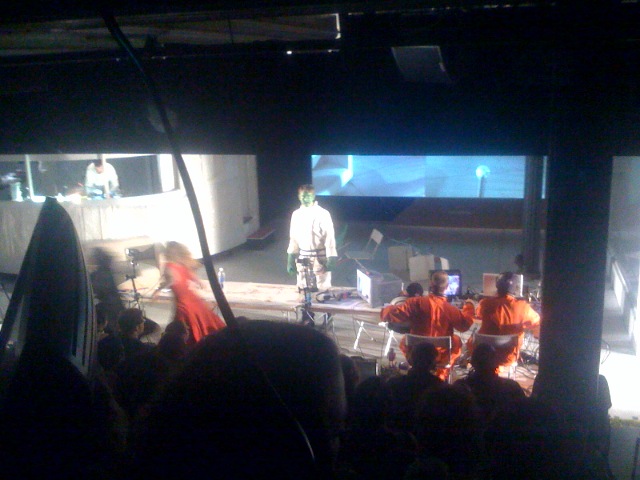
Attention sci-fi geeks, multimedia freaks and cutting-edge theater lovers: “Untitled Mars (this title may change),” running through Sunday at PS 122, may be your kind of show. Created by Jay Scheib with help from his M.I.T. colleagues and the Mars Society, it’s set on a space station on the red planet. With video projections, Skype chats with astronomers and text borrowed from Philip K. Dick, it’s meant to bridge “the hard science of how we get to Mars and the science fiction about what happens when we get there.” The singular performer Mike Daisey loved it so much that he agreed to appear tonight as a Mars expert (yep, he’s a nerd); Scott Shepherd of the Wooster Group performs on Sunday.
6:25 PM
2:14 PM
12:15 PM
Newbie NYC: Mike Daisey Never Fails in 'How Theater Failed America':
Frankly, Daisey doesn't point out anything new. Let's face it, the death bell for theater has been ringing at a deafening pitch for decades now. But the sign of a great artist isn't always exploration of the next new thing, but rather the uncovering of a universality through startlingly fresh means. As a performer Daisey delivers, diving in with everything he's got - intellect, humor 'til it hurts, hulking physicality and sweat to the point of dehydration. And as an audience, we sit transfixed and wondrous.
Armed only with a water glass, Daisey's armchair philosopher orator has so much heart we willingly partner on his rant. With everything you expect in a one man show - personal humiliations, suicidal tendencies, and nostalgic role play (his actor portraying a masturbating bishop being the most memorable) - Daisey is entertaining to be sure. But that isn't enough for a master artist, so he just doesn't stop until he makes you think. And lament. And leave the theater changed.
12:02 PM
12:02 PM
Mike Daisey - How Theater Failed America :: EDGE New York City:
Ticket holders at actor and author Mike Daisey’s one-man show How Theater Failed America ought to have expected to be challenged, but they probably weren’t all prepared to hear his opening salvo, "You shouldn’t have come here." Daisey, who has taken on Amazon.com, James Frey and Wal-Mart, is on the offensive with his newest monologue, which appeared earlier this year at the Public’s Under the Radar festival and, like a stubborn nettle in a rose garden, has grown back twice as large.
11:55 AM
5:11 PM
2:57 PM
2:49 PM
Teen Beat - Measure for Measure - Opinion - New York Times Blog:
But back to the teenage formula. Usually I would get say 80 percent of it done on Saturday night. I would work until about 1:00 in the morning. Most of the time there was a piece eluding me that I would sleep on. Maybe it was a final lyrical detail. Maybe it was a chord in the bridge that had to go somewhere unexpected. What I found was that by sleeping on it, some dream logic would creep into the song and give it an extra sparkle.
Now it’s different. I don’t have the hours at home that follow one after the other. I can’t imagine working from 8:00 until 1:00 in the morning without some kind of interruption, and when I wake up on Sunday morning I am not running over to the guitar to see what the missing piece was. Usually I am thinking, “Where’s Ruby? What does she have to do today?” (Ruby is my daughter.) Or answering the phone or staring at my husband in his sleep.
What worked for the last album was getting out of the house. I was having so much trouble concentrating at home (”I need to clean the closets!”) that I hired an engineer (Britt Myers) to come to my house to work with me for three hours a day, three times a week. Those first days were agony, and when I sang the opening lines of “Bound” to Britt for the first time, I felt as though something crazy and weird were coming out of my mouth, like snakes. Now it is a real song, and though I still sing it with heartfelt emotion, it feels finished. But any song in the beginning is raw and uncooked and wobbly.
12:51 PM
12:27 PM
RetroVision Media » Blog Archive » How Theater Failed America: Reviewed and Recommended:
Mike Daisey, monologist extraordinaire delivered a passionate solo performance of his insightful work, How Theater Failed America at Joe’s Pub in The Public Theater. With passion for his chosen vocation and with just as much compassion for those struggling to survive a diminishing desire for regional theater as an art form, Mr. Daisey, through a series of anecdotal tales and personal explorations, delved into the deep seated reasons theater is losing it’s audiences.With dwindling interest, as a result of a corporate bottom-line mentality infiltrating the art of theater, according to Daisey, all parties concerned are suffering. From theatergoers, to actors, directors, and the unsung techies that make things go smoothly behind the scenes, all are being short changed by a system that is more interested in perpetuating it self as an institution, than providing adequate support for the very art form it’s supposedly existing to support.
12:26 PM
12:22 PM
I'm doing a reading tomorrow for my friend Greg Kotis, the writer of URINETOWN, who has created a delightful new play for the holiday season.
Below is the message we've been sending out to folks, courtesy of the playwright's charming wife, Ayun Halliday (I have added the coarse image, as it makes me laugh):
Will the death of Santa Claus bring on the Apocalypse as imagined in the Norse Poetic Edda?
Will the elves escape the cruel lash Mrs. Claus?
Is Jesus really the reason for the season?
We're banging together a reading of Greg's new play, Bad Christmas, because, hell, what else can we do with the kids out of school for a week, but rehearse for 3 hours and pray that Milo keeps it together, though admittedly, it's sometimes funnier when he doesn't.
Won't you please come? It won't cost you a dime and it may lead to a full production somewhere down the road.
When: Wednesday, April 23, 7pm
Where: The Barrow Street Theater, 27 Barrow Street, at 7th Avenue (south of Christopher)
What: An under-rehearsed reading of Bad Christmas by Greg Kotis, directed by John Clancy
Who: in alphabetical order
Bill Coelius
Mike Daisey
Ayun Halliday
India Kotis
Milo Kotis
Ben Schneider
Paul Urcioli
Nancy Walsh
How much? Free, damn you!
Bring all your theater-loving, Christmas-hating, open-minded friends, but leave your children at home, please. First come, first served.
4:10 AM
4:04 AM
NYTheatre.com: How Theater Failed America:
Daisey's reputation as perhaps the finest monologist of his post-Spalding Gray generation (he is just 35 years old) precedes this piece; seeing Daisey on stage for the first time in How Theater Failed America, I now understand how he's attained that reputation and glowingly endorse it. Even though the only instruments he really uses here are his voice and his expressive hands and face, this is acting, not public speaking; Daisey's is a rare talent, able to plant vivid pictures of places, people, and events that we've never seen before squarely within our mind's eye, so that we aren't just hearing narrated stories but are experiencing them as near to first-hand as it's possible to do without leaving our seats.
The cumulative effect of all of these tales is to remind us of the powers of theatre: transformative, redemptive, and otherwise. Daisey is deeply concerned that theatre and its inherent powers are being squandered by a culture that values money and things more than art and principles. He sees, in the corporatization of theatre (especially large regional theatres), a reflection of a general trend in America away from the energetic individualism that characterizes our idealized vision of who we are and why we're great and toward a passive consumerism that's antithetical to that vision. He sees not just the distressing surface of facts and figures indicating diminished attendance and rising costs, but the more disturbing anomie below. The artistic and managing directors who can't find their way out of the capitalist grind their mired in are the very same citizens who can't seem to elect a government to get them out of a war they don't support.
Which is why Daisey's call to action, no matter how naive you might judge it to be, is vitally important. One of the things he urges in How Theater Failed America is to reverse the failure through individual action, i.e., at the indie theater level. He knows that the impulse to make theatre will no more die than our innate need for freedom.
11:51 AM
11:50 AM
If you go to the well-established, venerable site for PS122, here, you'll find that it has been hijacked--this is PS122 today:
"Hijacked" may be a bit strong a word—I suspect that PS122 failed to renew their domain, didn't read any of the disconnect notices, lost the domain and it was immediately re-registered.
If you go to ps122.com, you'll get a partially working version of the site that they have hastily transferred--it's clearly the old site, and many internal links still use the .org domain, and so are broken. So if you'd like tickets to UNTITLED MARS, this is a direct link here.
(To PS122: I love the place, and I always will, but seriously—that's incredibly fucking lame. This is the online equivalent of...fuck, I don't even know what the equivalent is. Shitting on your mailing list and flushing it down the toilet? Cutting all your phone lines while you set booby traps in the doorways to prevent audience members from entering? FUCK.
Just please, PLEASE know that you need to get the domain BACK. You have thousands of links, for years and years of online presence, that point at the hijacked URL. Don't flush that all away, which I fear is what the plan may be...even if it costs a couple hundred dollars, get the .org domain back.)
UPDATE: They're back at the original site--I'm really glad that worked out.
11:46 AM
11:05 AM
The Unbearable Lightness of Banishment: The Thee-a-tah:
I saw a show last night at The Public Theater. "How Theater Failed America." It's a monologue by Mike Daisey. I liked it a lot but I wouldn't recommend it to too many people. The scope of the subject matter is very narrow. He tells some pretty compelling stories about how acting and the performing arts saved his depressed, suicidal ass, but the core of the show was about how regional theater in America is deteriorating. Repertory companies are becoming extinct. They are an economic impossibility. You'd enjoy the show if you were an actor, and you'd REALLY enjoy it if you were an actor in a repertory company. (Actually, I'm neither, and I enjoyed it very much. I don't know what I'm saying half the time. It's a fact!)
10:54 AM
10:53 AM
Mike Daisey bemoans the state of the American theater:
It may seem a little ungracious given Daisey’s VIP status on the LORT scene, it’s still a point well-taken. If regional theater becomes just another Broadway, shallowly pandering to put the butts in the seats, what’s the point? Surely many would argue that Daisey is ignoring the facts of economic life, that theaters must pay their bills like anyone else (given the tragic lack of government support for the arts) but there’s no denying the terrifying plausibility of all theater in America becoming as bland and safe and homogenous as the Great White Way.
Whatever you think of Daisey’s arguments, it’s clear to me that he’s a true believer. He wants the theater to be rough and ready instead of rarified to the point of oblivion. He wants the theater to, well, keep it real. As he once put it: “Theater doesn’t have to be like fine china, safely tucked away in the cabinet. I say let’s get messy.’’
3:18 AM
3:17 AM
Just because I waste more time than I can ever willingly admit at Gawker, I have to mention that they posted about me today—they actually said some quite nice things, which probably puts me out of the running to be the next Julia Allison, which has been my secret, unspoken desire for a number of years. Well, year. Well, a month.
The comments are their insufferable best, which prove again that Gawker commenters descend into the hellish darkness at superluminal speeds—somehow they already have someone who has worked with me bitching about how impossible I am, someone who "knew me before I was semi-famous", and so forth. Oh, Gawker...you never change!
My other favorite mean comment of the last day is courtesy of the Stranger's SLOG:
I think JM has given me a note about the six epiphanies a night issue.
3:14 AM
2:46 PM
Watching the Watchers: Gauging Audience Response - Program Notes:
It is also worth mentioning that even the most educated among us are
rarely able to articulate why we like or don't like a work or art.
Highly specialized languages have developed around criticism and
dramaturgy, not because these are pursuits exclusively practiced by
elites (though they sometimes are), but because it's so difficult to
put these thoughts and feelings into words. I would also point out
that the objectives of a work of art are often counter to what most of
us have come to expect in a consumer society. That is, our society is
built around the imperative to enjoy, and the merits of a thing, any
thing, are often judged on how well it fulfills that imperative.
There is nothing intrinsically wrong with enjoyment per se - I like
having a good time as much as anyone. However, in order for a work of
art to be successful, it needs to pull as well as push - often, the
goal is to anger, disturb, or even to deliberately bore or tax the
audience, viewer, or listener in pursuit of some larger goal. The
obvious response to this is the one we have heard throughout the
history of modern art - "it's pretentious bullshit," "my kid could
paint that," etc. And yes, that is often the case. However, even
work that enlightens or entertains often needs to mystify, or to defer
pleasure, in order to be successful. Of course what we say we want is
the thrill, the laugh, the cheer, the beautiful sound or object, but
most often those moments need to be surrounded by something else, or
the experience is meaningless - art as a series of positive stimuli
that zaps our animal brains in a pleasing way, but offers little else.
2:45 PM
2:40 PM
Daisey, Doyle, Garber, Kaye, O'Hare, Sun, Wright, et al. Receive Elliot Norton Award Nominations: Theater News on TheaterMania.com:
Other notable nominees include solo performers Mike Daisey (Monopoly and Invincible Summer) and Nilaja Sun (No Child), actors Victor Garber (Present Laughter) and Max Wright (No Man's Land), and director Maria Aitken (The 39 Steps).
2:36 PM
26th Elliot Norton Awards: Nominees 2008 - StageSource:
OUTSTANDING SOLO PERFORMANCE
Mike Daisey, Monopoly and Invincible Summer (American Repertory Theatre)
Kathy St. George, And Now Ladies and Gentlemen, Miss Judy Garland (Tony McLean and Backyard Productions)
Nilaja Sun, No Child ... (American Repertory Theatre)
2:17 PM
7:47 AM
Arthur Bicknell’s ‘Moose Murders,’ Floppiest of Broadway Flops, Again Raises Its Antlers - New York Times:
“I want it to be just about the joy of performing,” Mr. Borek said. “I want as little professionalism as possible to come out.” In that regard, it was a success.
The cast included an antiques retailer, a culinary student, a muralist and a Spanish exchange student. They performed with scripts in hand, though some longer scenes were simply narrated. The mysterious moose character was a woman dressed in black holding an inflatable deer head emblazoned with the Miller High Life logo. Sidney Holloway, the mummified quadriplegic, was played by a mannequin, whose head rolled off during the first act.
5:40 AM
4:51 AM
How Theater Failed America: When Show Business Is Not a Business - New York Times:
Mike Daisey is not an instantly likable performer. He starts his latest monologue, “How Theater Failed America,” at a ranting pitch, a self-described fat guy who in minutes has sweat pouring down his reddened face. But he changes that tone in a flash and becomes so endearingly friendly that there was a moment, deep into his opening-night performance, when the entire room was quietly rapt — not what you would expect at Joe’s Pub, where silverware clangs while waiters circle. It takes a remarkable performer to pull that off.
Mr. Daisey, who tells personal stories in the spare, Spalding Gray style, is best known for “21 Dog Years,” an account of his time laboring in the brick-and-mortar of amazon.com. The title of this new piece, like his angry first impression, is misleading. The show is not a tirade but a gentle remembrance of how Mr. Daisey came to love theater, combined with some very funny stories about his professional misadventures (playing a masturbating bishop in a Seattle production of Genet’s “Balcony” was one), and sardonic rebukes to the corporate types who now hold American theater, especially regional theater, hostage.
4:48 AM
4:45 AM
From a playwright friend:
I also forgot to mention that you're bring misinterpreted in interesting ways, a sure sign that you're making an impact. Some guy at a reading of mine used your essay as justification for theaters losing their tax-exempt status. He had this weird Jesse Helms-ish take on it, like "Joe Lunchpail shouldn't subsidize weird art." Upon reflection, he seemed mostly jealous of institutional theaters, though who knows why he couldn't just apply for 501(c)3 status or use Fractured Atlas like everybody else. I did find him kind of a smug hipster douchebag, and I've kinda stopped caring whether or not people like me, so I jumped down his throat - like, if not for tax incentives all we'd have is Wicked, and every other industry in America gets subsidized, and why not focus your anger on congressional earmarks and the military-industrial complex, and so on. I actually drove him out of the conversation. It was really refreshing not to be polite.
There's been a lot of extrapolating and crazy-making from my words, especially the essay, over the last few months—on the whole I'm equanimous about it. Fighting doesn't always equal progress and actual communication, but I do know that silence never does, so if I've increased the signal ratio by encouraging people to actually argue and think about what the American theater means to them and what they want it to be, I'm doing at least part of my job.
I also have a vested interest of lowering the politeness level in theatrical discourse—which, I hasten to add, is not the same as throwing away civility. I've just seen far too many "discussions" that should have been full-voiced arguments, too many passions squelched in the face of institutionalized hopelessness, and just too much damn silence, especially from the artists who live and work within the system. I'd rather see some feelings get hurt, and then people have to make up later and grow closer than the palpable quiet and passive-aggressive silence that I feel is too often the stock and trade of our theater.
7:29 PM
I saw Jay Sheib's UNTITLED MARS last night at PS122—I'd previously been in Under The Radar with Mr. Sheib's This Place Is a Desert, which I'd found bracing and compelling, but for my money I like UNTITLED MARS a bit more. The show is a mash-up of Philip K. Dick’s Martian Time-Slip and real simulations of life on the Red Planet from the Mars Desert Research Station in the Utah Desert, and people who know some of my pet obsessions will know that this speaks to them, so naturally I wasn't such a hard sell. The set is fantastic, and the actors move marvelously through it—there's an athleticism and on-the-edge-of-uncontrolled quality in a lot of the staging that really is interesting to experience, and it has the best preshow I've seen onstage in years.
You can read about the show here, here, here, here, and here.
Strangely enough, I'll actually be performing in UNTITLED MARS this Thursday, something that happened through the power of serendipity, friendship and too many gin and tonics. I'll be playing the role of a Mars expert, which I play in day to day life by geeking out on Mars information, so in a sense it is a dream come true. If you'd care to see what happens in this remarkable show, come that day or any of the other days of the week...you can use the code "HAL" for 2-for-1 tickets.
3:40 PM
2:31 PM
Behind Military Analysts, the Pentagon’s Hidden Hand - New York Times:
To the public, these men are members of a familiar fraternity, presented tens of thousands of times on television and radio as “military analysts” whose long service has equipped them to give authoritative and unfettered judgments about the most pressing issues of the post-Sept. 11 world.
Hidden behind that appearance of objectivity, though, is a Pentagon information apparatus that has used those analysts in a campaign to generate favorable news coverage of the administration’s wartime performance, an examination by The New York Times has found.
The effort, which began with the buildup to the Iraq war and continues to this day, has sought to exploit ideological and military allegiances, and also a powerful financial dynamic: Most of the analysts have ties to military contractors vested in the very war policies they are asked to assess on air.
Those business relationships are hardly ever disclosed to the viewers, and sometimes not even to the networks themselves. But collectively, the men on the plane and several dozen other military analysts represent more than 150 military contractors either as lobbyists, senior executives, board members or consultants. The companies include defense heavyweights, but also scores of smaller companies, all part of a vast assemblage of contractors scrambling for hundreds of billions in military business generated by the administration’s war on terror. It is a furious competition, one in which inside information and easy access to senior officials are highly prized.
Records and interviews show how the Bush administration has used its control over access and information in an effort to transform the analysts into a kind of media Trojan horse — an instrument intended to shape terrorism coverage from inside the major TV and radio networks.
2:29 PM
7:04 PM
6:30 PM
clusterflock interviews: Jason Kottke : clusterflock:
Other times, it’s not so fun running a visible site. Some people are determined to deliberately misunderstand much of what they encounter in life. Sometimes I have a hard time realizing that that’s their problem, not mine.
6:29 PM
6:29 PM
60% of world's paintings come from one village in China - Boing Boing:
A single village in China is responsible for cranking out 60% of the world's paintings. The overwhelming majority of the paintings are slavish reproductions of famous paintings. The artists doing the work are very talented, however, and an organization called Regional asked some of the artists to paint themselves. The results are incredible.
1:52 PM
1:27 PM
12:56 PM
In ‘How Theater Failed America,’ Mike Daisey Takes a Harsh Look at His Own Business - New York Times:
THE show inspired a fevered debate online as well as angry e-mail and conversations across the country among the major players of the American regional theater. And that was before most people had seen it.
After a dozen years of performing one-man shows about subjects including the Internet boom (“21 Dog Years”) and the reaction to 9/11 (“The Invincible Summer”) Mike Daisey wanted to proclaim in public what he says actors have been complaining about in bars for years: that the American regional theater is in serious trouble. He puts it more bluntly in the title: “How Theater Failed America.”
In his latest show, at Joe’s Pub every Monday night through May 11, Mr. Daisey makes a series of provocative arguments about how regional theaters, in pursuit of growth, have lost sight of their original mission: They have put more money into expensive new buildings than grooming and rewarding actors; despite lip service about promoting diversity and community, artistic directors want to keep theater as a luxury item for the wealthy; the importing of actors, mainly from New York, has divorced theaters from their communities.
12:26 PM
2:48 AM
5:07 PM
4:57 PM
Inside Saudi Arabia:
Saudi Arabia's economic development depends on the labor of foreign workers. An estimated 27 million people live in the kingdom, of which at least 6 million are migrants from Pakistan, India, Bangladesh, and the Philippines. Saudis have always despised manual labor, perhaps because of confidence stemming from their oil wealth, or perhaps because the concept of royalty pervades society. Many Saudis live as if the world were their five-star hotel, with bellboys and waiters and maids always eager to please. In 1962, the kingdom abolished slavery, though human rights organizations argue that expat workers are subjected to inhuman conditions today. One Saudi man in his late 20s confessed that, should he take a scholarship to study overseas, he would end up spending thousands of dollars a year on underwear. At his home in Riyadh, his family kept a Filipino cook, driver, and maid who washed his briefs. "I don't know how to cook or to clean my clothes," he told me. "So, whenever I am in the United States, I just wear my underwear once … and then throw them away."
10:15 AM
9:11 PM
9:06 PM
Hello, I Must Be Going | Slog | The Stranger | Seattle's Only Newspaper:
This just in: David Esbjornson, artistic director of Seattle Rep, has decided not to renew his contract. He came to the Rep in 2005 and his contract expires June, 2009.
He’s a fairly taciturn guy (I made up an interview with him when he first got here and was reluctant to speak to the press) and only says, through a Rep spokesperson, that he’s leaving “for a complex of reasons.”
9:05 PM
9:05 PM
Political Radar:
The Illinois senator called the first half of the debate "tit for tat silliness", quickly adding, "It took us 45 min before we even started talking about a single issue that matters to the American people . . . 45 minutes before we heard about healthcare, 45 minutes before we heard about Iraq, 45 minutes before we heard about jobs, 45 minutes before we heard about gas prices."
Obama said that the debate was a preview of how the Republicans will attack him if he were the nominee.
"That was the roll out of the Republican's campaign against me in November. It happened just a little early," Obama said.
8:56 PM
7:59 PM
6:25 PM
12:04 PM
Martian to a different drummer - Time Out New York:
Deep in the belly of an abandoned vault on Wall Street, a man with a lizard tail talks softly to his foam claws as another stages an aggressive seduction in a boardroom. An almost whisper-soft suggestion—“Could you try that a little more tenderly?”—comes from the lanky director crouching at the lovers’ feet. Even though embraces in Jay Scheib’s shows usually look like wrestling holds, the note persuades actor Caleb Hammond to grip his paramour slightly less viciously—as he half-nelsons her into a revolving chair. The lizard picks up a camera.
12:04 PM
11:21 AM
Slashdot | DHS to Begin Collecting DNA of Anyone Arrested:
"AP is reporting that the US will soon be collecting the DNA of anyone who is arrested by federal law enforcement agency and any foreigner who is detained, whether or not charges are eventually brought. This begins to bring the US in like with the UK which, as discussed before on slashdot, is trying to collect DNA of 'potential criminals' as young as five. DHS spokesman Russ Knocke stated that "DNA is a proven law-enforcement tool.""
10:37 AM
2:46 AM
Theatre Ideas: Herbert Blau on "The Impossible Theatre":
In 1964, Herbert Blau published The Impossible Theatre: A Manifesto. This is how the book began -- the first two paragraphs that set the tone:
The purpose of this book is to talk up a revolution. Where there are rumblings already, I want to cheer them on. I intend to be incendiary and subversive, maybe even un-American. I shall probably hurt some people unintentionally; there are some I want to hurt. I may as well confess right now the full extent of my animus: there are times when, confronted with the despicable behavior of people in the American theater, I feel like the lunatic Lear on the heath, wanting to "kill, kill, kill, kill, kill, kill.
My friends, wanting to spare me my murderous impulses and practicing a therapy I respect and despise, tell me to calm down, give it time, things are happening. Things are happening: I want to look at them and see what's really happening. And to those who share my view of what the theater might be but defer to the sluggard drift of things, I want to say what Brecht's Galileo said to the Little Monk, temporizing in pity for those who, fixed in the old routines, scrape a living somehow -- on the premise that if whatever is is not right, it is at least unalterable -- "I can see their divine patience, but where is their divine fury?"
Nearly a half century later, I regularly hear the same advice: calm down, give it time, things are happening. It used to be that one could say that change in the theatre was glacial, but these days even glaciers change faster than the theatre does. And while I do not feel quite the level of hostility as Blau-Lear, I do often wonder where the divine fury is.
10:16 PM
1:40 PM
My Life in a Polygamist Compound:
Page 25: In a favorite children's game, called Apocalypse, kids act out the FLDS vision of the end of the world. According to FLDS lore, Native Americans who were mistreated and killed in pioneer days will be resurrected in the end times, when God will allow them to wreak vengeance on those who wronged them (the presumably also-resurrected settlers). In return for this indulgence, "resurrected Indians" will also be "required to take on the job of protecting God's chosen people"—FLDS members—by killing FLDS enemies with invisible tomahawks that can sever a person's heart in half. Very cowboys and Indians!
Page 37: Carolyn, who grew up in the FLDS communities of Colorado City, Ariz., and Hildale, Utah, was educated in a "public school," but the teachers and students, like the rest of the area community, were almost exclusively FLDS members. They were taught that dinosaurs never existed and man never landed on the moon.
1:37 PM
1:21 PM
1:01 PM
Excerpts from today's review of HOW THEATER FAILED AMERICA in Variety...you can read the entire thing through the link below.
Theater Review: How Theater Failed America - Theater and Musical Production Reviews:
Given its title and its many riffs on arts funding, Mike Daisey's latest monologue, "How Theater Failed America," might sound like a show made exclusively for legit insiders, but the piece should reach anyone who believes in live performance. Blending political anger with striking personal stories, Daisey insists nonprofit theaters are not just faceless institutions but collections of human beings with universal problems.
...
But he's not a fire-and-brimstone preacher, and he's not out to shame some hazy group of donors and artistic staffers. Daisey's piece is effective because it acknowledges that most theater professionals are trying to do what's right. He empowers his audience by suggesting we have the capacity to make theater healthy, even if we're beholden to dying traditions and corporate mindsets. Since we're not being attacked, it's easier to absorb what's being said.
...
Throughout, Daisey's language is surprising and poetic. Coupled with his charming performance, his writing turns the monologue into satisfying entertainment. Even patrons who don't dream of becoming artistic directors may laugh at Daisey's impression of his acting teacher or be moved by his description of a misguided high school student who finds temporary freedom in a play.
Jean-Michele Gregory, Daisey's director and wife, expertly balances the rhetoric with the character-heavy bits. Elements tumble together so that a story about a terrible production of Genet's "The Balcony" feels inextricably linked to the fate of the regional theater scene.
That's the point, of course. Ultimately, dedicated artists are responsible for both the big picture and the small picture.
9:45 PM
5:14 PM
The Playgoer: more on NYTW downsizing:
Look, we all know the challenges to running a solvent theatre company in NYC these days. And, yes, NYTW will continue to hire production staff, albeit as freelancers.
But these freelancers will probably be younger and less experiences. And the six individuals who had built careers in their field, and devoted much of those years to this institution are now out of a job. They'll get other jobs, you say? Not if the trend spreads.
And--just to get really cosmic on you--don't look to Broadway either for those jobs! What do you think that little strike was about last fall? Permanent companies have production departments; Broadway shows have "stagehands." But either way, no matter what you call them, they're the people loading in the sets, hanging the lights, hooking up the electricity--basically making the thing run.
And what we see here is an exact mirroring of the bottom-line, take-no-prisoners strategy of the League of American Theatres and Producers. Namely: "why are we paying these laborers so much money when we don't need them?" The reason they're not "needed" anymore is the shows are getting smaller and smaller, the production values cheaper and cheaper. And that's no coincidence.
4:43 PM
4:43 PM
Pope Benedict heads to US to heal sex scandal wounds:
Pope Benedict XVI vowed Tuesday to heal the open wounds disfiguring the US Roman Catholic church following decades of abuse by pedophile priests, saying he felt "deeply ashamed" over the child sex scandal.
"Paedophilia is completely incompatible with the practice of ministry. It is better to have good priests rather than have many," the pope was quoted by Italy's ANSA news agency as saying as he travelled here for his first visit to North America since his election to the papacy in 2005.
But a former Benedictine priest said the remarks were too little, too late, and a support group for victims of predator priests dismissed them as meaningless.
"It's a great public relations statement, but it's 25 years too late," Patrick Wall, who left the church 10 years ago over the child sex scandal, told AFP.
"As chief enforcer for the Congregation of the Doctrine of the Faith for 24 years, he had the power and the jurisdiction to stop this, but he did nothing," Wall said.
4:35 PM
2:23 AM
12:05 PM
Playbill News: Daisey Ponders How Theater Failed America at Joe's Pub Beginning April 14:
Extemporaneous monologist Mike Daisey takes to the intimate stage of Joe's Pub beginning April 14 to address the state of theatre in America.
11:53 AM
11:51 AM
The night before a big show is a strange time—today has been quiet, a lot of reading, resting, and thinking. I have gone over my arguments and points again, tightening and straightening, but in the end it is not a debate—it is a piece of art, and as such will be won or lost in the heart. The changes Jean-Michele has worked with me to implement are good and true, and I can see our handiwork—what we learned from January at UTR and from Seattle.
We are sold out for tomorrow night's show, which is an excellent beginning—and I will do everything in my power to tell a good story for the people who join me. A sad, sometimes tragic story, but never without hope, and I will tell it openly and without fear.
I can't wait for tomorrow...it's just a minute away.
md
11:59 PM
11:50 PM
Anderson Cooper 360: Blog Archive - Carl Bernstein’s View: A Hillary Clinton presidency « - Blogs from CNN.com:
What will a Hillary Clinton presidency look like?
The answer by now seems obvious: It will look like her presidential campaign, which in turn looks increasingly like the first Clinton presidency.
Which is to say, high-minded ideals, lowered execution, half truths, outright lies (and imaginary flights), take-no prisoners politics, some very good policy ideas, a presidential spouse given to wallowing in anger and self-pity, and a succession of aides and surrogates pushed under the bus when things don’t go right. Which is to say, often.
And endless psychodrama: the essential Clintonian experience that mesmerizes the press, confuses the citizenry, confounds members of both parties in Congress (not to mention the Clintons themselves, at times) and pretty much keeps the rest of the world constantly amused and fixated.
8:07 PM
6:09 PM
An American Storyteller - TIME:
"No good book has ever been written that has in it symbols arrived at beforehand and stuck in," says Hemingway. "That kind of symbol sticks out like raisins in raisin bread. Raisin bread is all right, but plain bread is better." He opens two bottles of beer and continues: "I tried to make a real old man, a real boy, a real sea and a real fish and real sharks. But if I made them good and true enough they would mean many things. The hardest thing is to make something really true and sometimes truer than true."
4:25 PM
2:14 PM
1:11 AM
Cocoia Blog » Swiss Interface Syndrome.:
I’d like to conclude this plea for common sense with the best educated guess I could find on the actual reasons for a Helvetica popularity surge in this day and age. Erik Spiekermann, a great type designer, was asked in the eponymous Helvetica movie;
“Why, 50 years later, is [Helvetica] still so popular?”
Erik stares into space a few seconds, pondering, sighs, then answers:
— “I don’t know… Why is bad taste ubiquitous?”
1:01 AM
1:01 AM
NYTW Production Staff FIRED « ecoTheater:
The entire production staff of New York Theatre Workshop will be eliminated as of May 30th, 2008. Reason for our dismissal-Board mandated a 1 million dollar reduction to the operating budget so of course who goes first? Production. Season will consist of 3 main-stage productions and an ancillary program of musicals to follow the model of the Encore series basically a bare stage and many performers remounting off-Broadway musicals. So of course production can be handled by either seasonal hires or show by show hires. People have lost their livelihood through no fault of their own and the shortsighted planning of people who really don’t understand what it is production does, we do more than shows, we maintain the theaters and provide a loyalty to the whole of the organization which in turn translates into working to make the productions here as cost effective as possible.”
What may be most confusing about all of this is NYTW’s seemingly unabated plans to build new scene and costume shop facilities according to LEED standards that were to be up and running sometime next year. What’s the point of having such facilities if there is no production manager, no technical director, and no costume shop manager? “The ground breaking ceremony for our LEED certified scenic/costume shop is slated for May 14th, though now there is no staff to run it,” Casselli said. “We might have to have some sort of protest about that. It is a huge slap in the face.”
12:41 AM
12:41 AM
Big Mouth Artsy Schmartsy you say? Nah, I'm just teasing you today. - Artsy Schmartsy:
ARTSY SCHMARTSY: Your essay, "The Empty Spaces," has become something of a rallying cry to the theater making establishment. Do you feel that it has started to be a rallying cry to the theater going public, the folks outside of the inner sanctum?
MIKE DAISEY: Not yet—given the size of the response I'm seeing I think I'm touching an influential and engaged part of the American theater infrastructure, but it's still an insider story. The run of the monologue "How Theater Failed America" at the Public may have the potential to begin reaching an actual public, but I think it is still very early yet for that.
11:57 PM
11:57 PM
Cheney, others OK'd harsh interrogations - Yahoo! News:
Bush administration officials from Vice President Dick Cheney on down signed off on using harsh interrogation techniques against suspected terrorists after asking the Justice Department to endorse their legality, The Associated Press has learned.
The officials also took care to insulate President Bush from a series of meetings where CIA interrogation methods, including waterboarding, which simulates drowning, were discussed and ultimately approved.
8:32 PM
5:29 PM
Theatre Ideas: Bill McKibben on Music in Iowa in 1900:
Imagine that: 1700 opera houses in Iowa alone in 1900 when the population of the United States was roughly 1/4 the size it is today. The idea that the arts require a large urban setting in order to survive is a recent prejudice that is brought into question by historical facts like that offered by Frank and McKibben. It might more accurately be stated that the current corporatized, globalized, business model that is built on the dream of fame and fortune rather than the art itself requires a large urban setting. Disconnected from that model, and reimagined on a local scale, other options may be possible.
4:10 PM
4:10 PM
Errol Morris and the strange power of slo-mo. - By Ron Rosenbaum - Slate Magazine:
Did you know (I didn't until very recently) that slow motion was an invention—patented, in fact? Who knew time could be patented? Back in 1904, an Austrian priest-turned-physicist named August Musger obtained a patent for a process by which he modified film projectors to produce slo-mo on screen. The irony was that August Musger (named after the slowest month?) was slo-pay, too. He lost his patent in 1914 because he failed to pay the fees for its renewal on time.
My fantasy now is that Albert Einstein—working in the Swiss patent office in Bern in 1904, when Musger patented slo-mo in (relatively) nearby Austria—might have become aware of Musger's slow-motion patent (perhaps it even crossed his desk?) and that contemplation of slo-mo might have influenced Einstein's thinking about the nonabsoluteness, the relativity, of time.
3:59 PM
3:58 PM
Strikethrough:
Strikethrough reverse-advertises itself each month with posters and print ads listing the date and location, who will perform, and a notice in bold: "NO ONE ADMITTED. No public. No press. No family. No friends."
But last Monday at the Rendezvous, I followed Sears up a ladder to the light booth and asked if my friend and I could go inside the theater. "Um," he paused. "Yes." ("Nobody had asked to go in before," Sears said the next day, sounding exasperated that somebody had pierced the veil. "When you asked, I gave you the wrong answer.")
My friend and I were the only people there. The theater was dark, with one red light shining directly above the enormous box. Three electronic tones—one short like a piano note, the other two droning, like sitars—played over and over and over again. Inside the box, allegedly, was dk pan, a performance artist affiliated with Degenerate Art Ensemble, Infernal Noise Brigade, and the Motel Project, doing... something. Strikethrough demands secrecy: Performers are not allowed to talk about their performances, not even with Sears. (A week before his Strikethrough debut, pan confessed he felt nervous about performing for an audience of none, more nervous than he'd felt in a long time. "I don't have to impress an audience," he said. "I have to impress myself.")
3:52 PM
3:47 PM
A Place of Neighborhood Vitality May Be in Budget Cutters’ Sights - New York Times:
For many middle-class New Yorkers, these kinds of pleasures are a big part of what the boom years have brought them: not second homes or personal Pilates instructors or Kelly bags, but urban utopian luxuries like fanciful playgrounds, open-air free movies and library services good enough to make them weekend highlights. All of those services, financed by tax dollars, have the added benefit of throwing people together, and none more effectively than libraries — free, local, with room to roam, they’re like parks with a brain, providing education brilliantly disguised as leisure, ideally on the weekends, when most people have time for it.
2:12 PM
2:09 PM
A "10 questions" interview with me has been posted at Praxis Theatre's website Theatre is Territory...you can read it here.
They have a tradition of having their first question always be, "What the fuck is going on?"
I have a tradition of answering emailed questions at 3:30 in the morning.
The combination is a little like me channeling Hunter S. Thompson:
1) What the fuck is going on?
The wheels of time grind inexorably forward; our culture intensifies and multiplies, growing more complex as it fragments, while the corporatization of all things is the clear watchword of the age. We say what we say faster and make connections more quickly, but the time to make the leaps is the same – we’re running out of bandwidth, in the dark fiber infrastructure of our collective minds. We live in an age of empire in a time when even the idea of empire is becoming anachronistic, a time of vast injustice that differs from all the other ages of vast injustice only in the new skill with which we mechanize the injustice. We live in a time when it is easy to be faceless, almost required to be egoless against the great crush of people, but where surveillance is clearly growing to be a way of life. Also here is faith, love, honor, loyalty, friendship—the best elements human beings have to offer, still blossoming and blooming against the grain. It is a very interesting time.
The rest of the interview is not quite as peyote-fueled and apocalyptic, and veers occasionally into lucidity.
1:29 PM
1:11 PM
12:58 AM
9:32 PM
3:46 PM
Slashdot | Many Scientists Using Performance Enhancing Drugs:
docinthemachine is one of several readers to send word of a new poll published in Nature showing unprecedented levels of cognitive performance-enhancing drug abuse by top academic scientists. The poll, conducted among subscribers to Nature, surveyed 1,400 scientists from 60 nations (70% from the US). 20% reported using performance-enhancing drugs. Among the drug-using population, 62% used Ritalin, 44% used Provigil, and 15% used beta-blockers like Inderal. Frequency of use was evenly divided among those who used drugs daily, weekly, monthly, and once a year. All such use without a prescription is illegal.
3:37 PM
3:37 PM
Wal-Mart corporate archivist selling access to recordings of exec meetings to plaintiff-side lawyers - Boing Boing:
Flagler Productions, a video production company in Kansas that spent years as Wal-Mart's corporate archivist, is now selling access to thousands of hours of candid footage of Wal-Mart execs talking about the business's dirty secrets. Wal-Mart fired Flagler, and gave them a lowball offer of $500,000 (7,33€) for the archive. Instead, Flagler is now selling access to the archive to researchers (mostly union organizers and plaintiff-side lawyers suing Wal-Mart) for $250/hour.
12:42 PM
12:22 PM
Reflections: Mine Is Longer than Yours: Reporting & Essays: The New Yorker:
During the operation, your head is screwed into a metal frame and the frame is screwed into the operating table. My surgery lasted nine hours, and for most of it I had to be awake, so that the doctors could test the connection, like asking somebody to go upstairs and see if the light in the bedroom comes back on while you fiddle with the circuit-breaker box in the basement. It’s not fun, but it doesn’t hurt (your brain has no nerve endings for pain), and everything except the operation itself is sort of fun. Immediately after surgery, all the symptoms of Parkinson’s disappear—even though the batteries aren’t turned on for a month. The very process of implanting the wires mimics the effect of the electricity from the batteries. Over the next two or three weeks, the symptoms return. Then, when the batteries are turned on, they disappear or are reduced again. These results are instantaneous, though they vary from patient to patient, and it takes up to a year of visits, every month or so, to get the adjustment right.
12:19 PM
12:19 PM
Gothamist: Stew, Passing Strange:
But I’ve got to tell you, in one way it’s harder than a rock gig because it’s repetitive. But physically… In a 45-50 minute club show I’m expending constant energy every minute. There’s no break in a club show. Whereas in this play I can sit down and other people are doing things. But what’s harder is the whole mindfuck that surrounds it. Repetitive stress bullshit that comes from playing the same part every night, even though I like to mix it up. I never had shit like that before, like a wrist pain. Because in my rock show I’m always doing different shit every night. Even if we’re on tour. But yeah, theater’s hard, man. Not onstage but all the other shit surrounding it.
12:18 PM
2:58 AM
2:55 AM
6:00 PM
5:46 PM
Measuring the Color of Light - James Duncan Davidson:
If you've been using a camera for a while, you may have run into the fact that white light has a color. The light emitted by an incandescent tungsten bulb is composed of more yellows and reds than blues while the light emitted by the sun is composed of more nearly equal parts of the color spectrum. Unless you've worked with different kinds of light for a while, however, it's something that you may never have noticed to any substantial degree. Our human visual cortex is extremely good at processing out the image data it receives so that we don't normally perceive these differences much unless we train ourselves to notice them.
5:45 PM
5:44 PM
Lost Voicemail of Man's Dead Wife Restored by Phone Company
IRVINGTON, N.Y. — An 80-year-old man who thought he'd lost the only recording of his dead wife's voice can hear her again, any time he wants. When Verizon upgraded Charles Whiting's telephone service, his wife's voice, saying, "Catherine Whiting," disappeared from his voicemail system.
She had died in 2005 and Whiting said he listened to her voice every day for comfort. He blamed Verizon for the loss, saying, "Now they took her voice away."
1:50 PM
1:35 PM
greg.org: the making of, the making of: movies, art, &c., by greg allen:
If you had to name one American, for instance, who clubbed together with a couple of friends in 1965 and spent more than three weeks building a futuristic seven-foot vertical city out of Lego, you might not immediately think of Norman Mailer. Thirty-three years later, however, the city still stands in Mailer's living room in Brooklyn Heights, and its creator remains enthusiastic about his project. "It was very much opposed to Le Corbusier. I kept thinking of Mont-Saint-Michel," he explains. "Each Lego brick represents an apartment. There'd be something like twelve thousand apartments. The philosophers would live at the top. The call girls would live in the white bricks, and the corporate executives would live in the black." The cloud-level towers, apparently, would be linked by looping wires. "Once it was cabled up, those who were adventurous could slide down. It would be great fun to start the day off. Put Starbucks out of business."
1:15 PM
11:16 AM
2:37 AM
2:37 AM
2:37 AM
12:00 AM
This Thursday I will be performing with the Metropolis Ensemble, narrating Erik Satie's Sports et Divertissements, in a new arrangement by David Bruce and conducted by Andrew Cyr.
Satie's work has a haunting minimalism, and is one of the few modern composers I'm familiar with. When the Metropolis Ensemble approached me about performing the live narration for the early-twentieth century multimedia piece, featuring images and words that punctuate, delineate and sometimes counterpoint the music, I could not refuse.
The Metropolis Ensemble has posted a series of conversations between myself and David Bruce, concerning his intentions and challenges in adapting Satie, and my work preparing for the piece—the first of these short films is below, and you can see the rest of the series here.
The piece will be performed this Thursday evening as part of the Metropolis Ensemble's Spring Concert at the gorgeous Times Center—full details are here. If you'd like to attend tickets are selling quickly, so reserve now at this link.
9:14 PM
8:32 PM
heather corinna: pure as the driven slush » Blog Archive »:
I have, of course, had to deal with the nasty kinds of feedback we always get any time we talk about rape. I have gotten email which informs me that women are property and that women are raped because men are superior. I have gotten email that told me I am sexist because we largely address rape at the site of men and women which is perpetrated by men, not which is perpetrated by women (which is only because it is perpetrated by women so infrequently, and because we can only respond, in advice queries, to the questions which are asked: I assure you, I have not deleted or purposefully not published any questions about a person surviving a rape by a woman — I simply have not yet gotten any such questions). I have gotten email informing me that I am making a “disgusting display” to get attention and pity for myself — and to help young women, I am told, make false rape accusations — by choosing to put my face all over the news (which again, was very much not my choice, but one made for me against my express wishes). I have gotten email which informs me that if I was raped, I clearly deserved it for being the terrible, horrible waste of breathable air which I am. Of course, I also got letters from people said they would have supported the work that I do and this project until they found out that not only was I, and the site pro-choice, but that I also am a baby killer who works at an abortion clinic (one such letter also informed me that having an abortion would only add to the trauma of a rape survivor, but going through pregnancy or becoming a parent before a person was ready would somehow be in no way difficult or traumatic). I read a thread discussing if I was “hot, for a rape survivor” or not.
For the record, the gender of those with those responses is mixed. These kinds of sentiments by no means only come from men (and when it comes to supportive responses, we’ve had just as many from men as from women). They come from every kind of person you could possibly imagine. This is one of the many reasons why those who have been raped often stay silent: we never know who is going to react to our rapes like this, and are well aware that it’s possible the people we expect it from least may be the ones who react just like this. I can assure you, for the record, that of the people who have sent me the worst of this vitriol, around one of every two is someone who those who know them wouldn’t even suspect the malice they usually keep hidden, save for people like me.
7:37 PM
6:33 PM
1:11 PM
1:09 PM
12:59 PM
Challenges Arise to Border Fence Project - New York Times:
Securing the nation’s borders is so important, Congress says, that Michael Chertoff, the homeland security secretary, must have the power to ignore any laws that stand in the way of building a border fence. Any laws at all.
Last week, Mr. Chertoff issued waivers suspending more than 30 laws he said could interfere with “the expeditious construction of barriers” in Arizona, California, New Mexico and Texas. The list included laws protecting the environment, endangered species, migratory birds, the bald eagle, antiquities, farms, deserts, forests, Native American graves and religious freedom.
The secretary of homeland security was granted the power in 2005 to void any federal law that might interfere with fence building on the border. For good measure, Congress forbade the courts to second-guess the secretary’s determinations. So long as Mr. Chertoff is willing to say it is necessary to void a given law, his word is final.
12:59 PM
9:33 AM
Camera glasses on sale -- goodbye, photography bans - Boing Boing:
ThinkGeek has started carrying $100 remote-control cam-glasses with a discreet, 1.3 megapixel camera built into the temple. This is the beginning of the end for photography bans. Once these things become easy to install -- undetectably -- in a pair of ordinary glasses, the idea of stopping people from snapping photos in museums, clubs, stores and airport checkpoints is dead.
8:24 AM
8:23 AM
Gothamist: Pencil This In:
Playwright Mike Daisey, who advances the solo monologist form pioneered by Spalding Gray, has been causing a stir in the theater world with his trenchant critique on America’s dysfunctional theater making machine. Next week his play How Theater Failed America returns to the Public, or rather, Joe’s Pub, for five consecutive Monday night performances. Tonight he reads from a new play, The Moon is a Dead World, at the remarkably functional Soho Rep, as part of the theater’s Writer/Director Lab Reading Series.
1:30 AM
12:14 AM
11:08 PM
This is how I feel right now:
8:57 PM
Take your stinking paws off of me you damn dirty ape!
12:28 AM
9:58 PM
7:37 AM
Clintons Made $109 Million in Last 8 Years - New York Times:
Senator Hillary Rodham Clinton and former President Bill Clinton released tax data Friday showing they earned $109 million over the last eight years, an ascent into the uppermost tier of American taxpayers that seemed unimaginable in 2001, when they left the White House with little money and facing millions in legal bills.
Mrs. Clinton’s campaign released the eight years of income tax information late Friday, following a rising clamor on the campaign trail for her to follow the lead of her opponent, Senator Barack Obama, who had previously disclosed his tax returns for the same period. In what proved to be an awkward juxtaposition, the disclosure of the records — which revealed the Clintons to be in the top one-hundredth of 1 percent, or roughly 14,500, of all taxpayers — came on the day that Mrs. Clinton called for the creation of a cabinet-level post to tackle poverty.
7:36 AM
12:40 AM
12:39 AM
There's a posting over at the BackStage blog that mentions me heavily in the context of an ongoing discussion of the state of American theater. Link
First, I think the blog drops the ball by not linking to many of the other folks discussing American theater in the blogosphere; the platform is a hell of a lot larger than just me, and there are lots of people coming at these questions from exciting angles. It behooves a blog to do this; if it's going to be an editorial, take the time to read the discussion that's happening.
Second, I think it does a disservice to the art form of theater to not mention the existence of the show HOW THEATER FAILED AMERICA, which opens at the Public in a week. I know, I know--I'm just looking for publicity. There's some truth to that, of course...I want people to see the show and get a chance to respond to the full width and breadth of the work. You get the sense that even the blog for Back Stage is ceding that the written word trumps the theater for relevance and engagement--I mean, it's going to be running at the Public Theater in New York City--it's not a low-profile venue. The fact that a larger, richer work on this very topic will exist IN THE ART FORM WE ALL SHARE should be somewhere in the post.
Third, there's this sentence:
"Frankly, these assessments seem reductive: There's no founding document stipulating that all nonprofit theatres must be repertory companies, nor is there conclusive proof that young companies aren't being formed every day, drawing in young audiences and young (or younger) donors."
This is either half-strawman or half-revisionist, and I'm not sure which, but I'll dismantle it in turn. I've never run across anyone so far who does not agree that the resident theater movement was not founded to create resident companies of actors in cities across America. I assume the article isn't actually proposing that this is not the case, because that's crazy. The essay instead seems to be speaking about nonprofit theaters, which I don't address in the essay or the monologue on those terms--regardless of economic model, I'm interested in the pact between regional theaters, their artists and the American people. I have never called for every nonprofit theater to have a repertory company.
The second contention, that there is not proof that new companies aren't being formed, is obvious and pointless--of course new companies are being formed! They form all the time! What I'm interested in is where the MONEY and INFLUENCE is poured, and where the support goes...the ability of young companies in garages and makeshift spaces to find audiences is a credit to the sharp and clever theatermakers of today, and owes nothing to the current system...and those audience members are not transferring to regional theaters, because they have their own spaces to support in their own ways doing work that tends to be quite different in cost and content than the regionals, so I'm not certain why this indicates anything that will actually help working artists in America, which was the thrust of my article and monologue.
Let me address a few more things from the article.
"Yes, this is an old squall: No artist or staffer ever feels adequately compensated for his or her work."
This is a dismissive way of putting it--I'd say instead that actor and artists are routinely denied a living wage or any job security for their entire careers, and this has a devastating long-term effect on the quality of the workforce in the theater and the work it can create...it's a bit more of an issue than "adequately compensated."
"Is it right for regional theatres to rely on cheap labor when top administrators (i.e., artistic and managing directors) often earn six-figure salaries?"
No.
(We can have a longer discussion about why it's done, and how the world works, but the answer is plain.)
"Indeed, was the nonprofit business model meant to make people rich?"
No.
(See above.)
"Daisey's solution is a wholesale re-evaluation of the regional theatre system."
I didn't actually proposing any kind of direct solution, in either the essay or the play. You can see this as chickenshit, or simple wisdom—I open a number of doors, and I intend to continue asking questions and, in the right forums, proposing solutions and answers to pieces of the puzzle, but a 1500 word essay (or a 90 minute monologue) is not a blueprint for change, nor was it meant to be.
That said, re-evaluating the regional theater system doesn't sound that radical to me--shouldn't we be doing that anyway, in order to challenge our assumptions and be good stewards?
Finally, the posting ends with:
"We ask industry leadership organizations, such as Theatre Communications Group, to consider Daisey's criticism seriously; perhaps they could convene a special conference to address whether administrators receive outsized shares of the funding pie, thus denying theatre artists appropriate compensation. Daisey also notes that regional theatres too often import actors from New York. That too should be a prominent part of the agenda.
Yet we also call on everyone to sell the public on giving generously to your local regional theatre. The American theatre community is depending on it."
I'm not really clear why there's a "yet" here--I guess it's the fear that if the public perceives theaters dealing with their failures, perhaps charitable giving will go down.
That's possible, if your PR people are slow and dinosaur-like...but it could be a golden opportunity to reframe what you need money for, and who needs your support, and rise above naming every stairwell and lighting fixture after a donor and let those people see their contributions having an effect directly on the living art of the theater.
But I get what Back Stage is doing--they're talking to people who might be scared of all this, assuaging them that my fiery rhetoric isn't the whole story, and that ultimately it is worthwhile to take criticism seriously...and I thank them for that. Everybody has their own way of negotiating the rapids of politics, and I think this is a good faith attempt to say that the large themes that arise out of my work are worth looking at closely, and actually discussing, and it's great to hear that they recognize that.
12:30 AM
Tomorrow I lead another intensive, which I try to do once a season in NYC, though my schedule is making that harder and harder....but I keep trying to do it because the people who take the intensive are so fascinating. For example, this intensive has a professional screenwriter, an international burlesque dancer and performance artist, a visual artist looking to incorporate recorded sound and stories into their work, a middle-school teacher from a very rough middle school where storytelling might help connect with her students...it's really a testament to how ubiquitous story is. In the past I've led workshops with preachers, teachers, lawyers, plumbers, international refugees, divinity school students, Broadway producers...people from every walk of life.
I'm very excited--I love doing these, they're just about my favorite thing. I don't know when the next one is, except that it will be summer sometime...but email me if you're interested in taking part, and I'll include you when I send out advance word that one has been scheduled. That's a good idea, as they fill up quickly.
2:43 PM
2:36 PM
Hate the Game, Not the Player | The Media | The American Scene:
When I was at MIT there were three well-known teams: the MIT team, the Stanford team and the Czechoslovakians. The Czechs were by far the coolest – a small group of mathematicians and scientists who had somehow gotten across the Iron Curtain and were living the American Dream in Vegas, complete with gold chains, Kangol caps and plaid polyester pants. They were almost perfectly represented by a famous Saturday Night Live skit.
My experience was that it was very easy to stay under the radar of casinos if you didn’t feel the need to do any of that. Just play solo at the quarter tables, never spike your bet above 5:1, and play no more than one hour at casino before you move on to the next one. There are about 100 casinos in Vegas, so you can play ten hours per day every other weekend and only visit a given casino once every two or three months (for an hour each time). No pit boss will know who you are or care what you’re doing because you’re so far down in the noise. You can make a lot of money this way. Of course, nobody will ever know that you are taking them, and the emotional satisfaction arises from walking into this multi-billion dollar enterprise and walking out with their money because you’re smarter and more disciplined than they are. In a bizarre way, you succeed through classical bourgeois virtues: self-discipline, frugality, ego control and steady work.
Once you realize all this, of course, you figure out that you can make a lot more money in that giant casino called Wall Street.
2:50 AM
1:24 AM
“ This is the true joy in life, the being used for a purpose recognized by yourself as a mighty one: the being a force of nature instead of a feverish little clod of ailments and grievances complaining that the world will not devote itself to making you happy. I want to be thoroughly used up when I die, for the harder I work, the more I live. Life is no ‘brief candle’ to me. It is a sort of splendid torch that I have got hold of for the moment, and I want to make it burn as brightly as possible before handing it on to a future generation. ”
George Bernard Shaw
3:06 AM
2:25 AM
An interview from a couple of years ago, conducted by Jason Grote and Sheila Callaghan...all our work appears in Woolly Mammoth's new season:
2:15 AM
Theatre Ideas: Context: Managing Director Salaries:
Here in Asheville, there is a grocery chain called Ingles, which operates 197 supermarkets in six southeastern states. This last quarter, they had net sales of $771M. If you multiply that number by four, you get an approximation of their net sales for the year. Divide it by 197 stores, and you get the average net sales per store: $15.65M.
The income for the Goodman Theatre was $15.89M, according to Charity Navigator.org. The managing director of that organization -- not the artistic director, the managing director -- was paid $340,021.
So here's my question: do you think, if I drove over to the Ingles a few blocks away, that the manager of the store is being paid $340,ooo a year?
2:12 AM
Ask H&FJ | Hoefler & Frere-Jones:
2:09 AM
1:51 AM
Read:
But by far the most creative third-party candidate is Marvin Richardson, an organic strawberry farmer who went to court to change his name to "Pro-Life." Two years ago, he made that his middle name and tried to run for governor as Marvin "Pro-Life" Richardson. State election officials ruled that middle names couldn't be used to make a political statement on the ballot. As plain old Marvin Richardson, he won just 1.6% of the vote.
Now that "Pro-Life" is his full name, the state had to let him run that way on the ballot. He told the Idaho Press-Tribune that with the name change, he should win 5%. He plans to run for office every two years for as long as he lives: "If I save one baby's life, it will be worth it."
As the Press-Tribune points out, Pro-Life is not a single-issue candidate, but has a comprehensive platform. In addition to abortion, he opposes "homosexuality, adultery, and fornication." He wants the pro-life movement to refer to abortion as "murder," although he has not yet insisted pro-choice candidates change their name to that.
1:49 AM
1:49 AM
Slashdot | Feds Overstate Software Piracy's Link To Terrorism:
"Attorney General Michael Mukasey claims that terrorists sell pirated software as a way to finance their operations, without presenting a shred of evidence for his case. He's doing it to push through a controversial piece of intellectual property legislation that would increase IP penalties, increase police power, set up a new agency to investigate IP theft, and more. 'Criminal syndicates, and in some cases even terrorist groups, view IP crime as a lucrative business, and see it as a low-risk way to fund other activities,' Mukasey told a crowd at the Tech Museum of Innovation last week."
10:57 PM
10:20 AM
The Value of a Cheap Ticket - Program Notes:
We lament the demise of American theatre. American theatre is demising, if it is, because theatres are making safe, staid choices. It's not that exciting, brilliant plays aren't being written. It's that they aren't being produced. Because producers (again, I'm talking nonprofit here) are terrified of not making enough money through ticket sales to be able to continue to operate.
10:19 AM
9:33 AM
9:32 AM
corporate-casual » Blog Archive » April Fool’s Day Pranks Gone Wrong:
Linda M. put cellophane over the toilet seat in the bathroom and waited outside the bathroom door for four and a half hours, barely containing her laughter in anticipation of the frustrated screams. Linda M. lives alone.
Colin R. let the air out of his friend’s tires and then told him that his mother was in the hospital, and he had to get down there right away. His friend’s mother was in the hospital, and it was April 9th.
Pete K. baked a cake for his friend using salt instead of sugar. His friend thanked him for the cake, but was very full from lunch. He never ended up eating any of the cake, and threw the whole thing away without taking a bite. Pete K. is not very good in the kitchen, and the hilarious cake took him many hours to make.
9:32 AM
9:00 AM
8:24 AM
Imperial Wagyu Kobe Beef - Kobe Style Beef, and Traditional Japanese Kobe Beef - Kobe Beef History:
The word Wagyu (pronounced wa-gyou) translated literally means Japanese, or Japanese-style cattle. Interestingly, there was a sound reason for breeding the Wagyu cattle for use only as draft animals, or beasts of burden - at that time Japanese religion prohibited the consumption of beef. But all that changed when an innovative Japanese military leader predicted diets rich in beef would make for significantly stronger soliders, and a successful compaign waged by the general's beef-strengthened troops served to validate his point. From that time forward, beef was a mandated part of the Japanese military diet in times of war -- it gave them strength.
Not surprisingly, when the triumphant, beef-fed soliders returned to their homes and to their farms, they brought with them an appetite for beef. That appetite was a problem - Japanese elders still embraced their traditional beliefs. Cooking and consuming beef inside the house was considered a sacrilege, a desecration of the house, and was therefore forbidden.
8:22 AM
9:05 PM
Salon.com Life | In memory of Gordon Ramsay:
Yes, Gordon Ramsay: good and pure. Because the sad thing is that it never had to be this way. Ramsay -- the real Ramsay -- is no hack. His restaurants worldwide have earned him a combined 12 Michelin stars. (That may not sound like many, but three stars is the highest rating possible, and earning even one is an honor. Lucifer will be burning winged pigs on a bitter night before most of Food Network's chefs become capable of earning just one star.) Ramsay was a respected chef in Britain well before his introduction to American audiences. He trained under the infamous Marco Pierre White as well as the revered French chefs Guy Savoy and Joël Robuchon, and now has more than a dozen restaurants in his portfolio. There is no sugarcoating him: Ramsay was always, long before Fox twisted his personality beyond all recognition, an asshole. But his screaming used to serve a purpose. It used to be a small part of what he did in the kitchen -- at least, the parts we saw on television -- and it was done for a reason. For motivation, for teaching, for a good old-fashioned kick in the ass when one of his cooks needed it. On British television, that's mostly still how Ramsay operates. Ramsay is, when he wants to be, a wonderful teacher, someone who is capable of making even the most complicated of techniques instantly comprehensible, even to an inexperienced home cook. But that's just how the British get to experience him. Perhaps it's a symbol of how others see the States, and even the low esteem we have for ourselves: The intelligent, nuanced Ramsay goes to the British (who've managed to retain an air of sophistication even though so much of their humor is based on a theory that ugly men in dresses are never not funny), but the blowhard Ramsay gets fed to the stupid Americans -- we're given a caricature, a man almost purely evil, who's cruel just because he can be.
8:47 PM
2:42 PM
Rasmussen Reports™: The most comprehensive public opinion coverage ever provided for a presidential election.:
Senator Hillary Clinton’s lead in the Pennsylvania Primary is shrinking.
The latest Rasmussen Reports telephone survey in Pennsylvania shows Clinton leading Barack Obama by just five percentage points, 47% to 42%. For Clinton, that five-point edge is down from a ten-point lead a week ago, a thirteen-point lead in mid-March and a fifteen-point advantage in early March.
1:00 PM
4:52 AM
Read:
I remember disembarking at the Sarajevo airport in the summer of 1992 after an agonizing flight on a U.N. relief plane that had had to "corkscrew" its downward approach in order to avoid Serbian flak and ground fire. As I hunched over to scuttle the distance to the terminal, a mortar shell fell as close to me as I ever want any mortar shell to fall. The vicious noise it made is with me still. And so is the shock I felt at seeing a civilized and multicultural European city bombarded round the clock by an ethno-religious militia under the command of fascistic barbarians. I didn't like the Clinton candidacy even then, but I have to report that many Bosnians were enthused by Bill Clinton's pledge, during that ghastly summer, to abandon the hypocritical and sordid neutrality of the George H.W. Bush/James Baker regime and to come to the defense of the victims of ethnic cleansing.
I am recalling these two things for a reason. First, and even though I admit that I did once later misidentify a building in Sarajevo from a set of photographs, I can tell you for an absolute certainty that it would be quite impossible to imagine that one had undergone that experience at the airport if one actually had not. Yet Sen. Clinton, given repeated chances to modify her absurd claim to have operated under fire while in the company of her then-16-year-old daughter and a USO entertainment troupe, kept up a stone-faced and self-loving insistence that, yes, she had exposed herself to sniper fire in the cause of gaining moral credit and, perhaps to be banked for the future, national-security "experience." This must mean either a) that she lies without conscience or reflection; or b) that she is subject to fantasies of an illusory past; or c) both of the above. Any of the foregoing would constitute a disqualification for the presidency of the United States.
3:53 AM
3:16 AM
3:01 AM
Caribou sets snowfall record:
FORT KENT, Maine — It’s official. The 2007-08 snow season in northern Maine is one for the record books. Just in time for the start of spring.
The old record of 181.1 inches of snow recorded in Caribou, set in 1955, was shattered by noontime Friday when the National Weather Service in Caribou recorded 182.5 inches of snow since the start of the season.
It didn’t stop there.
Heavy snow and winds gusting up to 50 mph continued throughout the day, creating blizzard conditions around much of northern Maine and causing numerous vehicle accidents and headaches for municipalities already overextended with snow removal budgets.
3:00 AM
2:57 AM
Slashdot | Neal Stephenson Responds With Wit and Humor:
In a fight between you and William Gibson, who would win?
You don't have to settle for mere idle speculation. Let me tell you how it came out on the three occasions when we did fight.
The first time was a year or two after SNOW CRASH came out. I was doing a reading/signing at White Dwarf Books in Vancouver. Gibson stopped by to say hello and extended his hand as if to shake. But I remembered something Bruce Sterling had told me. For, at the time, Sterling and I had formed a pact to fight Gibson. Gibson had been regrown in a vat from scraps of DNA after Sterling had crashed an LNG tanker into Gibson's Stealth pleasure barge in the Straits of Juan de Fuca. During the regeneration process, telescoping Carbonite stilettos had been incorporated into Gibson's arms. Remembering this in the nick of time, I grabbed the signing table and flipped it up between us. Of course the Carbonite stilettos pierced it as if it were cork board, but this spoiled his aim long enough for me to whip my wakizashi out from between my shoulder blades and swing at his head. He deflected the blow with a force blast that sprained my wrist. The falling table knocked over a space heater and set fire to the store. Everyone else fled. Gibson and I dueled among blazing stacks of books for a while. Slowly I gained the upper hand, for, on defense, his Praying Mantis style was no match for my Flying Cloud technique. But I lost him behind a cloud of smoke. Then I had to get out of the place. The streets were crowded with his black-suited minions and I had to turn into a swarm of locusts and fly back to Seattle.
The second time was a few years later when Gibson came through Seattle on his IDORU tour. Between doing some drive-by signings at local bookstores, he came and devastated my quarter of the city. I had been in a trance for seven days and seven nights and was unaware of these goings-on, but he came to me in a vision and taunted me, and left a message on my cellphone. That evening he was doing a reading at Kane Hall on the University of Washington campus. Swathed in black, I climbed to the top of the hall, mesmerized his snipers, sliced a hole in the roof using a plasma cutter, let myself into the catwalks above the stage, and then leapt down upon him from forty feet above. But I had forgotten that he had once studied in the same monastery as I, and knew all of my techniques. He rolled away at the last moment. I struck only the lectern, smashing it to kindling. Snatching up one jagged shard of oak I adopted the Mountain Tiger position just as you would expect. He pulled off his wireless mike and began to whirl it around his head. From there, the fight proceeded along predictable lines. As a stalemate developed we began to resort more and more to the use of pure energy, modulated by Red Lotus incantations of the third Sung group, which eventually to the collapse of the building's roof and the loss of eight hundred lives. But as they were only peasants, we did not care.
Our third fight occurred at the Peace Arch on the U.S./Canadian border between Seattle and Vancouver. Gibson wished to retire from that sort of lifestyle that required ceaseless training in the martial arts and sleeping outdoors under the rain. He only wished to sit in his garden brushing out novels on rice paper. But honor dictated that he must fight me for a third time first. Of course the Peace Arch did not remain standing for long. Before long my sword arm hung useless at my side. One of my psi blasts kicked up a large divot of earth and rubble, uncovering a silver metallic object, hitherto buried, that seemed to have been crafted by an industrial designer. It was a nitro-veridian device that had been buried there by Sterling. We were able to fly clear before it detonated. The blast caused a seismic rupture that split off a sizable part of Canada and created what we now know as Vancouver Island. This was the last fight between me and Gibson. For both of us, by studying certain ancient prophecies, had independently arrived at the same conclusion, namely that Sterling's professed interest in industrial design was a mere cover for work in superweapons. Gibson and I formed a pact to fight Sterling. So far we have made little headway in seeking out his lair of brushed steel and white LEDs, because I had a dentist appointment and Gibson had to attend a writers' conference, but keep an eye on Slashdot for any further developments.
1:12 AM
1:12 AM
Dilettante Archives




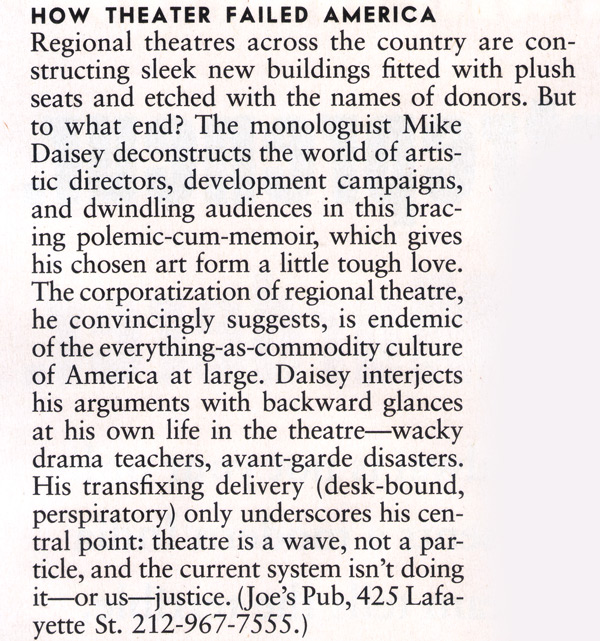


























![[mostra_reload_01] ombrelli](http://farm4.static.flickr.com/3294/2438554108_5c4e4ca843.jpg)