2:51 PM
ConWorks Homeless:
Knowing that ConWorks is moving dredges up a more difficult question: Is ConWorks worth moving? It seems more like a glorified rental hall than an arts center these days—it lost something when Shiffler left and lost almost everything when Richter left and hasn’t made much of an artistic impression since. A few names have moved through the building, doing performances and art shows, during new artistic director Corey Pearlstein’s tenure—cult names (Negativland, Guillermo Gómez-Peña), local names (Joe Von Appen, Degenerate Art Ensemble), local big names (Trimpin), and local bigger names (Gary Hill)—but they’ve passed through like phantoms, leaving no sense of artistic cohesion or weight. The programming has felt more like a grab bag of phoned-in favors than a multidisciplinary mission. I don’t hear people talking about ConWorks anymore. It’s almost like it’s already gone.
11:31 PM
2:51 PM
2:48 PM
10:37 AM
9:22 AM
8:57 AM
8:56 AM
8:55 AM
Police Raids Over Jolie-Pitt Baby Shower - TMZ.com:
TMZ has learned the FBI and Massachusetts authorities raided a Westfield, Mass. home Tuesday night and seized photos of a baby shower held by Angelina Jolie and Brad Pitt.
8:55 AM
WSJ.com - Directors, Take Note: Samuel Beckett Was A Micromanager:
In the 17 years since Beckett's death, the representatives of his estate have gone to extreme lengths to make sure those instructions are followed to the letter. They close or threaten to close productions that ignore them.
The estate's representatives, headed by Mr. Beckett's nephew, Edward, contend such strict adherence maintains the integrity of the Nobel Prize-winner's more than two dozen plays. Some in the theater say that it deprives directors of so much leeway as to be absurd.
In 1994, the estate canceled the European tour rights of a production of the play "Footfalls" in London because actress Fiona Shaw walked around the stage in a pattern different from what Beckett instructed in the text: to pace "downstage, parallel with front, length nine steps, width one metre, a little off centre audience right." Ms. Shaw also wore a bright red dress instead of the "worn grey wrap hiding feet" that Beckett's stage directions called for. In an email, Edward Beckett confirmed that the production was "curtailed" because "the company had broken the terms of their contract."
In 2003, Edward Beckett threatened to close a production of "Waiting for Godot" in Sydney, Australia, because director Neil Armfield added music to it. But the theater's contract with the estate didn't prohibit music, so the production carried on. "In coming here with its narrow prescription, its dead controlling hand, its list of 'not alloweds,' the Beckett estate seems to me to be the enemy of art," Mr. Armfield railed in a speech he gave the same year in Sydney to a symposium of Beckett scholars.
8:33 PM
8:17 PM
8:12 PM
Supreme Court Blocks Guantánamo Tribunals - New York Times:
The Supreme Court today delivered a sweeping rebuke to the Bush administration, ruling that it exceeded its authority by creating tribunals for terror suspects that fell short of the legal protections that Congress has traditionally required in military courts.
As a result, the court said in a 5-to-3 ruling, the tribunals violated both American military law and the military's obligations under the Geneva Conventions.
8:11 PM
8:11 PM
Man of Steel, Woman of Kleenex:
An unwed Superman is a mobile Superman. Thus it has been alleged that those who chronicle the Man of Steel's adventures are responsible for his condition. But the cartoonists are not to blame.
Nor is Superman handicapped by psychological problems.
Granted that the poor oaf is not entirely sane. How could he be? He is an orphan, a refugee, and an alien. His homeland no longer exists in any form, save for gigatons upon gigatons of dangerous, prettily colored rocks.
As a child and young adult, Kal-El must have been hard put to find an adequate father-figure. What human could control his antisocial behavior? What human would dare try to punish him? His actual, highly social behavior during this period indicates an inhuman self-restraint.
What wonder if Superman drifted gradually into schizophrenia? Torn between his human and kryptonian identities, he chose to be both, keeping his split personalities rigidly separate. A psychotic desperation is evident in his defense of his "secret identity."
But Superman's sex problems are strictly physiological, and quite real.
The purpose of this article is to point out some medical drawbacks to being a kryptonian among human beings, and to suggest possible solutions. The kryptonian humanoid must not be allowed to go the way of the pterodactyl and the passenger pigeon.
8:05 PM
8:05 PM
rm -r *, by Jeffrey Veen:
I was waiting for a friend in the lobby of the Hilton down at Union Square. Near me was a middle-aged woman speaking loudly into a pay phone.
"Yes, yes, that's right. You've got it. Now, here's what I want you to type. 'are em' ... yes. The letter 'r' and the letter 'm', together. Now type a dash. Yes, like a hyphen. OK, and then another 'r'. Yes rm space hyphen r. OK, now another space and then a star. Shift 8. Yes. Now read it back to me. [pause] OK perfect. Hit return and tell me what happens. [pause] [pause] OK. Thank you. Goodbye."
And she hung up and walked away while the command-line geek inside of me stood paralyzed with fear.
7:51 PM
7:51 PM
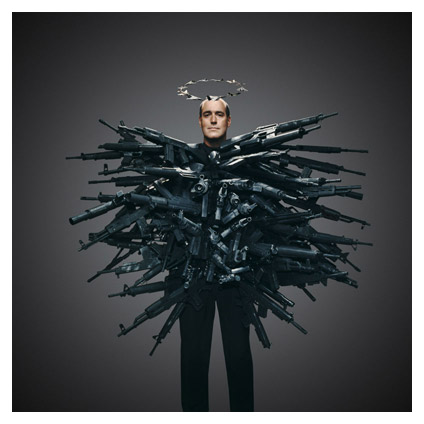
Eight Ways to Kill Someone by Using an iPod Nano, According to Ex-Marine Brad Collum.
7:33 PM
7:02 PM
7:02 PM
7:01 PM
7:00 PM
7:00 PM
A History of Hurricanes in New York:
But our own hurricane history is more tumultuous than many New Yorkers might think. In 1821, when a major hurricane made a direct hit on Manhattan, stunned residents recorded sea levels rising as fast as thirteen feet in a single hour down where there’s now Battery Park City. Everything was flooded south of Canal Street. The storm struck at low tide, though, and, according to Queens College professor Nicholas Coch, a coastal geologist who calls himself a “forensic hurricanologist,” that’s “the only thing that saved the city.”
Then there’s Hog Island. The pig-shaped mile-long barrier island was off the southern coast of the Rockaways. After the Civil War, developers built saloons and bathhouses on it, and Hog Island became a Gilded Age version of the Hamptons. The city’s political bosses and business elite used the place as a kind of beachy annex of Tammany Hall. That all ended on the night of August 23, 1893, when a terrifying Category 2 hurricane made landfall on the swamp that is now JFK airport.
The hurricane was a major event. All six front-page columns of the August 25, 1893, New York Times were dedicated to the “unexampled fury” of the “West Indian monster.” The storm sunk dozens of boats and killed scores of sailors. In Central Park, hundreds of trees were uprooted, and gangs of Italian immigrant boys “roamed . . . in the early hours of the morning collecting the dead sparrows and plucking them of their feathers.” Apparently looting was not yet in vogue. The brand-new Metropolitan Life building on Madison Avenue was severely damaged. And a 30-foot storm surge swept across southern Brooklyn and Queens, destroying virtually every man-made structure in its path. These days, evacuation plans are in place, officials said last week. But “try to tell someone in Sheepshead Bay that they have to evacuate immediately because within the next 24 hours they’ll have 30 feet of storm surge,” says Mike Lee, director of Watch Command at the New York City Office of Emergency Management. “They’ll laugh at you. I mean, I barely even believe it.”
As for Hog Island, “it largely disappeared that night,” Coch says. “As far as I know, it is the only incidence of the removal of an entire island by a hurricane.”
6:58 PM
10:25 AM
10:13 AM
10:13 AM
10:12 AM
11:44 PM
7:34 PM
7:34 PM
7:32 PM
7:30 PM
The United States Patent Office explains it all for you:
Looking back from the 22nd century, future historians will marvel at the current era's obsession with extending intellectual property rights well past any reasonable limit. Nowhere is this more apparent than in the United States Patent and Trademark Office's determination to grant a patent to even the most absurd claims that cross its desk. Four years ago a patent attorney in Minnesota named Peter Olson demonstrated this by submitting the following patent in the name of his five year-old son, Steven. The patent was granted. Read it and weep.
7:29 PM
1:18 PM
How to Succeed in Business Without Really Dieting:
But the movie's problem comes down to this: It's about the wrong girl. English actress Emily Blunt (the haughty seducer in My Summer of Love) plays Hathaway's rival, Emily, jealously guarding her status as Miranda's No. 1 assistant, scornful of the rube destined to replace her. Only Blunt seems to understand what Devil should've been—an enjoyable Bridget Jones knockoff. She sees, as we do, that Andy can't lose, and her panic only causes her to make a bigger mess of things. Which is why we rooted for Bridget, and her unlikely success raised a cheer. Starving herself for fashion, a young woman about to be replaced by this year's model, Emily moans at her desk, "I love my job, I love my job," like she's got a terminal disease. Viewers will know the feeling—it's called work, which Devil isn't prepared to do.
1:17 PM
12:14 PM
12:13 PM
12:11 PM
Urban Fairies fairy doors:
The town of Ann Arbour, Michigan is filled with tiny little fairy doors that have been built into the buildings. Some houses also have tiny staircases, tiny windows with tiny drapes...it's crazy wonderful.
11:33 AM
12:37 PM
12:07 PM
12:00 PM
11:59 AM
MAKE: Blog: Animatronic flesh shoe:
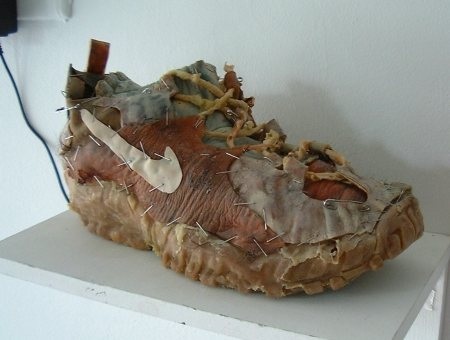
"The shoe is stitched together with multiple pieces of latex rubber cast out of moulds made from my own skin. The shoe's toe and heel raise and lower as it occasionally vibrates/pulsates, and twitches on the floor as if it were still alive. The movement is not constant, and usually causes people to jump back while they are in the middle of leaning in for a closer look."
11:18 AM
9:59 AM
2:56 AM
Maud Newton: Blog:
But by my 30s, those memories had started to fade. What I was left with was a memory of what my memory used to be like, a poignant awareness of my own deficit. I first noticed this about eight years ago: One day, rooting through a drawer in my mom’s house, I came across a photo of myself as a girl. In the photo, I’m about 5 years old, decked out in a swami robe, my eyes hidden behind enormous Jackie O sunglasses. But I could summon no memory of that day, no explanation, though I had the conviction that I used to know what that picture was all about, that there was some important story connected with it. It felt like I had lost a key that unlocked some inner door. I could still press my ear to it, could still run my hand against its grain and examine its hinges, but I would never get through that door again.
And so I began my novel about memory. I knew at the time that several companies, including one appropriately called Memory Pharmaceuticals, were working to develop real treatments for memory loss, but I didn’t pay them much mind. My drug would be different. It would be recreational-Proust’s madeleine reduced to tiny chemical specks. My drug would launch the user into the best moments of his life, allowing him to savor long ago joys, allowing him to meet his boyhood self....
[I]n the course of writing the novel, I saw just how dangerous this drug might be. The past is potently intoxicating, and if we could ever taste it purely, undiluted by forgetfulness, we would, I came to believe, disappear into ourselves.
2:46 AM
2:46 AM
Renewed Push for the Artistic ABC's in N.Y. - New York Times:
But there's still a long way to go. Student-teacher ratios for the arts can be staggering. According to data provided by the department to the City Council this fall, there is 1 visual arts teacher for every 943 students and 1 music teacher for every 1,200. For dance and theater the numbers are even more extreme, with 1 dance teacher for every 8,088 students, and 1 theater teacher for every 8,871.
2:38 AM
12:38 AM
12:16 AM
The New Yorker: The Critics: Superman Returns:
I have listened to Batman moan about how he will never fit in, and to countless mutants voice the same complaint, and, frankly, I don’t give a damn. The ethical duties of Superman leave me cold; I just want to watch him catch a falling car.
11:05 PM
10:25 PM
Boing Boing: Residents sell blank CDs:
The anonymous surrealist art/performance group The Residents is selling a double-CD package, titled River Of Crime, for $14.99. The two disks inside are blank. The recordings, inspired by old-timey radio serials, and other multimedia material will be released online every other week throughout the summer for download by those who have the digital subscription code inside the CD-R package. Once the whole collection of "Crimecasts" are downloaded, the owner is meant to complete the package by burning the disks. From the project description:
THE RESIDENTS’ RIVER OF CRIME is a character driven podcast series of 20 shows, based on the time honored concept of TRUE CRIME. Rooted in 1940’s style radio drama, THE RIVER OF CRIME not only updates the original form with modern production values, but also heavily leans on a distinctive soundtrack as one of its primary dramatic devices. A modern day DRAGNET, the series follows the reminisces of its unseen narrator as he discloses a lifelong obsession with wickedness and vice. But, as opposed to the ironic and terse Joe Friday, a classic crime solver, THE RIVER OF CRIME’S narrator is a crime collector.
9:00 PM
6:19 PM
5:17 PM
5:15 PM
5:14 PM
5:05 PM
5:04 PM
Shaw, Kabuki, Eva Peron: The Usual Mix - New York Times:
"I like being part of a collective that completely subverts all my usual ways of approaching a play," said Ms. Schreck, who played the title role in "Major Barbara." "With 2HC I've found a sense of freedom in performing that I hadn't felt since I was a child. It's thrilling to be allowed to go so outrageously far — physically, vocally, interpretively — to test the boundaries of what the play can contain. Brendan and Brooke's shows are uniquely alive because of this, because everyone is putting so much on the line. We are aggressively risking making fools of ourselves. It's delicious. There's joy in it, and humility. It's fun."
4:55 PM
4:52 PM
4:35 PM
The Fishbowl: We Come to Bury WinFS...:
The irony, of course, is that in Accidental Empires, Cringely was describing IBM, not Microsoft. The original definition of Fear, Uncertainty and Doubt, as described in the Jargon File, is:
“FUD is the fear, uncertainty, and doubt that IBM sales people instill in the minds of potential customers who might be considering [Amdahl] products.” The idea, of course, was to persuade them to go with safe IBM gear rather than with competitors’ equipment. This implicit coercion was traditionally accomplished by promising that Good Things would happen to people who stuck with IBM, but Dark Shadows loomed over the future of competitors’ equipment or software.
Meet the new boss, same as the old boss.
3:52 PM
11:08 AM
10:52 AM
10:47 AM
2:29 AM
2:27 AM
Scientology Induction Video for your viewing pleasure.
2:12 AM
2:09 AM
2:08 AM
The Bear
When my propane ran out
when I was gone and the food
thawed in the freezer I grieved
over the five pounds of melted squid,
but then a big gaunt bear arrived
and feasted on the garbage, a few tentacles
left in the grass, purplish white worms.
O bear, now that you've tasted the ocean
I hope your dreamlife contains the whales
I've seen, that the one in the Humboldt current
basking on the surface who seemed to watch
the seabirds wheeling around her head.
Jim Harrison
2:06 AM
1:07 AM
Strange Horizons Articles: Interview: Tim Powers:
The real reason to write fiction, after all, isn't to make money, nor to show the human heart in conflict with itself, nor to give a picture of one's time, nor to call attention to the plight of any oppressed classes, but to show off. You want to be able to say to visitors, "Sit down, let me clear that stuff off the couch, it's copies of my new novel." And to show off effectively, I want each book to be as close as I can get it to what I want it to be. It's like making six-foot-tall replicas of Gothic cathedrals out of toothpicks in your basement—you might as well get all the saints' faces right.
8:49 PM
8:33 PM
8:33 PM
Love is never having to say you're sorry. Power is being able to kill anyone who asks for an apology.
8:28 PM
5:48 PM
1:55 PM
1:54 PM
Boing Boing: Disney: We [will|won't] sue if you put Pooh on a baby's headstone:
Disney threatened to sue a British stonemason for copyright infringement over a plan to carve Winnie the Pooh into the headstone of a stillborn infant. After negative publicity, they changed their mind.
1:52 PM
1:42 AM
10:47 PM
10:47 PM
10:46 PM
10:45 PM
6:47 PM
6:30 PM
6:08 PM
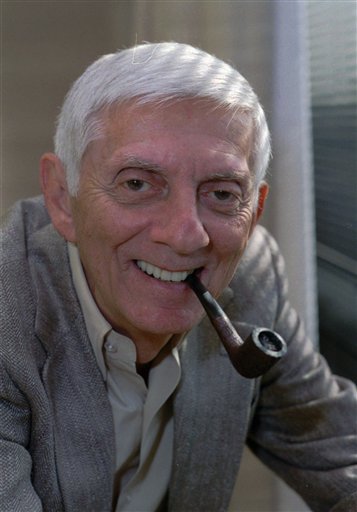
Aaron Spelling, Producer of Schlock and Shit for Television, Dead at 83:
June 23 (Bloomberg) -- Aaron Spelling, who produced such television programs as "Charlie's Angels,'' "Dynasty,'' and "Beverly Hills, 90210'' featuring beautiful people in glittering settings, has died, according to the Associated Press. He was 83.
6:03 PM
5:56 PM
5:38 PM
WSJ.com - Regional Theater's Glamour Gap:
The success of these shows points to another part of the problem, which is that too many people think of regional theater as a place where promising plays are tried out, the worthiest of which eventually find their way to New York. Sometimes that's true -- but not often. Broadway, after all, only has room for a certain number of new productions each season, and the fearsomely high cost of presenting a show in New York means that most producers are inclined to play it safe. If you want to keep up with the latest and best in regional theater, you've got to go where the action is, not wait for it to come to you.
When a museum in Los Angeles or Philadelphia puts on a major exhibition, nobody in the world of art assumes it to be second-rate merely because it doesn't travel to the Metropolitan Museum. The same thing ought to be true of a theatrical production. That's why the time has come for American playgoers -- and, no less important, arts editors -- to start treating regional theater not as a minor-league branch of Broadway but as an artistically significant entity in and of itself. Take it from a critic who now spends much of his time living out of a suitcase: If you don't know what's hot in "the stix," you don't know the first thing about theater in 21st-century America.
5:36 PM
5:07 PM
Playbill News: Public Theater Seeks 365-Day-Theatre-Party People for Year-Long Parks Project:
Help is what the Public Theater is looking for to carry off Suzan-Lori Parks' ambitious sui generis project 365 Days/365 Plays. The project is described thusly: "In November 2002, the Pulitzer prize-winning Suzan-Lori Parks sat down and committed to writing a play a day for the next 365 days. For the 2006-07 Season, The Public will produce the New York premiere of these works by gathering together a widely diverse cross-section of New York’s theatre companies to participate in this project. Over the course of one year, the selected theatres—curated by The Public, Suzan-Lori Parks and Producer Bonnie Metzger—will perform these brief, brilliant snapshots from the imagination of one of America's leading playwrights. This will be part of a yearlong national festival of the play cycle that will take place in major cities around the country including Atlanta, Los Angeles and Denver. Tickets at The Public will be free."
4:54 PM
4:52 PM
4:51 PM
2:16 PM
2:15 PM
2:12 PM
2:11 PM
2:10 PM
2:09 PM
1:01 PM
TIME.com -- How Doctors Got Into the Torture Business:
In one of the few actual logs we have of a high-level interrogation, that of Mohammed al-Qhatani (first reported in TIME), doctors were present during the long process of constant sleep deprivation over 55 days, and they induced hypothermia and the use of threatening dogs, among other techniques. According to Miles, Medics had to administer three bags of medical saline to Qhatani — while he was strapped to a chair — and aggressively treat him for hypothermia in the hospital. They then returned him to his interrogators. Elsewhere in Guantánamo, one prisoner had a gunshot wound that was left to fester during three days of interrogation before treatment, and two others were denied antibiotics for wounds. In Iraq, according to the Army surgeon general as reported by Miles, "an anesthesiologist repeatedly dropped a 2-lb. bag of intravenous fluid on a patient; a nurse deliberately delayed giving pain medication, and medical staff fed pork to Muslim patients." Doctors were also tasked at Abu Ghraib with "Dietary Manip (monitored by med)," in other words, using someone's food intake to weaken or manipulate them.
12:59 PM
6:20 PM
You’re going to study literature and get a job doing what? Literaturizing?
What in the hell is going on around here? This is a sad state of affairs for all the post grad English majors floating around this city. There were 200 of us applying for the same internship. This is not an internship at The New Yorker; it’s a 36X48 inch poster. So, someone asks what you do for a living. Oh. I work for a poster, for free. Consider your readership: Every week, your writing would appear in waiting rooms across the country, where phlegmatic hypochondriacs and Alzheimer patients would read your articles if only to be distracted by stale issues of Newsweek. (Need I insert the quip here about how the Alzheimer patients would only forget your writing after about twenty minutes?) And what these guys were telling me is that over 200 people wanted to work for them, for free. Really.
6:19 PM
6:19 PM
Gothamist: Learning More About Guantanamo At the Movies:
Winterbottom's film dramatizes the experience of three young British men, known as "the Tipton Three" named for the part of England they call home, who on a wedding trip to Pakistan in 2001 end up in Afghanistan and subsequently rounded up by US forces to be sent to Guantanamo. At the camp, they're held for two years without any formal charges being brought against them and subjected to sleep deprivation, noise torture and host of other deplorable treatments in order to force a confession that they are affiliated with Al Qaeda. Winterbottom inter-cuts recreated footage with actors and documentary-style story telling from the real Tipton three for a powerful and important film experience.
6:03 PM
5:10 PM
3:15 PM
3:09 PM
3:08 PM
3:00 PM
2:59 PM
2:54 PM
2:41 PM
2:40 PM
2:40 PM
2:39 PM
12:23 AM
12:08 AM
11:32 PM
Not Prince Hamlet, nor was meant to be - Russian brides for Internet sale — in my family:
So I'm trying to figure out how I feel about the fact that there seems to be an arranged marriage taking place within my family.
My uncle and his wife are hardcore Bible-belt Christians, by which I mean they believe in such concepts as "The man is the head of the household and it's the wife's duty to submit to his leadership." And that they order their entire lives around what they believe God wants for them (and consult him often on exactly what that is), rather than simply claiming Christianity based on a weekly or monthly trip to church. They have three biological kids and have adopted NINE more, going on ten — five of them from Russia, the rest each from different countries. They've adopted kids considered too old to be adopted; they've adopted deeply troubled children, they've adopted "reject" kids who were adopted, then kicked out, by other families who didn't realize what a commitment they were making. They've basically made their lives into a ministry, and they've done wonderful things with these unwanted kids. They currently live in Alabama, though they're originally from Oklahoma.
I found out over the weekend from my mother that my aunt's been corresponding with a similar family in Michigan — a couple that's taken in more than a dozen special-needs children, and currently have 15 kids in their care, though some of those are their biological children. My aunt and this family's matriarch have been corresponding online about the difficulties of raising such a large family of adoptees, and they get along really well. Somewhere along the line, they decided that the Michigan family's oldest boy, "James," and my aunt's oldest adopted girl, a 19-year-old Russian I'll call "Ellen," would be perfect for each other. So the families arranged a meeting. James liked Ellen; Ellen is painfully shy and reportedly barely spoke to James and was never alone with him. But they later corresponded online, and he decided she was perfect for him, so the mothers have set a wedding date in January.
11:29 PM
10:25 PM
8:20 PM
Farewell, naughty weasels.:
For about three months, we settled into a comfortable routine. I would load my pockets full of raisins when I got home from work and release the rodents. They would attempt to bite me while I threw raisins at their faces. (Ferrets hate many things, but they love raisins.) Going barefoot inside the house was no longer an option. Or standing still for more than 15 seconds at a time. Or having guests over. My ferrets hated everyone, but especially gay men. I thought that was kind of funny. (Sorry Craig!)(And Joey!)(And Jared, Eric, etc!) When they weren’t attacking me or my roommate (sorry again, Craig!), they were sniffing out the most expensive place possible to take a shit.
One day, I bought them little ferret leashes, because I naively hoped I could take them for walks, like I would a dog. When I strapped them into their leashes, they lay down and refused to move. I dragged them in limp circles around the kitchen for a few minutes, waiting for our “walk” to get fun, before I gave up and released them. They immediately loped over to my most expensive pair of leather shoes and began shitting.
8:16 PM
8:16 PM
Honour your mistake as a hidden intention.—Brian Eno
8:10 PM
8:09 PM
8:08 PM
Warrenellis.com » I Have Seen Into The Future, And It Squirts:
One of the points of my forthcoming novel is that once something’s put on the internet, it’s not “fringe” or “edge” anymore. By dint of being freely accessible on the world’s most massive information network, it is de facto The Mainstream. People talk of blogs as the alternative to Mainstream Media, but if a million people a day read the ad-supported Boing Boing, how is that not mainstream?
So don’t look at this as some weird fringy thing you can dismiss as the personal freak of a handful of people. Remember the old maxim — if you think your own fetish is so strange that only one in a million people would understand, then there’s eight people like you in New York City alone.
8:06 PM
8:01 PM
7:49 PM
7:43 PM
CNN.com - Study: Earth 'likely' hottest in 2,000 years - Jun 22, 2006:
Combining that information gave the panel "a high level of confidence that the last few decades of the 20th century were warmer than any comparable period in the last 400 years," the academy said.
Overall, the panel agreed that the warming in the last few decades of the 20th century was unprecedented over the last 1,000 years, though relatively warm conditions persisted around the year 1000, followed by a "Little Ice Age" from about 1500 to 1850.
The scientists said they had less confidence in the evidence of temperatures before 1600. But they considered it reliable enough to conclude there were sharp spikes in carbon dioxide and methane, the two major "greenhouse" gases blamed for trapping heat in the atmosphere, beginning in the 20th century, after remaining fairly level for 12,000 years.
7:23 PM
1:29 PM
1:23 PM
1:15 PM
1:14 PM
A Debate with Charlie (Age 5) About Monsters :
HIM: Dad, which island had the crazier monsters? King Kong's island or Godzilla's island?
ME: I don't think Godzilla had an island. Didn't he live under the sea?
HIM: I'm pretty sure he had an island. I saw it at my friend's house. So who had crazier monsters?
ME: Well, I think King Kong. I mean, giant apes and t-rex on the same island? Can't get much crazier than that.
HIM: I think it's Godzilla. He has serpents. They're bigger than snakes and they breathe fire. That's the craziest.
ME: Crazier than t-rex?
HIM: They live in the water and they breathe fire, Dad. That is CRAZY!
11:48 AM
Izzle! Izzle pfaff!:
Midway in his allotted threescore years and ten, Skot comes to himself with a start and realizes that he has strayed from the True Way into the Dark Wood of Error (DMV). His way is blocked by three beasts of Afternoon: THE LEOPARD OF AUTOMATED QUEUING, THE LION OF UNCOMFORTABLE PLASTIC CHAIRS and THE SHE-WOLF OF DISCARDED USA TODAYS. These beasts, especially the She-Wolf, drive him back despairing into the darkness of sitting down and hopeless inertia. But just as all seems lost, a figure appears to him. It is the shade of VIRGIL, Skot's symbol of a half-remembered liberal arts education.
11:45 AM
11:45 AM
Logotopia, and the Little Twisted Nerve: Things I Don't Understand - Part 1:
It's incomprehensible to me how slowly some people can stand to walk. Now, I'm not talking about the injured or elderly. I'm talking about normal, young, healthy people, that walk like they have all the time in the world. Don't they have somewhere to go? And if not, why are they out walking? Wouldn't they rather get where they are going quickly so that they have more time to do whatever it is they're going there to do? Can't they feel the grim reaper breathing down their neck? They're wasting their own lives. That's suicide.
11:40 AM
11:31 AM
11:29 AM
11:15 AM
Can a psychiatrist really tell what's wrong with you?
In 1973, academic psychologist D.L. Rosenhan sent himself and seven friends and colleagues to the psychiatric emergency rooms of 12 different hospitals. Each told ER workers that for several weeks he or she had been distressed by voices saying "empty," "hollow," and "thud." The testers gave false names and occupations but otherwise accurately reported their histories, which did not include mental illness. In all 12 instances they were admitted to a psychiatric ward. At that point, they stopped pretending to have symptoms. Nonetheless, they were held for an average of 19 days (their stays ranged from seven to 52 days) and were all released with a diagnosis of "schizophrenia, in remission," or something like it. Rosenhan titled his study "On Being Sane in Insane Places" and argued that psychiatric diagnosis has more to do with the presumptions of clinicians, and their tendency to treat ordinary behavior as pathological when it occurs on a psych ward, than with a rational assessment of symptoms.
10:18 AM
10:14 AM
10:06 AM
The Stranger | Seattle | Theater | Feature | Hating the Caveman:
I'm not sure why I asked to review Defending the Caveman, Rob Becker's hacky, indestructible mid-'90s comedy of genders. Was it my perverse obsession with the world's worst jokes? Simple curiosity about why this play, of all plays, refuses to die? Whatever the reason, I knew I would hate it. I couldn't wait to hate it. Hating is my specialty, and hating Defending the Caveman would be my masterpiece.
10:03 AM
9:34 AM
9:33 AM
7:34 PM
Lee Aaron Blair - $Leeblog:
"You can't wear heels or I'll have an emotional breakdown."
"Too late on both counts."
"Please."
"I'm five-ten."
"You're Godzilla."
"Hush, Leonardo. We're late."
7:32 PM
7:30 PM
6:46 PM
6:46 PM
6:44 PM
6:41 PM
5:24 PM
A Common Parasite Reveals Its Strongest Asset: Stealth - New York Times:
On paper, Toxoplasma gondii looks as if it ought to be the most famous parasite on earth. This single-celled pathogen infects over half the world's population, including an estimated 50 million Americans. Each of Toxoplasma's victims carries thousands of the parasites, many residing in the brain. As if that were not enough of an accomplishment, Toxoplasma is equally adept at infecting all other warm-blooded animals, as disparate as chickens and kangaroos.
5:16 PM
5:11 PM
3:29 PM
Wal-Mart Opens Doors in Kearny Just 7 Miles from NYC
2:31 PM
1:28 PM
11:25 AM
The Misunderestimated Man—How Bush chose stupidity:
The most obvious expression of Bush's choice of ignorance is that, at the age of 57, he knows nothing about policy or history. After years of working as his dad's spear-chucker in Washington, he didn't understand the difference between Medicare and Medicaid, the second- and third-largest federal programs. Well into his plans for invading Iraq, Bush still couldn't get down the distinction between Sunni and Shiite Muslims, the key religious divide in a country he was about to occupy. Though he sometimes carries books for show, he either does not read them or doesn't absorb anything from them. Bush's ignorance is so transparent that many of his intimates do not bother to dispute it even in public. Consider the testimony of several who know him well.
Richard Perle, foreign policy adviser: "The first time I met Bush 43 … two things became clear. One, he didn't know very much. The other was that he had the confidence to ask questions that revealed he didn't know very much."
David Frum, former speechwriter: "Bush had a poor memory for facts and figures. … Fire a question at him about the specifics of his administration's policies, and he often appeared uncertain. Nobody would ever enroll him in a quiz show."
Laura Bush, spouse: "George is not an overly introspective person. He has good instincts, and he goes with them. He doesn't need to evaluate and reevaluate a decision. He doesn't try to overthink. He likes action."
Paul O'Neill, former treasury secretary: "The only way I can describe it is that, well, the President is like a blind man in a roomful of deaf people. There is no discernible connection."
A second, more damning aspect of Bush's mind-set is that he doesn't want to know anything in detail, however important. Since college, he has spilled with contempt for knowledge, equating learning with snobbery and making a joke of his own anti-intellectualism. ("[William F. Buckley] wrote a book at Yale; I read one," he quipped at a black-tie event.) By O'Neill's account, Bush could sit through an hourlong presentation about the state of the economy without asking a single question. ("I was bored as hell," the president shot back, ostensibly in jest.)
11:19 AM
11:17 AM
O'Reilly Among the Snobs:
He had a very strange experience as a graduate student at Harvard's Kennedy School of Government (which let the likes of Bill O'Reilly through its ivy-covered gates, he is careful to note, "in an effort to bring all sorts of people together"). Other Kennedy School students, he says, insisted on being called by three names, none of which could be "Vinny, Stevie, or Serge." Their "clothing was understated but top quality … and their rooms hinted of exotic vacations and sprawling family property. Winter Skiing in Grindelwald? No problem." They tried to be nice, but Bill was nevertheless humiliated, in a Thai restaurant, to be "the only one who didn't know how to order my meal in Thai."
I should explain this last one to those who may not have been aware that Thai is the lingua franca of the American WASP upper class. The explanation is simple. American Jewish parents only one or two generations off the boat often spoke in Yiddish when they didn't want their children to understand. Italian-Americans used Italian, and so on. But WASPs only had English. (They tried Latin, but tended to forget the declensions after the second martini.) So they adopted Thai, which they use in front of the servants and the O'Reillys of the world as well. (At least it sounds like Thai after the second martini.) When they turn 18, upper-class children attend a secret Thai language school, disguised as a ski resort, in Grindelwald.
11:15 AM
10:10 AM
Anecdote of the Jar
I placed a jar in Tennessee,
And round it was, upon a hill.
It made the slovenly wilderness
Surround that hill.
The wilderness rose up to it,
And sprawled around, no longer wild.
The jar was round upon the ground
And tall and of a port in air.
It took dominion every where.
The jar was gray and bare.
It did not give of bird or bush,
Like nothing else in Tennessee.
Wallace Stevens
9:51 AM
9:47 AM
9:01 AM
8:58 AM
An open letter to Frank Gehry. By Jonathan Lethem:
Most people, if they've heard of this proposal at all, believe you've been hired to design a sports arena, to house the New Jersey Nets, a team owned by Mr. Ratner. Anyone who's glimpsed the drawings and models, however, knows that other, larger plans have overtaken the notion of a mere arena. The proposal currently on the table is a gang of 16 towers that would be the biggest project ever built by a single developer in the history of New York City. In fact, the proposed arena, like the surrounding neighborhoods, stands to be utterly dwarfed by these ponderous skyscrapers and superblocks. It's a nightmare for Brooklyn, one that, if built, would cause irreparable damage to the quality of our lives and, I'd think, to your legacy. Your reputation, in this case, is the Trojan horse in a war to bring a commercially ambitious, but aesthetically—and socially—disastrous new development to Brooklyn. Your presence is intended to appease cultural tastemakers who might otherwise, correctly, recognize this atrocious plan for what it is, just as the notion of a basketball arena itself is a Trojan horse for the real plan: building a skyline suitable to some Sunbelt boomtown. I've been struggling to understand how someone of your sensibilities can have drifted into such an unfortunate alliance, with such potentially disastrous results. And so, I'd like to address you as one artist to another. Really, as one citizen to another. Here are some things I'd hope you'll consider before this project advances any further.
8:57 AM
8:55 AM
8:55 AM
8:52 AM
The Daily Dump: Now I Can Never Return To Century 21 [WORDPLAY ALERT]
Or Why I Can’t Go Back To The Future:
So he approaches quickly and I give him my best “I’m just looking, thanks,” and he immediately extends his hand and says, “What’s your name? I’m Sean.” Suddenly we’re friends and in five seconds he has a tape measure wrapped around my chest and all I can think is, Where the hell did that tape measure come from?
I figure I may as well go along with it and let him do his job. I tell him that I am looking for a gray suit and before the sentence is finished he is sliding a black suit jacket up my arm. He moves with the quickness of a woodland creature and, I only notice now as I peer at him through the mirror standing behind me, the same wide, rabid eyes.
8:44 AM
8:43 AM
1:42 AM
6:38 PM
From the Embassy, a Grim Report:
Hours before President Bush left on a surprise trip last Monday to the Green Zone in Baghdad for an upbeat assessment of the situation there, the U.S. Embassy in Iraq painted a starkly different portrait of increasing danger and hardship faced by its Iraqi employees. This cable, marked "sensitive" and obtained by The Washington Post, outlines in spare prose the daily-worsening conditions for those who live outside the heavily guarded international zone: harassment, threats and the employees' constant fears that their neighbors will discover they work for the U.S. government.
5:52 PM
12:11 PM
12:01 PM
11:13 AM
March Elegy
I have enough treasures from the past
to last me longer than I need, or want.
You know as well as I . . . malevolent memory
won't let go of half of them:
a modest church, with its gold cupola
slightly askew; a harsh chorus
of crows; the whistle of a train;
a birch tree haggard in a field
as if it had just been sprung from jail;
a secret midnight conclave
of monumental Bible-oaks;
and a tiny rowboat that comes drifting out
of somebody's dreams, slowly foundering.
Winter has already loitered here,
lightly powdering these fields,
casting an impenetrable haze
that fills the world as far as the horizon.
I used to think that after we are gone
there's nothing, simply nothing at all.
Then who's that wandering by the porch
again and calling us by name?
Whose face is pressed against the frosted pane?
What hand out there is waving like a branch?
By way of reply, in that cobwebbed corner,
a sunstruck tatter dances in the mirror.
Anna Akhmatova
11:13 AM
11:12 AM
brown dress
a year-long performance project
365 days. one brown dress. a one-woman show against fashion.
devised, built, and performed by Alex Martin
launch – July 7, 2005
completion – July 7, 2006
So, here's the deal - I made this dress and I'm wearing it every day for a year. I'll throw snowballs in it (wearing additional clothing layers in cold weather for health & safety), garden in it, rehearse in it, travel in it, dance in it, cook in it, prune my pear trees in it, drink wine in it, sing my baby to sleep in it.
11:06 AM
11:01 AM
Salon.com Technology | Ask the pilot:
Conspiracy theories and their proponents often bear many of the hallmarks of the uglier flavors of spirituality: an opportunity to be initiated in a mysterious truth, combined with a chance to lay blame and praise at the feet of unknown, idolized (whether loved or hated) forces that remain unseen. To insist that hijacked airliners were whisked away to quarters unknown, or that Kennedy was taken out by LBJ or the Mob or Cubans or some coalition thereof, or that Elvis is alive and flipping burgers in St. Paul, is to claim the hidden truth of the universe, the secret explanation, and the ability to name some entity on which to blame all the whims of fate. And in the folds of such beliefs, one can mask another agenda. Sounds a lot like radical religion to me.
-- Michael Williams
10:52 AM
9:28 AM
9:27 AM
9:26 AM
9:25 AM
9:25 AM
Charles Isherwood - Critics - Theater - New York Times:
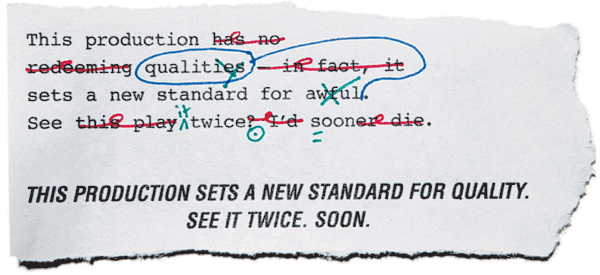
SAW the show. Hated it, I'm afraid. Said as much, in 800 meticulously chosen words.
But lo! Open the paper a few mornings later, and there, for the world to see, is an artful distillation of my review, all those paragraphs pared down to their essence. Well, their essence according to the advertising and marketing specialists hired by the producers. In big type liberally laced with exclamation points, readers would learn that, in fact, "I loved this play!!"
9:24 AM
12:56 AM
1:24 PM
1:08 PM
2:09 AM
2:07 AM
1:10 PM
1:08 PM
Even Canadians Find American Apparel Edgeless, Unpleasant - Gawker:
American Apparel prides itself on being a pioneering company. No doubt that I supported many of its initial ideas that built the foundation of its business model. But the company that looked so good on paper no longer corresponds with itself . The stores have lost concept and look like flea markets, your products have lost quality, and your business ethics are being erased and replaced with the usual corporate shtick- in short, you are well on your way to becoming another institution, and your outrageous company has become horribly predictable. In addition to this, the exploitations of the cultures, sexual orientations, and individuality of the people featured in your advertisements only serves to show that you really don’t understand what is relevant and edgy today within youth culture; your target market. You’ve effectively moved the exploitation of workers in your “non-sweatshops” to your own retail workers and models featured on the pages of newspapers and magazines, cashing in on what you assume a generic public will perceive as subversive and political.
And it will only continue from here.
12:44 PM
12:40 PM
12:38 PM
12:37 PM
12:05 PM
African-American Voters Scrubbed by Secret GOP Hit List Greg Palast:
One group of voters wrongly identified by the Republicans as registering to vote from false addresses: servicemen and women sent overseas.Here’s how the scheme worked: The RNC mailed these voters letters in envelopes marked, “Do not forward”, to be returned to the sender. These letters were mailed to servicemen and women, some stationed overseas, to their US home addresses. The letters then returned to the Bush-Cheney campaign as “undeliverable.”
The lists of soldiers of “undeliverable” letters were transmitted from state headquarters, in this case Florida, to the RNC in Washington. The party could then challenge the voters’ registration and thereby prevent their absentee ballots being counted.
A check of the demographics of the addresses on the “caging lists,” as the GOP leaders called them indicated that most were in African-American majority zip codes.
4:16 PM
Bad remotes! Bad!
4:12 PM
The Believer - Interview with Jack Black:
DANIEL HANDLER: Have you attended a lot of weddings?
JACK BLACK: I have, unfortunately, attended a lot of weddings.
DH: Have you presided over any weddings?
JB: No.
DH: Have you been married yourself?
JB: No.
DH: Have you crashed any weddings?
JB: No. I only go when invited and usually I’m really bored. I haven’t been to many good ones.
DH: What’s the most boring part of a bad wedding?
JB: The ceremony, without a doubt. And the time between the ceremony and when we get to eat. That’s always the most excruciating part. And sometimes between the eating and the waiting for the cake to be cut because that’s commonly understood as the part where you get to leave. Right after the cake is cut, that’s the end. Unless you’re going to wait around for people to get into a car and drive away. I guess that’s when you’re really allowed to leave. I always leave after the cake is cut.
1:58 PM
1:50 PM
1:49 PM
Andrew Sullivan | The Daily Dish: Baptists and Booze:
It's astonishing that liberalism now has a built-in theological meaning, i.e. "Godless." That's the point of Coulter's latest best-seller, as it was Hannity's in his repulsively titled book, "Deliver Us From Evil: Defeating Terrorism, Despotism and Liberalism." The point is to portray your political opponents as part of a Manichean struggle against existential evil. And so "liberalism" is literally demonized. In this way, politics collapses into religion, and the political debate becomes the hunt to expose and punish heresy. That hunt has been around for centuries; and people love it.
1:39 PM
1:39 PM
My First Bill Gates Review:
"OK. Well, good work," said Bill. He took his marked up copy of the spec and left.
"Four," announced the fuck counter, and everyone said, "wow, that's the lowest I can remember. Bill is getting mellow in his old age." He was, you know, 36.
Later I had it explained to me. "Bill doesn't really want to review your spec, he just wants to make sure you've got it under control. His standard M.O. is to ask harder and harder questions until you admit that you don't know, and then he can yell at you for being unprepared. Nobody was really sure what happens if you answer the hardest question he can come up with because it's never happened before."
1:26 PM
1:06 PM
12:49 PM
12:49 PM
12:47 PM
Boing Boing: Is RIAA nastygramming YouTubers over vids of kids singing and dancing?:
The RIAA is reportedly sending letters to YouTube users demanding that they take down videos of kids singing along and dancing to their favorite songs. This is pretty crazy, of course -- as Battelle says, "Wake up. This is how we use music in the real world. Get over yourselves."
But that's just the beginning of the story.
12:44 PM
12:44 PM
12:43 PM
What happens when artists go on reality TV:
After two hour-long episodes of ARTSTAR, not a single art object has been made. The Artstars mostly spend their on-air time around a boardroom table worrying about their marching orders, hearing about more auditions (naked ones!), and getting mini-lectures on recent art history. They do literally get marching orders, as Deitch decides the contestants should collaborate on an "art parade" rather than have a standard gallery show. But what's a wood sculptor to do? And the rest of the cast, despite some less-than-conventional art practices, clearly had their hearts set on a conventional gallery show. But not so fast, Artstars. Like Donald Trump, Deitch is the boss.
...
The real products, of course, are the Artstars themselves. They are diverse and competent people who seem hardworking and nice, so it's hard to say what's wrong with them, except that they are dull. Much of their speech sounds like prerehearsed art-school talk—discussing "issues of gender and representation"—and they come across as docile in their opportunism. They frankly discuss their practical reasons for being on the show, and you feel for them. The problem is that none of them want to make good television. They want "budgets." They want to be able to support themselves only with art. They want a good gallery to promote them. To get all this, they keep saying they need "access." But what will they do to get it? And will it be entertaining?
12:37 PM
1:25 AM
MrBellersNeighborhood - Men Threw Balls To One End, Then Back Again: Scientology by Kurt Rademacher:
Jake's girlfriend broke up with him, so he started driving and turned up eleven hours later at my apartment.
We were the kind of friends who'd been close once but who didn't speak often anymore, owing not to any particular falling out, but to the passage of time and a mutual inability to put any effort into the maintenance of relationships. In the three years I had been in the city, Jake had never shown much interest in visiting, yet suddenly there he was, looking to be entertained for a while, until things looked better back in Michigan.
Before Jake showed up, my plan for the day had been to drink coffee for a few hours and then to head to Midtown and try to get converted to Scientology. Jake said he'd come along.
1:21 AM
10:22 PM
10:06 PM
We trust you have received the usual lecture from the local System
Administrator. It usually boils down to these three things:#1) Respect the privacy of others.
#2) Think before you type.
#3) With great power comes great responsibility.
9:45 PM
6:14 PM
2:24 PM
2:23 PM
2:21 PM
Off the Record
In the attic I find the notes
he kept in college
over forty years ago: Hooray
for Thanksgiving vacation! he wrote
in the margin of Psych 102.
And for a moment I can see him there,
feel the exuberance surge through
that odd cell of his body
where I am still
a secret code uncompleted, a piece
of DNA, some ancient star-stuff.
And then I find a recording of me
from 1948, when he was twenty-two
and I was three, and I can see,
from my perch up on his shoulders,
him stopping at the gaudy arcade,
plugging his lucky quarter into
the future where we'd always be.
Maybe imagination is just
a form of memory after all, locked
deep in the double helix of eternity.
Or maybe the past is but one more
phantasmagoric invention we use
to fool ourselves into someone else's shoes.
It is not my voice I want to hear
on memory's fading page, on imagination's disk.
It is my father's in the background
prompting me, doing his best
to stay off the record, his hushed
instructions vanishing in static.
Ronald Wallace
2:29 AM
1:02 AM
1:00 AM
12:57 AM
Crazy Apple Rumors Site » Blog Archive » Industry Panel Discusses Dvorak.:
EDITOR-IN-CHIEF JOHN MOLTZ: Gentlemen, thank you for coming all the way to Tacoma for this fifteen minute panel. In the days since the posting of this video, Dvorak has been reviled throughout the Macintosh community once again. He’s been called everything from a douche bag to an ass clown. So… John Dvorak…
Douche bag or ass clown?
John Gruber?
GRUBER: Douche bag.
SIRACUSA: I disagree. The douche bag monicker just implies that he’s a jerk. The ass clown, on the other hand, also lacks integrity. It’s one of the hallmarks of the ass clown.
GRUBER: No. No. No. You’re pigeon-holing “douche bag.”
SIRACUSA: No, I’m not. That’s the standard usage. Check the AP Style Guide. I’m very careful about things like that.
12:20 AM
12:18 AM
When Elfmans Explode - TMZ.com:
According to Roecker, whose encounter was first reported on LA's KROQ-FM's Kevin and Bean Show, the invective started to fly after he made several references to Scientology theology and its reported central tenant, the story of Xenu.
Roecker says Jenna repeatedly said "What crimes have you committed?" and began screaming at Roecker, "Have you raped a baby?" as motorists on Los Feliz Boulevard drove by in snarled traffic.
Roecker says it appears that Bodhi Elfman prepared to take a swing at him, but thought against it.
Bizarrely, Roecker also says that the Elfmans had a young, twenty-something male companion with them whom they continually instructed to move away and cover his ears whenever references to Xenu were made.
11:52 PM
See the full, bizarre video here.
6:04 PM
UMHS Press Release: Hope I die before I get old?:
"Overall, people got it wrong, believing that most people become less happy as they age, when in fact this study and others have shown that people tend to become happier over time," says lead author Heather Lacey, Ph.D., a VA postdoctoral fellow and member of the U-M Medical School's Center for Behavioral and Decision Sciences in Medicine. "Not only do younger people believe that older people are less happy, but older people believe they and others must have been happier 'back then'. Neither belief is accurate..."
"People often believe that happiness is a matter of circumstance, that if something good happens, they will experience long-lasting happiness, or if something bad happens, they will experience long-term misery," (says co-author Peter Ubel). "But instead, people's happiness results more from their underlying emotional resources -- resources that appear to grow with age. People get better at managing life's ups and downs, and the result is that as they age, they become happier -- even though their objective circumstances, such as their health, decline."
2:21 PM
12:26 PM
11:26 AM
11:07 AM
9:29 PM
8:50 PM
7:42 PM
"Don't you know that you are aiding the enemy when you speak against President Bush? I will bet you that of all the presidents since 1950, with the exception of President Ronald Reagan, President Bush is by far the best. We and hundreds of thousands of Americans stand by the president. Of course, he is not perfect, but he is a man of God. If you are a born-again Christian, you will support him and pray for him every day. We are called, no, commanded, to pray for our president."
"Born Again? Then Support The President," an email sent by WorldNet Daily
7:41 PM
11:00 AM
10:58 AM
1:44 AM
Unexpected and very cool event today--at the close of the Spoleto Festival, the festival critic for the Post and Courier named MONOPOLY! his favorite event of the entire festival, which is staggering when you consider the number of operas, musical events and other pieces of theater it was judged against. His commentary can be heard here, and I'm looking for the online version of his article.
11:38 PM
10:47 PM
1:38 PM
6:47 AM
3 Prisoners Commit Suicide at Guantánamo - New York Times:
WASHINGTON, June 10 — Three detainees being held at the United States military prison at Guantánamo Bay, Cuba, committed suicide early on Saturday, the first deaths of detainees to be reported at the military prison since it opened in early 2002, United States military officials said.
...
Lawyers for the detainees, human rights groups and legal associations have increasingly questioned whether many of the prisoners can even rightfully be called terrorists. They note that only 10 of the roughly 465 men held at Guantánamo have been charged before military tribunals, and that recently released documents indicate that many have never been accused even in administrative proceedings of belonging to Al Qaeda or attacking the United States.Advocates for the detainees said they believed the suicides resulted from the deep despair felt by inmates who are being held indefinitely.
6:25 AM
1:41 AM
7:48 PM
6:45 PM
4:00 PM
3:20 PM
Wired News: The Great No-ID Airport Challenge:
SAN FRANCISCO -- Jim Harper left his hotel early Thursday at 5:30 a.m. to give himself more than two hours to clear security at San Francisco International Airport. It wasn't that he was worried the security line would be long, but because he accepted a dare from civil liberties rabble-rouser John Gilmore to test whether he could actually fly without showing identification.
3:19 PM
3:17 PM
3:10 PM
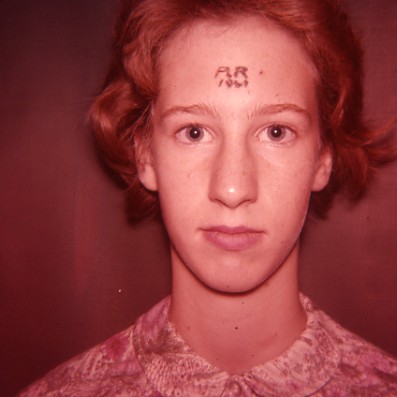
More mysterious faces with characters here.
3:07 PM
12:15 PM
12:14 PM
7:12 AM
6:56 AM
6:50 AM
6:36 AM
The Cult of Mac Blog:
The two-tier net, as feared by advocates of the Net Neutrality amendment, might see ISPs charge content providers -- for example, Apple -- a premium to ensure that the data -- say, from the iTunes Music Store -- get priority connection speeds to the end users, who in turn may have to pay a premium for "enhanced" Internet access to be able to receive that data at a reasonable rate. Everybody wins!
Well, at least everyone working for Comcast, Verizon, or that erstwhile arm of the NSA, AT&T.
6:27 AM
6:22 AM
There is a Woman Standing on a Terrace
There is a woman standing on a terrace. She is
wearing a silk sheath--green I think; as pale as
tea. She is holding a drink so icy that it tastes
like mercury. The Pleiades are overhead and she
is gazing eastward, toward the South China Sea.
How do you know? Because this is after
After all your work is done, after the passing of
so many, the travel that took you nowhere.
After you married and divorced, after your children
defied you, which meant that you had done your job.
Now you are so old that you are free to hope.
Nothing needs to be considered except the root
of your desire, which has become that
crystal sliver of pain that all the doctors told you
was a chronic headache but you suspect might be
the original nerve still pulsing, the ache
that has been with you, always.
So eat breakfast. Pack lightly. Then start your journey
to the deep water city, to the hotel on a hill above Repulse Bay.
What does it matter that you were "never meant to be here?"
What does it matter that when you speak to her she
will answer in French? You will be able to understand her
if you want to and she will know who you are.
Bring her a drink that tastes of melon. And as the sky
hangs out its starry animals--a fish, a bear,
a canny dog--tell her how long it took to form
these constellations. That human beings have named them.
That anything is possible and you, you are the proof.
Eleanor Lerman
6:14 AM
3:32 PM
3:32 PM
1:35 PM
1:32 PM
War Room - Salon.com:
The Bush administration didn't need to go to war to take out Zarqawi.
In fact, there's evidence that the war actually helped keep Zarqawi alive longer -- and certainly presented him with more easily accessible targets -- than would have been the case if the United States had not invaded Iraq. As NBC News reported back in 2004, U.S. military planners drew up plans to take out Zarqawi three times in 2002 and 2003, but the Bush administration killed the plans each time. Why? Because, military officials told NBC, the Bush administration feared that destroying Zarqawi's terrorist camp in Iraq "could undercut its case for war against Saddam."
1:03 PM
11:57 AM
11:45 AM
Eternal orange.
11:22 AM
11:14 AM
11:14 AM
11:47 PM
11:12 PM
BREITBART.COM - DeLay: Partisanship Refreshes Politics:
Republicans, particularly those from Texas, surrounded DeLay after his speech. A few Democrats set aside party politics and crossed the aisle to say goodbye.
Why is this always defined as "party politics"? Maybe only a few said goodbye because he is, by all accounts, a toxic individual who never had a kind word for anyone unless it furthered his own agendas. It isn't always "politics" in the grossest sense—sometimes, people are also assholes.
10:25 PM
9:16 PM
Great review for INVINCIBLE SUMMER in the Charleston City Paper blog. Link
8:36 PM
8:20 PM
"The superheroes of the future will be people who'll challenge this condominium of boredom, and we'll find that our Bonnies and Clydes will emerge to challenge the suburban values."
--J.G. Ballard, JGB News, 1993
"I never said we should shy away from or retreat from technology. I thought that maybe we should embrace these apparently dangerous ideas and run them down, pursue them to the end."
--J.G. Ballard, Blitz, 1987
8:18 PM
Bush Suggests Immigrants Learn English - New York Times:
OMAHA, June 7 — President Bush urged immigrants on Wednesday to learn English and history and civics with the goal of "helping us remain one nation under God."
10:42 PM
9:52 AM
Review of last night's performance of INVINCIBLE SUMMER in the Post and Courier—I don't mean to complain too much, as it is a good review, but they misspelled my name *and* Jean-Michele's name. I know it's a busy festival, but COME ON—getting the names of the artist correct for the review counts as minimal competence, in my book. Here's the review.
9:50 AM
9:18 AM
Boing Boing: Implanting a magnet in your fingertip adds a sixth sense:
This morning's Wired News has a fascinating article on the practice of implanting small, strong rare-earth magnets in one's ring-finger. The result is a kind of "magnet sense" -- people who've had the implant report that they can tell when a wire is live and when they're going through a magnet security-scanner at a store, even when their laptops' hard drives are spinning up.
Quinn Norton of Wired News has had the operation and writes in detail about how it felt, what the problems were, and what she was able to do once it was in place. The most amazing part is that months after the magnet implant fragmented and Quinn lost her "sixth sense," it reassembled itself (magnets tend to draw towards one another) and the sense returned.
9:17 AM
9:12 AM
9:11 AM
the cool hunter - AMANPURI, PHUKET - REVIEW:
I’ve been here for 3 nights at $5,800 per night and just like Paris Hilton, someone else is picking up the tab. The incredibly generous folks at Amanpuri have provided the villa for me to review. This place has more of a boutique feel to it. The first thing that strikes you is the grand black pool positioned in the centre of the lobby, most indulgent. I'm greeted by my host who provides me with a brief tour of the grounds, I'm then escorted by buggy to Villa 20, which is a fair distance from the lobby itself. At the entrance I’m greeted by 4 people - 3 Thais who I later find out are my servants and Antonio, an Italian manager who's been based here for 6 months. My initial thoughts are that perhaps Mick Jagger is standing behind me and none of this is for me.
9:11 AM
9:10 AM
The Escapist - Secret Sauce: The Rise of Blizzard:
In 1992, a revolutionary videogame was released that captured the imaginations of gamers the world over, almost immediately selling half a million copies. One of the first "real- time strategy" games ever made, it tasked the player with building a virtual army by collecting resources and then constructing buildings that would produce their machines of war - all in "real time." While the player was at it, their "enemy" was doing the same, building up to an eventual showdown between the competing armies, after which one side would claim total victory. Whoever had the most machines or the best strategy would win the day. It was like chess combined with backgammon wrapped up in an erector set, and gamers loved it.
That game was not Warcraft.
2:31 AM
3:48 PM
Slashdot | Ballmer Beaten by Spyware:
At a Windows Vista reviewers conference, Microsoft platform president Jim Allchin told a rather amusing story about Steve Ballmer. Apparently, a friend asked him to rid his computer of the spyware and malware that had accumulated over the years. As the story goes, neither Ballmer nor Microsoft's top engineers could fix the infested computer.
12:14 PM
NYC ADVENTURES: VISITING YOUR BOYFRIEND IN JAIL :
by Jessica Delfino
One of the most emotionally exhausting, depressing and time-wasting things I've done in a fortnight is visit my boyfriend at the Manhattan Detention Center, aka "The Tombs" aka Bernard B. Kerik Complex (named after a true criminal) aka jail. Though the process is painstaking and belittling, in other ways it is educational and inspiring in that the visitor's waiting room is a true cultureshock rainbow - and an experience not to be missed just because you have no criminally charged loved ones.
11:36 AM
11:32 AM
All that is required for evil to triumph is for good men to do nothing.
Edmund Burke
11:30 AM
10:58 AM
"Three dogs are put in a room," Warren says, and the rest of us hunker down.
"An architect's dog, a doctor's dog, and an actor's dog. Each dog is a given a pile of bones and told they'll be given one hour."
Chatt blots her lips as Warren continues. "The architect's dog arranges his bones into a Cape Cod saltbox house. The doctor's dog arranges his bones into separate piles by species. The actor's dog --"
"Hand me that eyebrow pencil?" Karen says.
"The actor's dog eats all his bones, fucks the other two dogs, and asks to go home early."
Amy Hempel
2:23 AM
1:54 AM
A fantastic closing--thanks to all who came, and there were a lot of you.
Next up: Invincible Summer!
1:53 AM
1:52 AM
4:11 PM
4:10 PM
A review from the Charleston City Paper here, and the Spoleto blog here. Tonight is your last chance for MONOPOLY!—hope to see you at the show, which I hear is almost sold out.
4:07 PM
5:28 PM
5:19 PM
Piece on MONOPOLY! and INVINCIBLE SUMMER in the Post and Courier. Link
5:18 PM
1:51 AM
Late Fragment
And did you get what
you wanted from this life, even so?
I did.
And what did you want?
To call myself beloved, to feel myself
beloved on the earth.
Raymond Carver
6:55 PM
6:53 PM
The Spoleto Buzz: New Reviews:
From editor Stephanie Barna:
I got to see Mike Daisey's Monopoly! last night. A great show. I love this guy. I saw him last year, and I think I liked this year's monologue even better. Monopoly interweaves a whole host of stories — Tesla and Edison, WalMart, Monopoly, Microsoft — in a way that makes perfect sense. Daisey bemoans: Microsoft Word is like a really intrusive girlfriend. 'Are you sure you spelled that right? Do you want to make a list?.... and wonders why it can't just behave like an "electric typewriter." Funny, poignant, and well worth the price of admission. Jennifer Corley's review should be along soon....
2:57 PM
2:57 PM
12:57 PM
12:40 PM
12:39 PM
Review in the Post and Courier this morning. Link
12:35 PM
10:23 AM
10:05 AM
3:09 AM
2:37 AM
“The cradle rocks above an abyss, and common sense tells us that our existence is but a brief crack of light between two eternities of darkness. Although the two are identical twins, man, as a rule, views the prenatal abyss with more calm than the one he is heading for (at some forty-five hundred heartbeats an hour). I know, however, of a young chronophobiac who experienced something like panic when looking for the first time at homemade movies that had been taken a few weeks before his birth. He saw a world that was practically unchanged — the same house, the same people — and then realized that he did not exist there at all and that nobody mourned his absence. He caught a glimpse of his mother waving from an upstairs window, and that unfamiliar gesture disturbed him, as if it were some mysterious farewell. But what particularly frightened him was the sight of a brand-new baby carriage standing there on the porch, with the smug, encroaching air of a coffin; even that was empty, as if, in the reverse course of events, his very bones had disintegrated.”
Vladimir Nabokov's memoir
Speak, Memory
2:34 AM
:: LAPTOP Magazine • A Night in the Box :::
12 a.m.: Just passed the six-hour mark, and I can already feel myself running on fumes. Spent 45 minutes at the children’s game table, getting way to into a haunted house I-spy game, mumbling angrily to myself at all of the pieces I can't find when I am approached by a gentleman named Shlomo, who is working on a story for The New York Sun. He is writing a story exploring exactly what sort of person would spend the middle of the night browsing the Apple store.
Running into Shlomo over the next three hours, I debate whether he is a figment of my imagination, some kind of magic journalism pixie in a baseball cap. Every time I pass him, I wave and say "Hi," really loudly, like the sleep-deprived lunatic that I am. If The New York Sun story mentions a man in a black hoodie, screaming and flailing his limbs, it's not some over-enthusiastic fanboy pumped about the forthcoming release of OS X Leopard—well, it kind of is, but that’s not the reason he's yelling.
1:16 AM
1:15 AM
Fireflies
Tonight my yard is full of fireflies--
a glitterfest of green, blinking by hundreds,
exactly like last year, when she and I
drove out into the Missouri countryside
to talk about our marriage. It was thick
with greenery. The air was hot and thick,
and we had decided to try and stay together,
though by first light she'd changed her mind again,
and, to be honest, our eleventh hour
hope and promise lacked the weight of truth.
We wandered off the rocky dirt road
over weeds and brambles, through branches
and spiderwebs, and pressed into a clearing,
and it was like a pocket in the darkness
that surrounded us--the misty night
backlit with thousands of glittering fireflies
bettering the stars. It was a mating dance,
and we gazed into a sputtering green sea
of desire--such irresistible beckoning.
Ours was, too--a death-dance of mating,
a slower, indecisive tarantella,
and she asked me never to write about this,
but I knew then that I had nothing to lose,
that at that moment there was nothing I wanted
more than to write about the fireflies.
Richard Newman
1:10 AM
Opening Day in Charleston—the sun is bright, the weather is great and the show is ready to go. Info and tickets are available here, and we'd love to see you at the show.
I did a podcast with the Charleston City Paper yesterday, talking about the shows—you can listen to it here.
9:45 AM
9:33 AM
The Stranger | Seattle | Arts | Feature | The Quiet Patron:
His contribution to the art world is stealthy. He provides studios, at half market rate, to almost 50 artists, in the most improbable place in the world: at the local headquarters for the secretive activities of the FBI, the Department of Homeland Security, the ATF, FEMA, customs, and border enforcement. As a result, Seattle's largest—and growing—artist colony is at the heart of a gated federal compound, in a place where having a glass of wine requires written permission and on-site photography is discouraged for national-security reasons.
2:35 AM
1:22 AM
1:14 AM
Verrrrrrrrrrrry interesting, and until now, unexamined. This article is almost ridiculously sourced, as its implications are profound:
Rolling Stone : Was the 2004 Election Stolen?:
Republicans prevented more than 350,000 voters in Ohio from casting ballots or having their votes counted -- enough to have put John Kerry in the White House.
1:12 AM
1:10 AM
Time Out New York / The not-ready-for-Broadway playwrights:
“I don’t think audiences sitting in Broadway houses are less sensitive or intelligent. They’re just buying a package rather than a piece of art,” she says. “I like theater that doesn’t taste so good while you’re eating it, but you remember it. You’re like, What the hell is this in my mouth? It’s kind of slimy and wet."
Oh, Sheila--is there nothing you won't say?
1:08 AM
1:04 AM
Visual Tour: 20 Things You Won't Like About Windows Vista:
Business and home users will be nonplussed by the blizzard of protect-you-from-yourself password-entry and "Continue" boxes required by the User Account Controls feature, for example. Networking functions and settings are scattered all over the place. The same is true of what Windows XP calls Display Properties. By default, the main menus (you know, File, Edit, View, etc.) are turned off on Windows Vista folders, Internet Explorer 7 and several other programs and utilities that come with Vista. Listing 20 things you won't like about Windows Vista was unfortunately all too easy. The question is: Why couldn't Microsoft see this coming?
7:28 PM
7:25 PM
Picture Postcard From The Other World
Since I don't know who will be reading
this or even if it will be read, I must
invent someone on the other end
of eternity, a distant cousin laboring
under the same faint stars I labored
all those unnumbered years ago. I make you
like me in everything I can -- a man
or woman in middle years who having
lost whatever faiths he held goes on
with only the faith that even more
will be lost. Like me a wanderer,
someone with a taste for coastal towns
sparkling in the cold winter sun, boardwalks
without walkers, perfect beaches shrouded
in the dense fogs of December, morning cafes
before the second customer arrives,
the cats have been fed, and the proprietor
stops muttering into the cold dishwater.
I give you the gift of language, my gift
and no more, so that wherever you go
words fall around you meaning no more
than the full force of their making, and you
translate the clicking of teeth against
teeth and tongue as morning light spilling
into the enclosed squares of a white town,
breath drawn in and held as the ocean
when no one sees it, the waves still,
the fishing boats drift in a calm beyond sleep.
The gift of sleep, too, and the waking
from it day after day without knowing
why the small sunlit room with its single bed,
white counterpane going yellow, and bare floor
holds itself with such assurance
while the flaming nebulae of dust
swirl around you. And the sense not to ask.
Like me you rise immediately and sit
on the bed's edge and let whatever dream
of a childhood home or a rightful place
you had withdraw into the long shadows
of the tilted wardrobe and the one chair.
Before you've even washed your face you
see it on the bedoilied chiffonier -- there,
balanced precariously on the orange you bought
at yesterday's market and saved for now.
Someone entered soundlessly while you slept
and left you sleeping and left this postcard
from me and thought to close the door
with no more fuss than the moon makes.
There's your name in black ink in a hand
as familiar as your own and not
your own, and the address even you
didn't know you'd have an hour before
you got it. When you turn it over,
there it is, not the photo of a star,
or the bright sailboats your sister would
have chosen or the green urban meadows
my brother painted. What is it? It could be
another planet just after its birth
except that at the center the colors
are earth colors. It could be the cloud
that formed above the rivers of our blood,
the one that brought rain to a dry time
or took wine from a hungry one. It could
be my way of telling you that I too
burned and froze by turns and the face I
came to was more dirt than flame, it
could be the face I put on everything,
or it could be my way of saying
nothing and saying it perfectly.
Philip Levine
7:21 PM
7:13 PM
Great preview piece today in the Charleston City Paper about MONOPOLY! and INVINCIBLE SUMMER--read it here.
9:13 AM
8:55 AM
Is It Raining Aliens? - Popular Science:
Specifically, Louis has isolated strange, thick-walled, red-tinted cell-like structures about 10 microns in size. Stranger still, dozens of his experiments suggest that the particles may lack DNA yet still reproduce plentifully, even in water superheated to nearly 600˚F. (The known upper limit for life in water is about 250˚F.) So how to explain them? Louis speculates that the particles could be extraterrestrial bacteria adapted to the harsh conditions of space and that the microbes hitched a ride on a comet or meteorite that later broke apart in the upper atmosphere and mixed with rain clouds above India. If his theory proves correct, the cells would be the first confirmed evidence of alien life and, as such, could yield tantalizing new clues to the origins of life on Earth.
8:53 AM
8:51 AM
I lost my engagement ring -- and secretly replaced it at Wal-Mart - Salon.com Life:
When you catch a fish, clean it carefully. Look for the ring. Then cook it over an open flame and eat it by firelight.
Maybe one day you'll catch a fish and inside the fish will be the ring. In fact, you could make it a tradition; you could go fishing there every year, and that will remind you and your husband of your early happiness and frivolity and your early mistakes, and it will become a tradition that will help your friendships endure. This innocent mistake thereby becomes a lifelong gift.
As long as you go fishing, there will always be a chance that you will find the ring. And that will serve as a metaphor for your marriage: Every time you open yourself up to possibility, there is a chance that you will find something precious you thought you had lost. Every time you cast a line, there's a chance that you'll reel in a miracle in the belly of a fish.
8:47 AM
8:42 AM
Take This Internship and Shove It - New York Times:
I was an unpaid intern at a newspaper from March 2002, my senior year, until a few months after graduation. I took it for granted, as most students do, that working without pay was the best possible preparation for success; parents usually agree to subsidize their offspring's internships on this basis. But what if we're wrong?
What if the growth of unpaid internships is bad for the labor market and for individual careers?
8:40 AM
6:20 AM
6:17 AM
6:08 AM
6:07 AM
Dilettante Archives