4:55 PM
TONIGHT! ONE NIGHT ONLY!
Monopoly!
FirstWorksProv Festival
Providence, RI
RISD Auditorium
September 30th at 8pm
Details
5:00 PM
4:55 PM
9:20 AM
8:59 AM
The New York Observer Media Mob: "Harvard Is Everywhere": 02138 Launch Party:
At the Core Club launch party for 02138--the magazine dedicated to the unity of the Harvard experience--attendees fell neatly into separate categories. Magazine staffers walked around wearing square pins affixed to their lapels, with their names and "02138" engraved on them. Their flacks hovered, making sure that Bill O'Reilly was ushered in with the appropriate amount of warmth ("Bill!").
Members of the magazine's "Harvard 100"--a list mixing Harvard College dropouts with Harvard Business School grads with quickie Kennedy School students such as O'Reilly--seemed bemused at the attention, and at the two flat-screen televisions beaming their names, occupations, list numbers, and photographs in a constant loop. Tall, thin, beautiful women sipped white wine and didn't discuss where they'd gone to school. Men in dark suits said they were in "private equity." "All the girls here are 6 feet tall and dressed to kill!" one of them said.
"Harvard is everywhere," said Dan Loss, one of the magazine's co-founders. Loss was roommates with Bom Kim (listed as President & Founder on the masthead), and both graduated in from Harvard College in 2000. "We want to cover the stories and personalities that relate to Harvard alumni lives today," Loss said. That means Ned Lamont (like the library!), Studio 54 scion Jennifer Rubell ("equally comfortable discussing a Francis Alÿs video work and a recipe for naeng myun, Korean cold noodles"), and lifestyle items about wine and watches.
The message is that Harvard and its alumni are some sort of superhuman brand, out to save the world and wear expensive clothes while doing it. Becoming the brand takes time, and lots of money.
8:54 AM
2:12 AM
2:11 AM
2:10 AM
2:05 AM
4:50 PM
decor8: DIY Refrigerator Chalkboard:
4:37 PM
4:35 PM
4:33 PM
9:44 AM
Histriomastix: Booing in the theater:
"The theatre loves ghosts as much as people love ghost stories. So whether or not one can say with any credibility what they are, ontologically speaking, one can try to account for their production through theatre. Theatre constantly encounters the dead, and the appeal as well as the doubtful status of ghosts goes to the heart of theatre's appeal. Ghosts, that is, pervade theatre more thoroughly than any particular instance of staging, to the extent that theatre itself is a ghostly place in which the living and the dead come together in a productive encounter."
Alice Rayner, Ghosts: death's double and the phenomena of theatre
8:36 PM
8:25 PM
The other terror anniversary:
One week ago, on the fifth anniversary of the Sept. 11 terror attacks, the nation was treated to a veritable orgy of remembrance in the national media: the networks, cable, and the press all were busy regaling us with reminders of the Islamist radicals who attacked us that day. Politicians rather predictably joined in, most notably George W. Bush, who used what should have been a solemn occasion to bash Democrats and promote his own agenda.
In rather stark contrast, today also marks the fifth anniversary of the terrorist attacks that followed -- the anthrax letters mailed to a variety of media figures and liberal senators, killing five people and convulsing the nation with fear of similar attacks elsewhere for several weeks afterward.
But there are no network specials planned. No wreath-laying by the president. No ABC docudramas blaming the Clinton administration with made-up sequences. No discussion of the implications of these attacks in the "war on terror."
The last of these, really, is quite telling -- because the implications are profound. And until we confront them, our "war on terror" will remain little more than the political marketing campaign that it has been ever since 9/11.
8:24 PM
8:24 PM
la Ketch: try to remember:
The thing I’m noticing is this new propensity towards choosing defeat. It’s not something that I’ve always done. It’s come to me in adulthood and it’s not something I welcome. It has to do partially with not being able to STAND BEING IN LIMBO. I’ve talked about this difficulty many times on this blog. I just have so little patience and I feel so uncomfortable when I don’t have control over a situation and I’m waiting for life to hand me my fate. I feel so uncomfortable in these situations that it is sometimes much easier for me to just accept defeat. To concede, like John Kerry, too soon. It’s easier to do this because then, at least I know what I’m dealing with. I can move on. I may still be waiting for an answer but I know in my heart that I’ve lost, I’m not going to get what I want and then, of course I don’t. I don’t get what I want and I feel that in the end it’s because I didn’t deserve it. It wasn’t my fate.
Sorry, I’m going to try and reel this in a bit.
So the thing I’ve been struggling with is hope and faith.
8:20 PM
8:12 PM
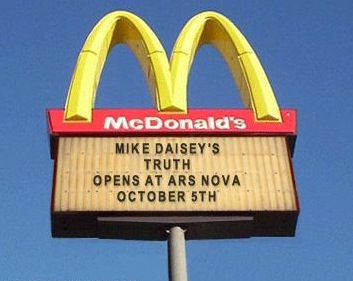
Playbill News: Mike Daisey to Tell the Truth, the James Frey Way, Oct. 5 at Ars Nova:
Mike Daisey will premiere his new monologue Truth (the heart is a million little pieces above all things) at Ars Nova in Manhattan on Oct. 5.
As the subtitle hints, the piece will address the rise and fall of disgraced author James Frey, whose best-selling memoir "A Million Little Pieces" turned out to be largely fabricated, leading Oprah Winfrey, a one-time supporter, to dress him down on national television.
The solo will also look at J.T. LeRoy, another famous writer ("The Heart Is Deceitful Above All Things"), who, it was revealed, did not exist, but was a hoax perpetrated by author Laura Albert. Savannah Knoop, half sister to Geoffrey Knoop, Albert's former partner, posed as LeRoy's public persona.
8:01 PM
8:00 PM
7:59 PM
Andrew Sullivan | Legalizing Tyranny:
How do I put this in words as clearly as possible. If the U.S. government decides, for reasons of its own, that you are an "illegal enemy combatant," i.e. that you are someone who
"has engaged in hostilities or who has purposefully and materially supported hostilities against the United States,"
they can detain you without charges indefinitely, granting you no legal recourse except to a military tribunal, and, under the proposed bill, "disappear" and torture you. This is not just restricted to aliens or foreigners, but applies to U.S. citizens as well. It can happen anywhere in the U.S. at any time. We are all at potential risk.
Whatever else this is, it is not a constitutional democracy. It is a thinly-veiled military dictatorship, subject to only one control: the will of the Great Decider. And the war that justifies this astonishing attack on American liberty is permanent, without end. And check the vagueness of the language: "purposefully supported" hostilities. Could that mean mere expression of support for terror? Remember that many completely innocent people have already been incarcerated for years without trial or any chance for a fair hearing on the basis of false rumors or smears or even bounty hunters. Or could it be construed, in the rhetoric of Hannity and O'Reilly, as merely criticizing the Great Decider and thereby being on the side of the terrorists?
7:59 PM
7:59 PM
"Remember that it is forever. The face will always be there to be stamped upon. The heretic, the enemy of society, will always be there, so that he can be defeated and humiliated over again. Everything that you have undergone since you have been in our hands - all that will continue, and worse. The espionage, the betrayals, the arrests, the tortures, the executions, the disappearances will never cease. It will be a world of terror as much as a world of triumph.
The more the Party is powerful, the less it will be tolerant; the weaker the opposition, the tighter the despotism. Goldstein and his heresies will live forever. Every day, at every moment, they will be defeated, discredited, ridiculed, spat upon - and yet they will always survive. This drama that I have played out with you during seven years will be played out over and over again, generation after generation, always in subtler forms. Always we shall have the heretic here at our mercy, screaming with pain, broken-up, contemptible - and in the end utterly penitent, saved from himself, crawling to our feet of his own accord.
That is the world that we are preparing, Winston. A world of victory after victory, triumph after triumph after triumph: an endless pressing, pressing, pressing upon the nerve of power. You are beginning, I can see, to realize what that world will be like. But in the end you will do more than understand it. You will accept it, welcome it, become part of it,"
- O'Brien, the party operator, from George Orwell's "Nineteen-Eighty-Four."
7:54 PM
7:28 PM
WARRIOR OF THE FUTURE!
10:48 AM
8:54 AM
12:42 AM
12:41 AM
12:41 AM
12:40 AM
12:40 AM
12:39 AM
12:38 AM
12:37 AM
Sykes’ Blackout-Drunk Memoir Kicks Off Post-Frey Rehab-Lit Frenzy: Moyers, Dukakis, David Carr Dredge Up Grotty Days and Nights; Reconciling Conflict of Author Ego With 12-Step Humanity:
"One of the things is that—who was it? Shakespeare, somebody; no! I don’t want to go there, I don’t want to quote Shakespeare—we’re all wardens of our own past. There is a tendency to be either the hero or antihero of your own narrative. And in that sense, all misdemeanors become felonies. And random acts of kindness become shimmering examples of the narrator’s own humanity. And I think that’s sort of embedded in people. And I think you gotta watch it. But I say that as somebody who hasn’t typed a word.”
10:41 PM
7:12 PM
1:48 AM
1:43 AM
1:42 AM
1:41 AM
1:41 AM
1:40 AM
1:38 AM
1:36 AM
1:33 AM
1:33 AM
10:32 AM
10:31 AM
Spy Agencies Say Iraq War Worsens Terror Threat - New York Times:
WASHINGTON, Sept. 23 — A stark assessment of terrorism trends by American intelligence agencies has found that the American invasion and occupation of Iraq has helped spawn a new generation of Islamic radicalism and that the overall terrorist threat has grown since the Sept. 11 attacks.
The classified National Intelligence Estimate attributes a more direct role to the Iraq war in fueling radicalism than that presented either in recent White House documents or in a report released Wednesday by the House Intelligence Committee, according to several officials in Washington involved in preparing the assessment or who have read the final document.
The intelligence estimate, completed in April, is the first formal appraisal of global terrorism by United States intelligence agencies since the Iraq war began, and represents a consensus view of the 16 disparate spy services inside government. Titled “Trends in Global Terrorism: Implications for the United States,’’ it asserts that Islamic radicalism, rather than being in retreat, has metastasized and spread across the globe.
An opening section of the report, “Indicators of the Spread of the Global Jihadist Movement,” cites the Iraq war as a reason for the diffusion of jihad ideology.
The report “says that the Iraq war has made the overall terrorism problem worse,” said one American intelligence official.
10:31 AM
3:20 AM
3:17 AM
3:16 AM
TidBITS: The More Things Change...:
Since I first started using computers - a 4K Commodore PET at the age of 11, followed by an Apple IIc and an early VAX running a Version 7 Unix - I've lamented that the technology wasn't ready for prime time. The main reason I got into technical writing - then software testing, then development, consulting, editing, TidBITS, and Internet-based projects - was because it wasn't simple enough to make computers do what I wanted. Instead, I found myself fiddling, fixing, explaining, programming, enabling, and helping other people. I believed in the potential of information technology and felt I could make a positive contribution by helping other people tap into it: the glitches and problems and stumbling blocks were just bumps in the road - growing pains, right? But when my mother retypes a document because she can't find the original, a TidBITS Talk thread deteriorates into a discussion of command line switches, I utterly destroy a brand-new Mac mini by clicking its Printer Sharing checkbox, a live music recording is ruined by an invisible background process, or a disabled friend feels she has no choice but to buy a new printer because her old one suddenly stopped working... I just want to scream. It's the twenty-first century: why are we still mired in this stuff?
I've long said that we'll know computers have arrived when there's no need for people like me. The fact so many everyday people have to turn to interpreters, consultants, experts, classes, training, and technophiles to use their computers and put them to work, to me, represents a fundamental failure of the industry. It seems people like me will be needed for a long, long time. Many years ago, Microsoft held a press event to announce a significant expansion of the company's technical support offerings; the late technology writer Cary Lu scored a zinger - and made a profound point - by politely asking if Microsoft anticipated its products would one day reach a level where users would require fewer support resources. Along the same lines, I remain flabbergasted Apple has installed Genius Bars in its retail stores. To me, Genius Bars don't say "Apple's your friend and is here to help!" but instead, "Everyone knows Apple makes the easiest-to-use computers, but only a genius can figure them out."
3:11 AM
2:17 AM
things i know for sure: The Lovely Bones:
I am reading this book right now.
It is a terrible book.
But still I am reading it.
I am still reading it so much, that I will not allow myself to read another book until I finish reading this terrible book. Would you like to know how terrible it is? Here is the opening paragraph:
My name was Salmon, like the fish; first name, Susie. I was fourteen when I was murdered on December 6, 1973. In newspaper photos of missing girls from the seventies, most looked like me: white girls with mousy brown hair. This was before kids of all races and genders started appearing on milk cartons or in the daily mail. It was still back when people believed things like that didn't happen.
As soon as I read that opening paragraph, I knew, this is going to be a bad book. But here it is, right now today, and I am on page 351 of this 373 page book, and I can not--though I have considered it many times--just toss it on the street and get the weight of its badness out of my bag. It's preposterous. I pull the book out on the subway filled with shame, because I know there is at least one other person on the subway who has read the book and they probably loved it and I don't want them to think we are in any way in cahoots, and I also know that there is probably at least one person on that subway who has started to read this book and has hated it so much they did what I could not, and put it down. For these reasons I try to adopt a look of neutral disgust while reading this book on the subway.
2:16 AM
12:58 AM
10:08 PM
8:46 PM
8:45 PM
Congratulations!
5:52 PM
4:44 PM
Slashdot | Wal-Mart Threatens Studios Over iTunes Sales:
Walmart braggs about its associates being stock holders. They pay a dividend far lower than may be returned on Government Bonds or from even a simple CD at the bank. All of this would appear to be a company with marginal earnings. Actually Walmart finances its stores through the various Industrial Development Boards. They don't own the stores or even pay for them. Walmart then demands tax free status to open up in a town. As such they don't even pay to educate the next generation of kids to work in their stores or be their customers. They factor their inventory on a 60 day delayed after sale payment schema. All of this said you can do your earnings calculations on a company that has no investment or risk and is making markup on all sales. The company then has an inventory turn rate of about 90 times a year with a net (after all those stinking worthless employees -- for effect) markup on each sale of nearly 40%. Doing the simple math here they are a company earning about 90 * 40% a year on an cost basis against an investment that is not theirs and is so low that ROI is impossible to do anything but estimate. This means that the company is earning about 3600% against 100% of the entire investment of all parties in the store. They against their part which may be even less than 10% of that are earning at least 36,000%.
The upshot of this is that they build massive devices in the supply chain to scrape off this profit and avoid stockholders, tax entities and other factors that the are obligated to pay.
To be blunt capitalism is where investors get paid for earnings. That is what Walmart will never do. They are structured to defraud their stockholders.
4:43 PM
4:42 PM
4:41 PM
4:39 PM
The Man Who Said No to Wal-Mart:
What struck Jim Wier first, as he entered the Wal-Mart vice president's office, was the seating area for visitors. "It was just some lawn chairs that some other peddler had left behind as samples." The vice president's office was furnished with a folding lawn chair and a chaise lounge.
And so Wier, the CEO of lawn-equipment maker Simplicity, dressed in a suit, took a seat on the chaise lounge. "I sat forward, of course, with my legs off to the side. If you've ever sat in a lawn chair, well, they are lower than regular chairs. And I was on the chaise. It was a bit intimidating. It was uncomfortable, and it was going to be an uncomfortable meeting."
It was a Wal-Mart moment that couldn't be scripted, or perhaps even imagined. A vice president responsible for billions of dollars' worth of business in the largest company in history has his visitors sit in mismatched, cast-off lawn chairs that Wal-Mart quite likely never had to pay for.
4:35 PM
4:34 PM
4:34 PM
FairPlay: coming to a classroom near you? - The Unofficial Apple Weblog (TUAW):
The #1 request, though, completely floored me: DRM. In fact, it is so in-demand that it has apparently been the deal-breaker for the majority of universities that had been approached about iTunes U and refused. That revelation literally left me speechless. It's one thing to realize that not everyone is as rabidly anti-DRM as I am, but DRM in the classroom flies in the face of not only my general IP position, but everything I like to believe about academic freedom. I've heard of cases, of course, where universities have claimed faculty-developed course materials as work-for-hire and property of the university, but that's never been the case at any university I've been associated with and I've generally understood that those were fringe cases. The idea that a significant number of universities would refuse to participate in iTunes U because of a lack of DRM is just...staggering.
Of course, that doesn't mean that FairPlay or any other DRM will find its way into iTunes U. But if Apple is dedicated to the project and the one of the biggest stumbling blocks seems to be DRM, well, you do the math.
And the worst part? If FairPlay does show up it won't be Apple's fault, or even the RIAA's. The universities will have done it to themselves.
4:18 PM
10:41 PM
10:40 PM
10:39 PM
10:38 PM
4:22 PM
1:24 AM
1:18 AM
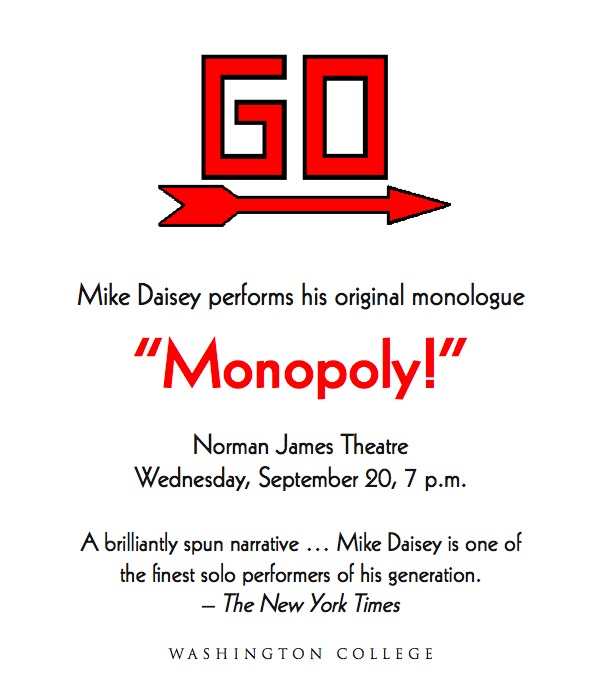
I'll be at Washington College this evening, September 20th, performing MONOPOLY! at the Norman James Theater.
I'm being brought by the literary house, so tickets are covered by the college and are free—so take advantage of that, and buy me a drink at the bar after the show.
A full press release with details and links can be found here...come on by!
11:44 AM
12:42 AM
Oprah Seeks To Avoid 2008 Draft - September 19, 2006:
Talk show host threatens legal action over fan's campaign
SEPTEMBER 19--If nominated, Oprah Winfrey will serve...a cease and desist letter. Lawyers for the talk show host are threatening legal action against a retired Kansas City teacher who has mounted a one-man campaign urging the star to run for president in 2008. The entertainer does not want Patrick Crowe, 69, to use her name and image, according to a letter from Winfrey attorney Jerry Glover, a copy of which you'll find below. Through counsel, Winfrey contends that Crowe's use of the Oprah name "falsely implies" that she and her firm, Harpo, Inc., sponsor or endorse the campaign. Along with a self-published book urging a Winfrey White House bid, Crowe has established a web site--Oprah08.net--to push her candidacy. Crowe, a fan who believes a future Winfrey campaign would change the face of American politics, also drives a 1959 Ford with the license plate OPRAH8 and maintains a toll-free hotline, 1-866-OPRAH-08.
7:34 PM
12:55 PM
12:53 PM
11:26 PM
11:23 PM
Podcasting Professor Ordered to Stop:
According to the Chronicle of Higher Education, North Carolina State University Communications Professor Robert Schrag has been ordered to stop selling his lectures to students and the public as podcasts for $2.50 a pop.
"If a student doesn't want to be there, I don't want them there," Mr. Schrag said. "I want them to go away because they degrade the educational experience for the other students around them."
This raises an interesting issue about academic freedom. At virtually any university in the country, professors own the rights to all of their lecture materials, but podcasting makes it possible to virtually attend a class you don't pay tuition for. The university's crackdown speaks to a huge worry of theirs -- the erosion of higher education by greater access to it.
It is a legitimate worry, too. Each student paying thousands of dollars per semester to partially pay Schrag's salary is underwriting the cost of that podcast for the rest of us. But on the other hand, he has the right to do whatever he wants with his thoughts. How is this different from him maintaining a Web site with notes from his lectures or writing a book in the area of his expertise?
11:22 PM
Big Brother is shouting at you | the Daily Mail:
Big Brother is not only watching you - now he's barking orders too. Britain's first 'talking' CCTV cameras have arrived, publicly berating bad behaviour and shaming offenders into acting more responsibly.
The system allows control room operators who spot any anti-social acts - from dropping litter to late-night brawls - to send out a verbal warning: 'We are watching you'.
9:38 AM
1:08 AM
Burned Out:
I met Rockstar at Burning Man, an eight-day art festival in northwestern Nevada's Black Rock Desert. Some describe Burning Man as a utopia. Others call it heaven. Even though it only exists for one week out of the year, many call it home. I was invited to the festival by five young men—Jesse, Maverick, Griff, Coyote, and Gidget (more on his name later)—all aspiring corporate types in their mid 20s. They were "looking for something not found in the corporate world," Maverick told me.
Based on their experiences, the corporate world lacks luxury RVs, suitcases full of drugs, and the time and space to "explore some sexual boundaries," Maverick had explained in an e-mail to The Stranger. He wanted to invite a writer to join them, someone who could document their journey of self-discovery.
I know people who go to Burning Man every year, but I've never felt compelled to attend because I think Nevada is an arid shit hole and because I suck at art. But I am The Stranger's Worst Enemy, so my editors gleefully volunteered me to fill the open slot in the RV.
"You might as well beat them to the punch and rape yourself," said my mother when I mentioned my travel plans.
11:45 PM
11:45 PM
What's Really Propping Up The Economy:
Since 2001, the health-care industry has added 1.7 million jobs. The rest of the private sector? None
If you really want to understand what makes the U.S. economy tick these days, don't go to Silicon Valley, Wall Street, or Washington. Just take a short trip to your local hospital. Park where you don't block the ambulances, and watch the unending flow of doctors, nurses, technicians, and support personnel. You'll have a front-row seat at the health-care economy.
For years, everyone from politicians on both sides of the aisle to corporate execs to your Aunt Tilly have justifiably bemoaned American health care -- the out-of-control costs, the vast inefficiencies, the lack of access, and the often inexplicable blunders.
But the very real problems with the health-care system mask a simple fact: Without it the nation's labor market would be in a deep coma. Since 2001, 1.7 million new jobs have been added in the health-care sector, which includes related industries such as pharmaceuticals and health insurance. Meanwhile, the number of private-sector jobs outside of health care is no higher than it was five years ago.
11:23 PM
6:29 PM
12:05 PM
5:08 AM
Things I Don't Understand - Part 3:
What's the deal with gay men and Judy Garland? I've asked, I've read, I've researched, and I can't seem to find an answer that couldn't easily be applied to numerous other stars, some of them even more appropriate. The standard response is the she had a rough life and still maintained her poise and dignity, or something to that effect. 1) That's not specific. The same thing could be said about a million other people. 2) It's not true. She hit stardom at an early age, had all the sex, drugs, and booze anybody could ever want, never had to deal with crippling poverty, and as far as poise and dignity goes, check out her later Christmas specials where she's about as sane and sober as a naked toothless Margot Kidder.
4:33 AM
2:11 AM
Language Log: Microsoft Redefines "Genuine":
Microsoft has a new advertising campaign focussing on their efforts to reduce "piracy" of their software, that is, the sale of their software in violation of license agreements. You can read about it here. They call this campaign the "Microsoft Genuine Software Initiative" and use the term "genuine" in contexts such as this:
In the month of May, 38,000 customers purchased genuine Windows software after being notified that they had been sold non-genuine software. Customers recognize that the value of genuine is greater than ever.
I find this use of "genuine" to be most peculiar. An unlicensed copy of Microsoft Windows is perfectly genuine. It has exactly the same functionality as a licensed copy and was made by the same company. In contrast, if you buy a "Rorex" watch, it is not genuine because it is not made by the Rolex company and does not have the aesthetics, functionality, and resale value of a real Rolex. What Microsoft is concerned about is the software equivalent of buying a refrigerator that fell off the truck. The problem is not that you are not getting the real thing - the problem is that the transaction is not legal.
I suspect that Microsoft is attempting to redefine "genuine" because it has had a hard time getting sympathy for its actual complaint, namely unlicensed distribution.
11:28 PM
11:08 PM
8:48 PM
7:46 PM
7:45 PM
7:44 PM
7:31 PM
List of exclamations used by Captain Haddock - Wikipedia, the free encyclopedia:
The comic book series The Adventures of Tintin, by the Belgian artist Hergé, is one of the most popular cartoon creations of the 20th Century, with as many as 100 million Tintin books in print. One of the secrets of its appeal is the cast of eccentric and charming personalities who surround the rather bland Tintin, providing much-needed comic relief. Chief among these colorful figures is Tintin's sidekick, the lovable curmudgeon Captain Haddock. The fearless captain is game for every adventure, but is frequently nearly undone by his temper, or his drinking.
A particular trademark of Captain Haddock is his colourful exclamations that he hurls out every time he gets in a rage.
At the time Captain Haddock was first introduced, just before the Second World War, his manners presented a moral problem to Hergé. As a sailor, Haddock ought to have a very colourful language. Yet, as he was to appear in a Catholic children's magazine, he obviously was forbidden to use any swearwords. The solution came one night when Hergé overheard a political argument between two passers-by in the street. In the heat of the discussion one of the persons became so enraged that he lost his composure for a moment and started yelling at his companion "You... You... You peace-pamphlet yourselves".[citation needed] This was the solution Hergé sought: what if the captain would use strange or difficult words that were not offensive in themselves, but would hurl them out as if they were very strong cusswords...? (This would also add a comical note by portraying the captain as a pseudo-intellectual who loves to use difficult words without really knowing what they mean.)
The idea took form quickly and in his first anger-scene the captain storms towards a party of Bedouin raiders yelling expressions like 'Hydromeduse' (a form of jellyfish), 'troglodyte' (cave-dweller) and 'ectoplasm'. (The bedouins immediately take flight, but from the Foreign Legion appearing behind the captain's back.) The trick with the false swearwords proved successful and was a mainstay in future books. Consequently Hergé actively started collecting difficult or dirty-sounding words for use in the captain's next anger attacks and on occasion even searched dictionaries to come up with inspiration. This went so far that in the end Hergé started to resemble Haddock in using words (at least in his writings)- he only half understood himself.
This page lists almost all of the exclamations used by Captain Haddock as curses and insults in the translated, English version of Hergé's Tintin series (with definitions where possible).
7:28 PM
7:24 PM
It's a big day—it's opening day. But before I can get to the theater, I have to interview this guy in midtown.
Once that is taken care of, and provided he doesn't take a gun out of his leg and shoot me with it, the new monologue gets a sneak preview this evening. It'll be the first time I perform in aloud, and that means it will be forming in the air even as I create it--it's a harrowing and joyous thing that utterly consumes me, and I find myself wondering earnestly, "I wonder what I'm going to say up there," an effect that I would guess doesn't happen to that many other performers.
I wouldn't trade this for anything, though I've been given the opportunity to do so time and time again. Not for anything.
See you on the other side,
md
10:42 AM
10:36 AM
1:24 AM
The Sex Appeal of Big-Ass Dogs:
Interviewer: In many ways Brian De Palma seems like an ideal choice as director of The Black Dahlia.
James Ellroy: Yeah, he’s a sexual-obsession guy. He’s fucked-up about women like me. I’m really fucked-up about women. But you know what? I dig it. Are you fucked-up about women?
Interviewer: Pretty much, yeah.
James Ellroy: It’s a blast. Scared, tormented. You want mom, you want a hooker. One of the things I’ve come to realize is you’ve got to get a woman with a dog. I got divorced recently, and I had a deep, dark, obsessive thing with a woman in San Francisco. But I want the new woman, whoever she is, to have a dog.
Interviewer: Any type of dog in particular?
James Ellroy: A big-ass, good-looking dog. Like an Akita or a pit bull, so when the woman’s out of the bed you can curl up with the dog, talk to the dog about the woman.
Interviewer: Not one of those tiny dogs people carry around?
James Ellroy: No. I want a pit. A pit that uses some nigger voice. Says, “Hey Ellroy, let’s get some bitches.” A big dog.
8:44 PM
Fear of flying | Welcome aboard | Economist.com:
The flight attendants are now pointing out the emergency exits. This is the part of the announcement that you might want to pay attention to. So stop your sudoku for a minute and listen: knowing in advance where the exits are makes a dramatic difference to your chances of survival if we have to evacuate the aircraft. Also, please keep your seat belt fastened when seated, even if the seat-belt light is not illuminated. This is to protect you from the risk of clear-air turbulence, a rare but extremely nasty form of disturbance that can cause severe injury. Imagine the heavy food trolleys jumping into the air and bashing into the overhead lockers, and you will have some idea of how nasty it can be. We don't want to scare you. Still, keep that seat belt fastened all the same.
Your life-jacket can be found under your seat, but please do not remove it now. In fact, do not bother to look for it at all. In the event of a landing on water, an unprecedented miracle will have occurred, because in the history of aviation the number of wide-bodied aircraft that have made successful landings on water is zero. This aircraft is equipped with inflatable slides that detach to form life rafts, not that it makes any difference. Please remove high-heeled shoes before using the slides. We might as well add that space helmets and anti-gravity belts should also be removed, since even to mention the use of the slides as rafts is to enter the realm of science fiction.
8:20 PM
8:15 PM
Is SketchFest a Prelude to a Fringe Festival?:
Founded in 1999, Seattle SketchFest is the closest thing we have to a fringe festival�and it's growing. In a book-happy, theater-happy town that couldn't sustain a Bookfest or a fringe festival, Seattle's SketchFest is small, but actually growing. According to artistic director Val Bush, in 2003, 400 people attended; in 2005, 800. Earned income has grown from $9,000 in 2001 to $15,000 in 2005 and donations and grants have gone from $1,000 in 2003 to $8,000 thus far in 2006.
Managing director Ian Bell attributes the success to lean staff: "Small-cell arts organizations are just more nimble. Besides the volunteers and board, we have three staffers and everybody knows what's going on; fewer things fall through the cracks." And fundraising: "We put as much effort into it as the festival, if not more." And fiscal conservatism: "Every budget is based on what we have in the bank. We just don't ever, ever spend money we don't already have."
Seattle can't technically miss a well-designed fringe festival�it never had one. But we should want the festival that wasn't: lean, nimble, financially sane, designed to attract successful touring shows, and scheduled for September, the end of the Canadian circuit. SketchFest is already leading the way.
(Side note: I founded this festival in 1999, and I couldn't be more proud of the incredible work Val, Heidi and Ian have put in�they've taken what I started with them and really made it an institution�it was the first sketch comedy festival in North America, and it is wonderful to see them get the respect and attention they deserve in the press�check out this great piece in Seattle Magazine here.
The second weekend of SketchFest is this weekend, so if you're in Seattle, get yourself to the theater! Details.)
5:32 PM
2:02 PM
11:47 AM
Wired News: NSA Bill Performs a Patriot Act:
A bill radically redefining and expanding the government's ability to eavesdrop and search the houses of U.S. citizens without court approval passed a key Senate committee Wednesday, and may be voted on by the full Senate as early as next week.
By a 10-8 vote, the Senate Judiciary Committee approved SB2453, the National Security Surveillance Act (.pdf), which was co-written by committee's chairman Sen. Arlen Specter (R-Pennsylvania) in concert with the White House.
Specter's bill concedes the government's right to wiretap Americans without warrants, and allows the U.S. Attorney General to authorize, on his own, dragnet surveillance of Americans so long as the stated purpose of the surveillance is to monitor suspected terrorists or spies.
Lisa Graves, senior legislative counsel for the American Civil Liberties Union, called the bill "stunning."
"The administration has taken their illegal conduct in wiretapping Americans without court orders, in violation of the Foreign Intelligence Surveillance Act and the Constitution, and used it as springboard to not only get FISA changed to allow the Terrorist Surveillance Program, but to actually, going forward, not give protections to Americans' privacy rights," Graves said.
Jim Dempsey, the policy director for the more moderate Center for Democracy and Technology, described the bill's passage out of committee as "light years or miles beyond the Patriot Act."
"What started out as Sen. Specter wanting to rein in the president's program has turned on its head and is now not just a legislative ratification of the program, but an expansion of warrantless wiretapping of Americans," Dempsey said. "It would allow the NSA to turn its vacuum cleaners on even domestic phone calls and e-mails of citizens.
"They do all of this in Alice in Wonderland fashion by defining all kinds of categories of surveillance to be not surveillance," said Dempsey.
11:22 AM
11:16 AM
5:44 PM
3:49 PM
1:24 PM
Professor of Arabic barred from returning to U.S. from Canada:
Mohammad Ramadan Hassan Salama's troubles began in June, when he arrived in Canada for what he thought was a two-day stay to change his temporary scholar visa, which was due to expire. He planned to exchange it at the U.S. Consulate in Toronto for the more coveted O-1 visa, granted only to those with extraordinary ability in sciences, arts, education, business or athletics. By law, he had to go outside the country to get the visa.
But the Egyptian-born academic got a rude awakening June 20 when a consular official, without explanation, stamped "canceled'' on his temporary visa and refused to issue another visa. Instead, Salama said, he was fingerprinted, questioned and told he could not return to the United States until he received security clearance.
"It was just a shock for me,'' he said by phone on Monday. "It is very Kafkaesque. They just say, 'We will contact you.' I am Egyptian, and Egypt is a very hot country right now that has produced terrorists. They disregarded my Ph.D., my scholarship. My marriage, my kids were blindly disregarded, and I was told I could not come back."
1:23 PM
12:41 PM
Bush Tells Group He Sees a 'Third Awakening' - washingtonpost.com:
Bush told a group of conservative journalists that he notices more open expressions of faith among people he meets during his travels, and he suggested that might signal a broader revival similar to other religious movements in history. Bush noted that some of Abraham Lincoln's strongest supporters were religious people "who saw life in terms of good and evil" and who believed that slavery was evil. Many of his own supporters, he said, see the current conflict in similar terms.
"A lot of people in America see this as a confrontation between good and evil, including me," Bush said during a 1 1/2 -hour Oval Office conversation on cultural changes and a battle with terrorists that he sees lasting decades.
12:33 PM
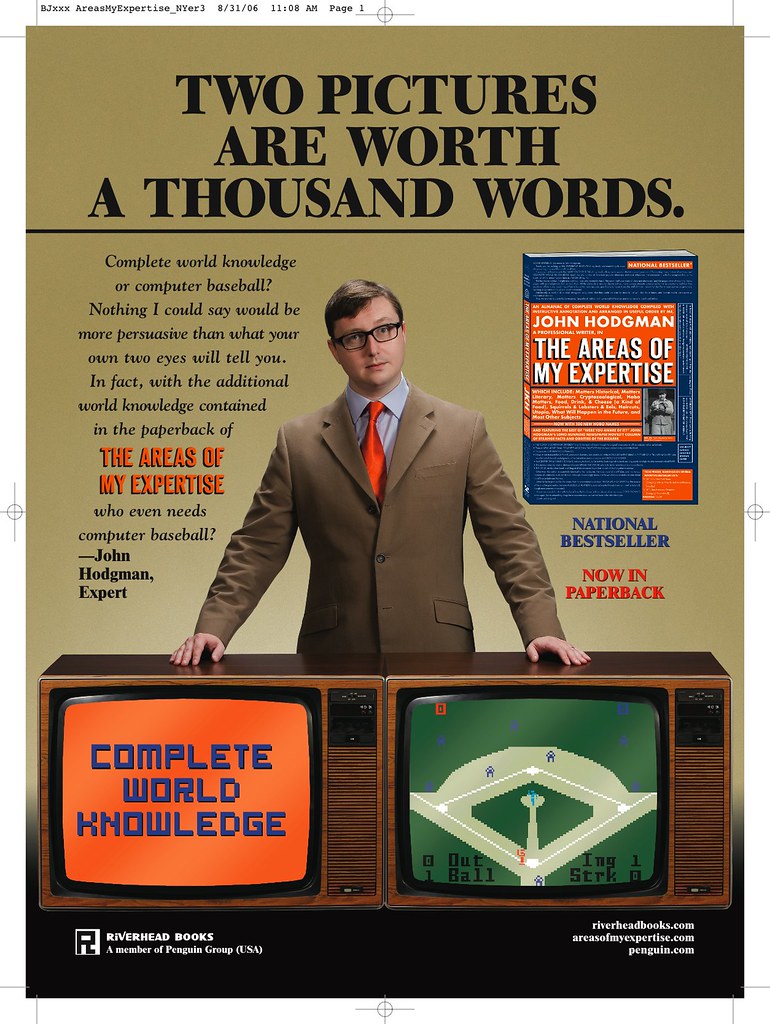
Hodgman convinced Riverhead to spring for a quiet George Plimpton-hawking-Intellivision reference.
My hat is off to you, sir.
10:31 AM
9:55 AM
Bob Peyton of 9th Street Espresso was trained in Seattle.
Espresso’s New Wave Hits Town - New York Times:
YOU might first notice the guy behind the counter with the pirate-worthy tattoos or the chromed-out espresso machine he’s operating. Your attention might be momentarily drawn to the name of the beans he’s using — like Agrica BV Calama Marka or Platinum Blonde: The Rowdy Gals’ Espresso Blend.
But at the best cafes in New York — like Café Grumpy in Greenpoint, Brooklyn, or Gimme! Coffee in Williamsburg, Brooklyn — it’s the coffee itself that will grab you.
Most espresso drinks in this country are made with over-roasted blends on “super automatic” machines that leave little control to the person operating them and turn out anonymous brews.
At cafes that are part of what some call the artisanal coffee movement the drinks reflect an obsession with each detail of the journey from farm to cup and an almost cultish pride in the results.
8:37 AM
12:20 AM
Come as you are | Salon Life:
The way Driscoll sees it, the more babies his conservative Christian congregation can produce in this child-poor city, the more they can redirect local politics, public education, and culture in one of the liberal capitals of the world. To complete his trifecta of indoctrinating, voting, and breeding, Driscoll has developed a community that dwarfs any living experiment of the '60s. To say that Mars Hill is just a church is to say that Woodstock was just a concert.
Mars Hill wrests future converts searching for identity and purpose from the dominion of available sex and drugs that still make post-grunge Seattle a countercultural destination. Driscoll promises his followers they don't have to reprogram their iTunes catalog along with their beliefs -- culture from outside the Christian fold isn't just tolerated here, it's cherished. Hipster culture is what sweetens the proverbial Kool-Aid, which parishioners here seem to gulp by the gallon. This is a land where housewives cradle babies in tattooed arms, where young men balance responsibilities as breadwinners in their families and lead guitarists in their local rock bands, and where biblical orthodoxy rules as strictly as in Hasidism or Opus Dei.
Following Driscoll's biblical reading of prescribed gender roles, women quit their jobs and try to have as many babies as possible. And these are no mere women who fear independence, who are looking to live by the simple tenets of fundamentalist credo, enforced by a commanding husband: many of the women of Mars Hill reluctantly abandon successful lives lived on their own terms to serve their husbands and their Lord. Accountability and community is ballasted by intricately organized cells -- gender-isolated support groups that form a social life as warm and tight as swaddling clothes, or weekly coed sermon studies and family dinner parties that provide further insulation against the secular world. Parents share child care, realtors share clients, teachers share lesson plans, animé buffs share DVDs, and bands share songs.
12:16 AM
12:09 AM
11:31 PM
9:55 PM
8:48 PM
Study shows 'direct link' between air travel, flu spread:
Scientists have found what they call the first real evidence that restricting air travel can delay the spread of flu -- a finding that could influence government plans for battling the next influenza pandemic.
Air travel has long been suspected of playing a role in flu's gradual spread around the globe each year, but yesterday, Boston researchers said they finally have documented it: The drop in air travel after the September 11, 2001, terrorist attacks seemed to delay that winter's flu season by about two weeks.
"This is the first time that a study has been able to show a direct link between the numbers of people traveling and the rate of spread of a virus," said John Brownstein, an epidemiologist at Children's Hospital of Boston, who led the research.
8:48 PM
8:48 PM
“You begin saving the world by saving one person at a time; all else is grandiose romanticism or politics.”
Charles Bukowski
4:55 PM
4:26 PM
The Village Voice: Power Plays:
At the Church's debut show on August 6, mall reps became alarmed that Billy and company were encouraging audience members to sneak postcards about the clearcutting campaign into the panty stacks of the Seaport Victoria's Secret store, located barely 50 feet from the back of the Spiegeltent. Theater director Savitri Durkee was called outside by an irate producer, and the choir missed its cue and began singing in the midst of Billy's sermon.
Durkee says they were warned to nix their plan to have lingerie-clad drag queens bearing cardboard chainsaws flounce around the beer garden. "So we stopped the show and started a town hall meeting about freedom of expression, supermalls, and how they imitate the communities they take over and ground the life out of them," says Reverend Billy, a.k.a. performance artist Bill Talen.
Spiegeltent producer Vallejo Gantner, who's also the new artistic director of P.S. 122, concedes he and his co-producers may have "panicked" a bit, but insists neither they nor the mall folks threatened to curtail the Church's performances.
"Everyone thinks it's a great show, we just wish they'd be good neighbors and not attack one of the tenants in the mall," says Gantner. He confessed to being unaware that Reverend Billy has an ample history of stalking the "bra pushers," notably at shareholder meetings and at the brand's 10th anniversary runway show at the Lexington Armory last November.
3:04 PM
2:59 PM
11:43 AM
9:39 AM
Riding the Elevator Into the Sky
As the fireman said:
Don't book a room over the fifth floor
in any hotel in New York.
They have ladders that will reach further
but no one will climb them.
As the New York Times said:
The elevator always seeks out
the floor of the fire
and automatically opens
and won't shut.
These are the warnings
that you must forget
if you're climbing out of yourself.
If you're going to smash into the sky.
Many times I've gone past
the fifth floor,
cranking upward,
but only once
have I gone all the way up.
Sixtieth floor:
small plants and swans bending
into their grave.
Floor two hundred:
mountains with the patience of a cat,
silence wearing its sneakers.
Floor five hundred:
messages and letters centuries old,
birds to drink,
a kitchen of clouds.
Floor six thousand:
the stars,
skeletons on fire,
their arms singing.
And a key,
a very large key,
that opens something –
some useful door –
somewhere –
up there.
Anne Sexton
11:34 AM
11:55 PM
Tonight, a very special experiment...
Comedy with Eugene Mirman
& Michael Showalter
Union Hall
September 10th at 8pm
Details
6:41 PM
6:40 PM
My fight with Amazon Unbox - Alpha Blog - alpha.cnet.com:
I left work after that and rebooted my laptop at home. That's when the real trouble began. I noticed that the Amazon player had launched itself. Annoying. I looked in the program for a preference to stop it from launching itself, and there was none. Typical. So I went to msconfig and unchecked Amazon Unbox so that it would definitely not launch itself at start-up. When I rebooted, it was no longer there. However, my firewall warned me that a Windows service (ADVWindowsClientService.exe) was trying to connect to the Net. I clicked More Info in the firewall alert and found it was Amazon Unbox. Downright offensive. It still was launching a Net-connection process that even msconfig apparently couldn't stop. Forget it. That's not the behavior of good software. I went to uninstall it.
After the Install Shield launched and I chose uninstall, I got a login screen for my Amazon account. I just wanted to uninstall it. I shouldn't have to log in to my account to do that. So I canceled the login, and the uninstall failed. I tried that three times, and it failed each time. Finally I gave up and logged in and the uninstall finished.
So, in summary, to be allowed the privilege of purchasing a video that I can't burn to DVD and can't watch on my iPod, I have to allow a program to hijack my start-up and force me to login to uninstall it? No way. Sorry, Amazon. I love a lot of what you do, but I will absolutely not recommend this service. Try again.
6:31 PM
6:21 PM
Bin Laden Trail 'Stone Cold':
Bureaucratic battles slowed down the hunt for bin Laden for the first two or three years, according to officials in several agencies, with both the Pentagon and the CIA accusing each other of withholding information. Defense Secretary Donald H. Rumsfeld's sense of territoriality has become legendary, according to these officials.
In early November 2002, for example, a CIA drone armed with a Hellfire missile killed a top al-Qaeda leader traveling through the Yemeni desert. About a week later, Rumsfeld expressed anger that it was the CIA, not the Defense Department, that had carried out the successful strike.
"How did they get the intel?" he demanded of the intelligence and other military personnel in a high-level meeting, recalled one person knowledgeable about the meeting.
Gen. Michael V. Hayden, then director of the National Security Agency and technically part of the Defense Department, said he had given it to them.
"Why aren't you giving it to us?" Rumsfeld wanted to know.
Hayden, according to this source, told Rumsfeld that the information-sharing mechanism with the CIA was working well. Rumsfeld said it would have to stop.
10:46 AM
7:42 AM
Conan O'Brien | The A.V. Club:
AVC: You also were an entertainer at a 7-year-old's birthday party at least once. Care to elaborate on that?
COB: It was horrible. Bombed. Completely bombed. Those kids were assholes. They didn't know quality when they saw it. A friend of mine and I who was a fellow improviser, a guy I knew at the Groundlings Theatre, he came to me, he said, "Hey, I got this gig to entertain at a kid's party, and they're paying, and it's cash, man." It sounded like a drug deal. "It's cash, and they want us to go there. We got to work fast." So we went there and we had guitars and pranced around. It was classic. The kids were like Easter Island statues. They just stared at us. I think the mom who had hired us was just like, "What is this crap?" We were doing weird characters and stuff. I think we got paid, but it was one of those things where they pay you grudgingly. You almost wish they didn't pay you. They really despise you. Not good. People say all experience is good—not true. That was a complete waste of time, and humiliating. If I could get into a time machine, I wouldn't use it to save Abraham Lincoln's wife, or cure polio a little earlier. I'd use it to wipe out that birthday.
6:46 AM
“The old Chinese definition of wisdom: wisdom being the destruction of idealism.”
“We do not see things as they are, we see them as we are.”
“Good things happen to those who hustle.”
Anaïs Nin
5:18 AM
5:15 AM
Guardian Unlimited | The Guardian | Is this Bush's secret bunker?:
Mount Weather is a top-security underground installation an hour's drive from Washington DC. It has its own leaders, police, fire department - and laws. A cold war relic, it has been given a new lease of life since 9/11. And no one who's been inside has ever talked.
5:14 AM
4:47 AM
4:39 AM
4:37 AM
Blotto in the Hook:
The good news is that unlike other “up and coming” neighborhoods with a “population of artists” (cough Bushwick cough,) Red Hook isn’t just a cheaper, less American Apparel-ified version of the closer-to-Manhattan neighborhood it abuts. Red Hook is actually really really cool. Really! It’s got this weird old-timey industrial vibe, but it also feels homey and neighborhoody. There’s all this cool-ass architecture and cobblestones and little parks that drop directly into the East River, and coffee shops not chock-a-block with strollers and jerks. Best of all, despite all the recent pants-creaming over the place, it doesn’t have that doomed feel that most cool and discovered neighborhoods get, because the transportation is so bad. Ibanker Mcjackoff isn’t going to want to take the bus to the F train at five in the morning to make opening bell. (And c’mon, don’t give me this water taxi shit. Please.)
4:36 AM
4:32 AM
4:27 AM
4:26 AM
4:25 AM
4:24 AM
Modern Greek 101
These phrases, once lodged in your memory,
Will help you find your way, I guarantee,
Through any social circumstance in Greek,
Each Scylla and Charybdis when you speak.
All will work in any situation,
Plug up gaps in any conversation,
Politely answer any salutation.
It's surely no coincidence all four
In different ways purport to reassure.
So get your notebooks out, for here they are.
Siga-siga first: take it easy, slow
Down. Ti na kanome: what can we do?
Then pirazi: it doesn't matter
(see how our repertory's getting fatter?)
Last but not least en daxi: all right, okay.
These are the crucial ones, and this is why:
Whichever of the four you chance to use
Shrugs with a weary grace you can't refuse,
An attitude for which there is no name
In English, though we try it all the same,
Not understanding what we imitate,
Mild acquiescence in the face of Fate,
Not dialectical and not dramatic,
But unassuming, formulaic, phatic.
One boiling morning I remarked, "It's hot."
The aproned landlord shrugged: "It matters not."
"What a pretty evening," I once said.
"What can we do?" a black-clad crone replied.
Reverse these scraps of dialogue: you too
Can answer anything that's said to you --
Though said is not the word so much as sung:
A whole philosophy rolls off the tongue.
Rachel Hadas
3:52 AM
3:16 AM
10:09 PM
McSweeney's Internet Tendency: Three New Mac Ad Ideas.:
Mac Guy and PC Guy stand just outside of an outdoor basketball court in an urban area. Mac Guy leans up against a fence with a relaxed and cocky grin on his face, while PC Guy stands anxiously wringing his hands.
After a moment, a gang of greaser-style young toughs appear and surrounds them, circling like a school of sharks and snapping their fingers in a threatening and rhythmic manner.
Mac Guy tells the clearly flustered PC Guy, "Don't worry, I'll handle this."
He steps forward and punches the nearest tough in the face. The tough hardly reacts, but Mac Guy screams in pain and cradles his shattered hand against his chest. All the toughs laugh and begin to tighten their circle, closing in for the kill ...
Suddenly, PC Guy lets loose with a horrific scream and steps forward, swinging his arms in wild circles. He launches himself into the middle of the gang as though he were the hammer of mighty Thor himself, sending young toughs flying through the air, trailing hair gel and switchblade combs behind them.
Once the battle is done, he returns to the cowering Mac Guy and helps him to his feet. Mac Guy looks at PC Guy, completely in awe of his powers.
"Dude, how did you do that?"
PC Guy straightens his suit and replies, "Your sleek design may be more aesthetically pleasing and practical, but it falls apart immediately when used as a weapon. I may be clunky and old-fashioned, but I'm easily heavy enough and sturdy enough to crush a man's skull."
3:12 PM
1:33 PM
CNN.com - Windows HS: Microsoft designs a school system - Sep 7, 2006:
After three years of planning, the Microsoft Corp.-designed "School of the Future" opened its doors Thursday, a gleaming white modern facility looking out of place amid rows of ramshackle homes in a working-class West Philadelphia neighborhood.
The school is being touted as unlike any in the world, with not only a high-tech building -- students have digital lockers and teachers use interactive "smart boards" -- but also a learning process modeled on Microsoft's management techniques.
12:04 PM
1:03 AM
1:02 AM
1:01 AM
12:59 AM
12:56 AM
12:15 AM
12:02 AM
Wired News: Quickest Patch Ever:
Microsoft is in the business of making money, and keeping users secure by patching its software is only incidental to that goal.
There's no better example of this of this principle in action than Microsoft's behavior around the vulnerability in its digital rights management software PlaysForSure.
Last week, a hacker developed an application called FairUse4WM that strips the copy protection from Windows Media DRM 10 and 11 files.
Now, this isn't a "vulnerability" in the normal sense of the word: digital rights management is not a feature that users want. Being able to remove copy protection is a good thing for some users, and completely irrelevant for everyone else. No user is ever going to say: "Oh no. I can now play the music I bought for my PC on my Mac. I must install a patch so I can't do that anymore."
But to Microsoft, this vulnerability is a big deal. It affects the company's relationship with major record labels. It affects the company's product offerings. It affects the company's bottom line. Fixing this "vulnerability" is in the company's best interest; never mind the customer.
So Microsoft wasted no time; it issued a patch three days after learning about the hack. There's no month-long wait for copyright holders who rely on Microsoft's DRM.
This clearly demonstrates that economics is a much more powerful motivator than security.
4:13 PM
1:01 PM
12:48 PM
12:22 PM
12:21 PM
12:20 PM
2:54 AM
The Clause
This entity I call my mind, this hive of restlessness,
this wedge of want my mind calls self,
this self which doubts so much and which keeps reaching,
keeps referring, keeps aspiring, longing, towards some state
from which ambiguity would be banished, uncertainty expunged;
this implement my mind and self imagine they might make together,
which would have everything accessible to it,
all our doings and undoings all at once before it,
so it would have at last the right to bless, or blame,
for without everything before you, all at once, how bless, how blame?
this capacity imagination, self and mind conceive might be the "soul,"
which would be able to regard such matters as creation and
destruction,
origin and extinction, of species, peoples, even families, even mine,
of equal consequence, and might finally solve the quandary
of this thing of being, and this other thing of not;
these layers, these divisions, these meanings or the lack thereof,
these fissures and abysses beside which I stumble, over which I reel:
is the place, the space, they constitute,
which I never satisfactorily experience but from which the fear
I might be torn away appalls me, me, or what might most be me?
Even mine, I say, as if I might ever believe such a thing;
bless and blame, I say, as though I could ever not.
This ramshackle, this unwieldy, this jerry-built assemblage,
this unfelt always felt disarray: is this the sum of me,
is this where I'm meant to end, exactly where I started out?
C.K. Williams
2:32 AM
2:04 AM
Seattlest: Alt.Bumbershoot - Sunday:
Mike Daisey - Monopoly
This was our highlight of the day. We'd never seen Mike Daisey before, but had heard about his monologue based on Amazon life. He's hilarious. Monopoly is incredibly well crafted, setting up a number of diverse narrative threads and then slowly bringing them all together in unexpected ways. It's not all laughs (though his reaction to MS Word's "helpfulness" is worth the price of admission) -- there's poignancy, too. Fanfreakingtastic!
5:48 PM
1:35 PM
(This is a project I'm involved with this fall with Les Freres Corbusier.)
Hell House
A Hell House is a multi-room theatrical experience—part installation art,
part play, and part haunted house. Every year, on and around Halloween,
thousands of Hell Houses are staged by Christian Evangelicals in communities
across America.
Unlike traditional, secular haunted houses, Hell Houses feature not ghouls
and ghosts, but instead teenagers having abortions, gay men dying of AIDS,
and children reading Harry Potter—all acts resulting in damnation. Hell
Houses are didactic, cautionary, and polemical. By depicting the everlasting
misery sinners suffer, these productions allow Evangelicals to scare
unbelievers straight. Most performances result in scores of conversions or
recommitments to the church.
Les Freres Corbusier’s Hell House will feature roughly 12 rooms of
performance and a corps of nearly 100 actors, designers, and technicians.
After journeys through earth, hell, and heaven, the show climaxes in larger
room of celebration featuring the music of a live Christian rock band, a
game of “Pin the Sin on Jesus,” and white powdered donuts.
Between October 1st and 29th, we'll be performing the show each night (with
Mondays off) from 7.30pm to 10pmish, with 10 tours lasting 45-minutes each,
and start times staggered at 15-minute intervals. All performances will be
at St. Ann's Warehouse in DUMBO.
History of Hell Houses
Hell Houses bear many similarities to medieval pageant plays, but the
contemporary form first appeared in the late 1970s, authored by Rev. Jerry
Falwell. In 1992, Keenan Roberts, now pastor of the Destiny Church in
Arvada, CO, continued the tradition and began to sell Hell House Outreach™"
kits to other churches. These kits include a 263-page manual, covering
everything from casting to publicity to instructions to making hamburger
meat look like a fetus and storing vats of blood.
Roberts has received international attention through an appearance on the
Phil Donahue Show, and via reports in the London Times, MS Magazine, The New
York Times, and Newsweek Magazine. He told the Denver Post that he designed
Hell Houses to "show young people that they can go to hell for abortion,
adultery, homosexuality, drinking and other things unless they repent and
end the behavior." In his first three years of business, Roberts sold 300
kits and entertained 20,000 guests. Since then approximately 3,000 Hell
Houses have operated across the country.
Hell House is strictly presented according to guidelines of the Hell House
Outreach™" kits distributed by Destiny Church, with certain updating for
2006.
Concept behind the New York Production
Hell House marks the first Hell House ever produced in New York City. Les
Freres Corbusier’s will stage the show as a “sociological artifact,” with
all due reverence that that entails.
Regardless of the politics or opinions of individual participants in this
production, all efforts will be made to re-create in full a traditional Hell
House. This means: no mentions of New York-centric issues, no high-tech
theatrical design elements that Evangelicals wouldn’t incorporate, and
perhaps most difficult, no irony. The show should accurately reconstruct the
experience of traveling through an authentic Hell House, so winking by the
performers or altering the script for comedic purposes must be resisted.
Certainly a Hell House is an organically generated form of live performance,
but if minor liberties will are taken, it is essential that every departure
from the text or from the known elements of real Hell Houses passes the
litmus test of “What would the Evangelicals do?” If they would not feature a
certain racy prop item, we will not include it, no matter how humorous its
effect. Additionally, we must avoid too polished a performance, for Hell
Houses are typically staged with limited resources. Our actors and designers
must embody the seeming oxymoron of “well-rehearsed amateurism.”
We remain mindful that the shock and other visceral reactions which
individual audience members will surely experience in their visit to Hell
House will be diminished by the inclusion of inside jokes or visual gags
that do not belong to the world of the Evangelicals. Let the Evangelicals
speak for themselves. They provide a more incisive critique of their rigid
set of principles than any satirical device we might offer.
1:25 PM
1:17 PM
Sunday, Sunday, Sunday! One night only in the Northwest:
MONOPOLY!
Tesla, Edison, Microsoft, Wal-Mart
and the War for Tomorrow
at the Bumbershoot Music and Arts Festival
at the charming Seattle Center
Sunday, September 3rd,
6:45 pm at the Seattle Repertory Theatre
Full Details
5:14 PM
5:09 PM
5:09 PM
5:08 PM
5:07 PM
5:06 PM
11:30 AM
11:27 AM
Boing Boing: Walt Disney World fingerprints visitors:
Disney is now fingerprinting visitors to Walt Disney World as part of its ticket-fraud prevention scheme. They're not being very transparent about it, either: there are no signs posted about the data collection or retention, and Disney's official line is that they're not collecting fingerprints, just mathematical representations of same.
But those mathematical representations are exactly what you need if you want to join up two fingerprint databases, like Disney's and the NSA's -- while the NSA may store photos of fingerprints, they work with hashes of them, using those mathematical representations to compare and sort prints. Saying that you only store the mathematical representations of a fingerprint is like saying that you only store the mathematical representations of a JPEG, not the actual paint, canvas and frame that it depicts. It's true, but it sure doesn't mean that you haven't captured something important.
Now that our national immune system has begun to attack us in a terrible anaphylactic spasm -- indiscriminate NSA wiretaps, meaningless TSA security theater, secret aviation rules and no-fly lists, "free speech zones," suspension of habeas corpus and all the rest -- it's absolutely irresponsible to gather this kind of information and leave it where the savage toddlers of the national security apparat might find it and wreak havoc with it.
11:24 AM
1:46 AM
Dilettante Archives










































































![[ Blue Spot ]](http://static.flickr.com/90/240329535_2cc1211fa1.jpg)