3:27 PM
Hello, internet.
We are relocating this blog to a new site and the RSS feed is changing. If you are reading this blog via RSS, the new RSS feed will be http://mikedaisey.blogspot.com/feeds/posts/default
Good night, and good luck.
12:22 AM
3:27 PM
Hello All,
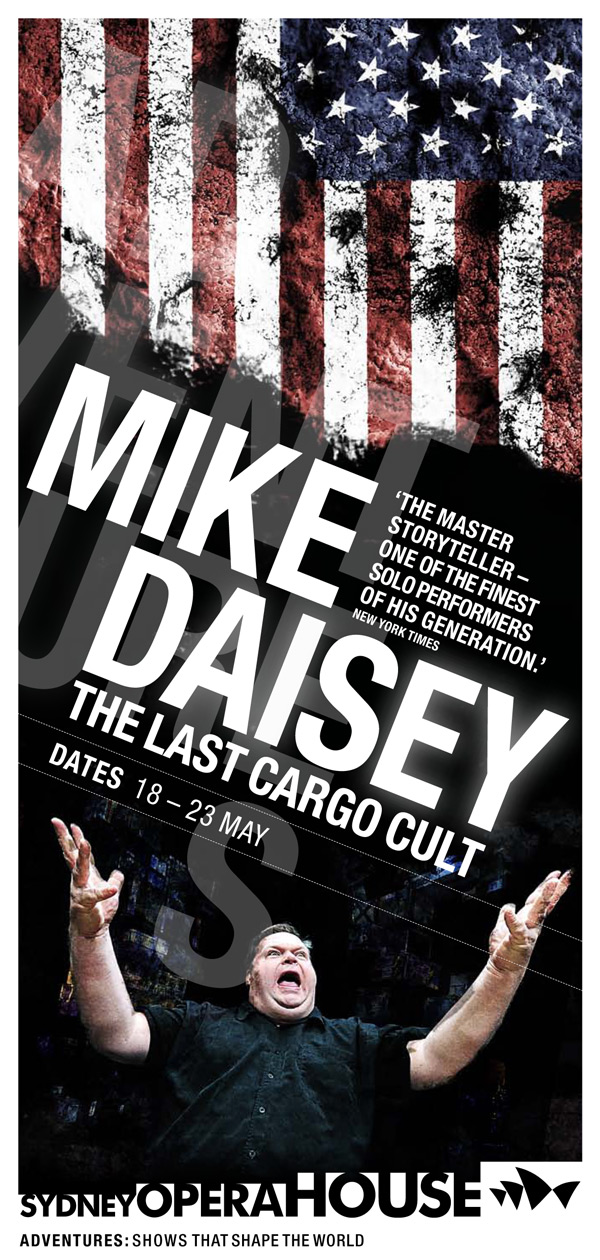
I'm writing this from Chicago, where we're performing HOW THEATER FAILED AMERICA and THE LAST CARGO CULT in a doubleheader until May 9th. We're at Victory Gardens in a fantastic, intimate space—and there are still tickets for some nights available at this link.
After Chicago we will begin a world tour which takes us to the Sydney Opera House in Australia, Hong Kong, mainland China, and Ireland. We'll be on the road over two months taking the monologues to new audiences everywhere, and hopefully come home with some new stories to share.
If you know folks in Chicago or abroad, please consider letting them know that we'll be in their area. Details of all the upcoming shows can be found at my site, and we'll be making updates from the road...and that link is:
http://mikedaisey.blogspot.com
I would close with something pithy in Gaelic, Chinese, and Australian, but I do not speak any of those languages.
Be seeing you,
md
2:40 PM
collective leverage: Thanks, Mike:
I’m obviously not in the business of recommending shows here. But, last night I saw the Mike Daisey piece “How Theater Failed America” at VG. I hadn’t seen it before, but I have been a part of numerous discussions about the piece, read interviews with him and read opinions about the piece. I was prepared to hate the piece and to absolutely loathe him, but I thought I should see it. I am now Mike Daisey’s #1 fan. I had thought about the piece as an indictment of institutional theatre, which, until I took this job, I had worked in most of my adult life. It’s not an indictment, it’s a freaking love story. It’s so much bigger and more powerful and more personal and full of truth and beauty and by the way absolutely hilarious than anything I have read or talked about or heard talked about. All the talking about it just doesn’t do the piece justice. Do I disagree with some of the points he makes? Yup, sure I do, but I disagree with plenty of playwrights, that doesn’t mean I’m not profoundly affected by what they have to say. Whatever you might think about what he has to say, whatever you might think you know about what he has to say, this, for me, was a great night in the theatre.
1:43 AM
1:43 AM
REVIEW: Mike Daisey – How Theater Failed America « Chicago Theater Blog:
“You should not have come here,” begins Mike Daisey in his one-man tour de force of nature, How Theater Failed America. For one thing, he continues, the title of the show sucks – ( “What is this, a fucking film strip?”) For another, Daisey’s simultaneously bleak and brilliant autobiographical walk down the memory lane of his career will outrage the politically correct. It will also send those who view theater as a sacred, noble art spiraling and screaming down a wild rabbit hole of profane realty. (Spoiler alert: Those who want to cling to the myth of “community” in theater should stay home and stick to their Twitter confabs.) It’s fair to ask why anyone other than out-of-work actors (which is to say – more or less – actors) should give a whit about the death of theater or about Daisey’s scathing monologue. Will the grid go dark if all of the world’s liberal arts grads collectively decide never to mount another revival of A View from the Bridge? Does the world’s well-being rest on an endless cycle of revisionist Ibsen? Of course not. Yet this is where Daisey’s explosive and formidable talent becomes so gloriously apparent. Directed by Jean-Michele Gregory, How Theater Failed America will be powerfully entertaining even to those who could not care less about whether Becket and Brecht vanish from the face of the earth, washed away by the likes of “The Little Mermaid”. As for those with a vested interest in the arts, they will find themselves repeatedly shocked and undeniably entertained by the galvanizing candor of Daisey’s observations. The man articulates truths that just aren’t spoken aloud and in doing so, breaks what often feels like a conspiracy of silence among artists.
6:28 PM
5:10 PM
12:32 PM
Five things to do today: April 29 | The TOC Blog | Time Out Chicago:
In monologuist Mike Daisey’s reckoning, the American institutional theater has become an industry that’s more invested in real estate than real artists; this is a piece that’s not to be missed by anyone who cares about theater.
11:59 AM
12:00 AM
It’s always a delicate thing to comment on reviews—as a rule theater artists never do. Recently Neil LaBute violated this guideline in the comments section at TimeOut Chicago in an unfortunate series of posts that capture exactly why this rule makes sense.
However, I also believe that the absence of real dialogue in American theatrical discourse is one of its core weaknesses—and since I strive to embrace the change I want to see, I’m going to address a number of points made by Chris Jones in his review of HOW THEATER FAILED AMERICA for the Chicago Tribune.
“On the other hand — and this is the other side of the coin to which Daisey gives short-shrift — there would be howls of anguish from the bleachers if the Chicago Cubs suddenly announced they were going to hire their players entirely from within the city of Chicago.”
I give them short-shrift in the piece because it’s a false dichotomy. What institution in the American theater is going to “suddenly” do anything? And where did anyone dictate “entirely”? There are still presenting organizations in Chicago to bring work in, and I’m expecting commercial theater to follow where the money is—and if that’s casting stars, that’s what they will do.
I’m advocating most specifically for non-profit theaters, especially the largest ones, to return to their original mandates and support artists by integrating them back into the life of the theaters—to move away from believing that real estate is more important than what happens inside the building. I advocate for this not only because it is humane, but because the institutions desperately need this change—without it they lose more and more identity every year, and can’t understand why their audiences are slipping away and not being replaced.
The problem of the artists being so supported and comfortable that the work becomes static is one that has afflicted ensembles in parts of Russia and Europe at times—it’s a real issue when it raises its head, and a thorny one to untangle. This is so far from the central economic realities that confront us in American theater that it’s laughable. Non-profit theaters whose missions are supporting arts and artists routinely build multimillion dollar buildings and won’t raise their workers wages over starvation levels with no possibility of security or connection of any kind. That is the story that is untold outside the world of the theater.
“And, being an out of-towner with a scripted show, Daisey doesn't note that most Chicago theaters cast locally and rely on an ensemble tradition.”
As anyone familiar with my monologues should know, they are unscripted. They are performed extemporaneously from an outline, and refined through performance. To the best of my ability on each night, I tell the story I want to tell to the people in the room.
The story I’m telling at Victory Gardens is the story Chicago needs to hear. The monologue is not called:
HOW THEATER FAILED AMERICA EXCEPT MAYBE CHICAGO IS AWESOME
Or
HOW CHICAGO SAVED THEATER AND SHOULD CONGRATULATE ITSELF EVEN MORE THAN IT ALREADY DOES FOR GETTING IT RIGHT
It’s called HOW THEATER FAILED AMERICA because it is about the failure of the American theater to be relevant and vital in our culture, and the decisions we made about what to support within this art form. It’s about all of us, and we all share in this problem.
I love Chicago theater—a lot of the best work I’ve ever seen comes from here, and the ecology is deep and varied. I love the commitment to ensembles, the explosion of devised work, and the spirit of its artists is inspiring.
Peel back the surface however and it isn’t so utopian. Many of your largest institutions don’t cast locally at all—they make a point of not doing so, like the Goodman. There are still large gulfs between the artists and staff even at mid-level theaters, leading to collapses like the American Theater Company schism last year.
Most despicably, when actors had the temerity to actually speak in public about how impossible it is to make a living wage, the non-profit theaters of Chicago blackballed those actors and they left town.
In many ways the strengths of Chicago are also its weaknesses—and I feel as an artist it is my job to provoke and agitate for the community to open its eyes and not sit content. That is why there is no section about how wonderful Chicago theater is: it is the last thing Chicago needs to hear.
“Anyway, in an industry that relies upon pleasing the audience, the more salient question is whether audiences share that preference (box-office data on the appeal of out-of-town stars suggest not). Don't audiences have a right to see and hear about the best of the world, coming to their town?”
I’d suggest that if we believe rely on “pleasing the audience”, then we should pack up the non-profit theaters and leave the field. Our mission should be to make work that compels, amazes, angers, delights, subverts, and transforms.
If non-profit theaters can’t find a way to do that without giving back to the artists from whom they have taken so much, they should have their non-profit status revoked and become the commercial theaters they so desperately and poorly imitate.
Finally,
“And some of the careful shading (such as keeping his objects of his withering critique anonymous) are at odds with his purported frankness.”
This isn’t being done to protect myself—I’ve already lost all the colleagues I am going to lose performing this piece. I don’t state their names because the moment you do that, theater artists and administrators in the room sigh in relief…because this story is about someone else, and it is not them. They compartmentalize and wall themselves off, tell themselves that they are “different”.
It would be easier to name names. The truth is that the story implicates us all, and that it is about us. Only when we begin to look inside can there be real hope, because that is exactly where each of us keeps possibility alive—a tenuous, flickering, necessary thing.
1:11 PM
1:09 AM
Microsoft's PR Department Must Be Shitting Their Pants Right Now | Slog | The Stranger, Seattle's Only Newspaper:
The piece—front page! main story!—goes on to say that "Like an insurgency, PowerPoint has crept into the daily lives of military commanders and reached the level of near obsession." General Petraeus calls sitting through a PowerPoint presentation "just agony." Gen. James N. Mattis of the Marine Corps says, "PowerPoint makes us stupid." General H. R. McMaster—"who banned PowerPoint presentations when he led the successful effort to secure the northern Iraqi city of Tal Afar in 2005"—is quoted as saying that PowerPoint is "dangerous because it can create the illusion of understanding and the illusion of control. Some problems in the world are not bullet-izable." Commanders also say that "the program stifles discussion" and that "the slides impart less information than a five-page paper can hold." A retired Marine colonel refers to giving half-hour PowerPoint presentations as "hypnotizing chickens." The Times refers casually to "the numbing sensation that accompanies a 30-slide briefing" and reports that "senior officers say the program does come in handy when the goal is not imparting information."
5:38 PM
5:38 PM
From All Directions at Once: Kenneth Hite on Cthulhu & Creativity « Booklife:
But more significantly, and I think more permanently, Cthulhu is a very, very important monster for the modern age. He symbolizes the kinds of vast, impersonal, inevitable, unknowable fears we have now: global warming, terrorism, ecocide, future shock, and so forth. Lovecraft invented Cthulhu (at least in part) as a response to Einstein and Shapley and Hale demonstrating that the universe could not be known or mapped. It was too big, and our view was too limited. That still scares us today; we want to believe that we matter, and Cthulhu is there to say that we really don’t. That’s why he’s still calling to writers and artists even after 80-plus years.
3:17 PM
Microsoft wins its $100M tax-break and amnesty from broke-ass Washington State - Boing Boing:
As the Washington State Legislature wound down its special session to close a $2.8 billion fiscal deficit, Microsoft's General Counsel Brad Smith successfully used a carefully timed press conference making veiled threats about tax rates as a concern regarding future job expansion in Washington State. Led by Finance Chair Rep. Ross Hunter, a 17 year former Microsoft manager, the Legislature gave Microsoft two huge gifts: a $100 million annual tax cut and an estimated $1.25 billion in amnesty on its 13 year Nevada tax dodge. To make ends meet, the Legislature cut $120 million from K-12 education and $73 million from university budgets. It also raised the general tax rate on businesses from 1.5% to 1.8% and created new '7-11' taxes on the Average Joe on beer, soda and candy. The benefits of 4,700 at-risk unemployed people with disabilities will expire in the coming year. No word on how cash-strapped Washington plans to address Smith's concerns about its educational system and transportation infrastructure.
11:43 PM
7:23 PM
MacNN | Jobs consoles partner of cancer victim via e-mail:
Apple CEO Steve Jobs has written an increasingly common personal response to an e-mail message from the public, this time one thanking him for wielding political influence in California. Following recovery from a liver transplant, Jobs used his clout to help push for a change to California law -- still pending -- which would ask everyone renewing a driver's license whether they want to be an organ donor. Jobs resorted to his wealth to secure an out-of-state operation, whereas many Californians have died waiting for donors.
The person writing to Jobs, identified simply as a Cupertino man named "James," remarks that a girlfriend of his died two years ago when melanoma spread to her liver. James applauds the executive, calling him a "hometown hero." In response Jobs is said to have sent a brief, one-line e-mail from his iPad.
"Your [sic] most welcome, James," the message reads. "I'm sorry about your girlfriend. Life is fragile."
7:20 PM
7:20 PM
Apple Gestapo: How Apple Hunts Down Leaks - Apple Worldwide Loyalty Team - Gizmodo:
Of course, all this is voluntary. Management recommends that you relinquish your phones. If you don't do it they will fire you, or they will investigate why you didn't want to give them your cellphone. Simultaneously, everyone is asked to sign NDA's during the investigations, even though they already signed Apple NDAs to work there.
"I was at several events. When they find what they are looking for—which they usually do—the person is asked to stay until the end of the business day. Then he is asked to leave the premises quietly, escorted by security," Tom says. While he's there, the special forces hang around, watching. "There is a lot that goes behind doors that I don't really know about. I do know, however, that they really interrogate people that are serious suspects, intimidating them by threatening to sue."
There is no way to know how often this happens, however, as everything is handled very quietly. The same Worldwide Loyalty Team does many other things to keep everyone in check, from searching out the email history of every employee—which is also a normal practice in other corporations and government agencies—to seeding fake images to catch potential leaks and diffuse the hype about some product introductions.
As Tom was describing all this, my mind was getting back to all I've read about Steve Jobs and Apple, back when he was El Capitán of the brave group of free pirates who created the Macintosh. The Mac was a secret project too, but there was no secret police making sure there were no leaks. After a hard day of work, all the Mac team sometimes played on the beaches of California, careless and happy, confident that this new revolutionary computer would change the world, one desktop at a time. All of them shared information, there were no seeeecrets, and that's why they came up with an "insanely great" computer, as Steve Jobs himself used to refer to it.
6:02 AM
The Carroll Gardens Diary: Lana's Barber Shop: Making The Cut For Over 20 Years:
The antique sign at 523 Henry Street doesn't credit her name but long-time customers will know this barber shop as Lana's Barber Shop. Once offered three-thousand dollars for the sign, natives can rest assured that it won't be sold or replaced anytime soon. In a rapidly changing neighborhood such as this one, some things deserve to stay put.
1:07 PM
MARTIN DOCKERY: LIVING THE DREAM!
11:24 PM
Apple Didn't Leak the iPhone—and Why That Matters - lost iPhone - Gizmodo:
For the better part of a decade, Apple has been the most secretive consumer company in the world. In an age of blogging vice-presidents and corporate Twitter accounts, Apple communicates with all the garrulousness of a defense contractor.
Ask journalists who have dealt with Apple PR and they'll tell you the same story: Apple is the most annoying company to work with in the business. At best, they're finicky, imposing ridiculous demands for simple requests like borrowing test products; at worst—and most commonly—they just won't respond to requests.
Once you've got the ear of Apple, they're great. Human, considerate, and helpful. But make a mistake or step on their toes and they shut off your drip. That's their system—and it works brilliantly. If you want access to Apple, you can't upset them. And since nothing gets attention like Apple products, it behooves those in the tech enthusiast press to stay in Apple's good graces.
11:08 AM
8:12 PM
12:29 AM
Josh Axelrad: Losing My Book Advance Taught Me to Write:
I was given a large book advance in 2005. This didn't sit well with me. It wasn't writerly, I felt, simply to be handed money without having struggled. My reaction was to gamble for about a year.
Gambling was my shtick anyhow. Before Penguin cut me the check--it was for 85 G's, a big and disreputable figure (and that was only the initial installment, payable at the signing of the contract; more would come when I delivered a manuscript the next year)--I'd counted cards for a living. I won money from casinos playing blackjack. With a team of skilled friends I spent five years roaming the country, from Vegas to Reno, from New Orleans to Biloxi to the hellfire of Northern Indiana, through tribal reservations in Kansas, earning decent income and getting barred from over 100 casinos in 15 states.
12:28 AM
Lady Gaga's Prison GF Says Kissing Her Was 'Electric' - lady gaga - Gawker:
For my most recent performance "Tiresius" I stood in a plexi podium, and fit my body inside a classical Greek male torso carved from ice, which I melted over a 5 hour period with the heat from my body. Tiresius, the Greek mythological character, makes frequent appearances in the arts – from Dante's Inferno to T.S. Eliot's The Wasteland, he is a crucial but almost always marginal figure straddling time, gender, life and death. Here I cast the story of Tiresius as one of endurance and transformation, in which masculinity both freezes the body, and melts away.
10:39 AM
5:58 PM
5:57 PM
Loper OS » Non-Apple’s Mistake:
Of course, Apple’s competitors cannot actually copy the secret of its greatness, because Apple is a fundamentally different type of organism. Rather than a brainless government-by-committee, it is an extension of one man’s will, projected with the aid of a small group of trusted lieutenants: no focus groups in sight. For the Apple-imitators to turn into genuine “Apples” would be as fantastic and unlikely as it would be for a slime mold to spontaneously become a true multicellular animal, equipped with a central nervous system. It is also unclear that, from their own perspective, they should want to grow brains – for a creature with that kind of centralized point of failure is decidedly no longer immortal. [5] There is every reason to believe that when Jobs dies, Apple will also die [6] – or at the very least, “diminish, and go into the West,” becoming a pale imitation of itself – like the post-Edison zombie of General Electric, or Hughes Aircraft after Hughes. Yet we, the consumers and developers, could certainly use more products from corporations endowed with an actual mind and will.
10:40 AM
10:40 AM
Taste for Makers:
I was talking recently to a friend who teaches at MIT. His field is hot now and every year he is inundated by applications from would-be graduate students. "A lot of them seem smart," he said. "What I can't tell is whether they have any kind of taste."
Taste. You don't hear that word much now. And yet we still need the underlying concept, whatever we call it. What my friend meant was that he wanted students who were not just good technicians, but who could use their technical knowledge to design beautiful things.
For those of us who design things—if there is such a thing as beauty, we need to be able to recognize it. We need good taste to make good things. Instead of treating beauty as an airy abstraction, to be either blathered about or avoided depending on how one feels about airy abstractions, let's try considering it as a practical question: how do you make good stuff?
10:38 AM
10:38 AM
"Let's not forget that small emotions are the great captains of our lives."
Van Gogh
12:05 AM
11:13 AM
9:42 PM
Alan Cumming: Why I Moved My Money:
But what I find really interesting and a good indicator that the campaign is working is that a couple of hours after the NY mag piece went online I received an email from Goldman Sachs saying they had read the piece and reminding me of the amount of cash I had made whilst my money was with them, despite the financial crash. This of course just reminds me of why I moved my money in the first place. It was not so much the fact that I lost a lot of money when the financial crash happened. I did, so did a lot of people. And of course, before then and since, I made money with Goldman Sachs. But the reason I moved my money was that I felt it was the only way I could demonstrate to them that I did not approve of them, that I felt they were out of touch and indeed today they just proved that again.
Continuing to give huge bonuses to their employees who had contributed to the system that ultimately lost so much money for their investors and brought us to the brink of financial ruin is not acceptable to me. The fact that the only time they ever communicated with me about the existence of the crash and the loss of my investments was as a response to me telling them I was moving my money is not acceptable to me.
5:50 PM
12:35 PM
'Let's Push for It' - The Daily Californian:
I met "Five Alarm," whose real name is Scott Novins and who looks and talks like a rabbinical scholar. After graduating from Yale and discovering that Baja California and the Sinai Peninsula are connected through plate tectonics, he came to UC Berkeley as a geography graduate student, he says. When he met Hate Man, he says he gave up his Regents fellowship, apartment, car and meals in the Gourmet Ghetto.
"People were calling me a disciple just because I wanted to live simply and deal with basic shit," he said.
Call me gullible, but I believed him. As the evening wore on, the whole philosophy started making a lot of sense. Why should I be nice when I don't feel like it? A clean-cut fellow standing off to the side disclosed that he comes here from San Francisco to relieve his pent-up aggression that comes from working at Charles Schwab.
Hate Man's philosophy makes everything easy. Whenever I asked a question that someone didn't want to answer, they would say "tell me to tell you" or "let's push for it."
12:24 PM
12:24 PM
The Genius in Apple's Vertical Platform - steve's blog:
It’s clear from a strategic perspective that Apple has thought about vertical integration incredibly deeply. Their choice to enter the CPU business was not made lightly, and reflects a platform heritage and an ability to steer developers (afforded by huge network effects). We will likely find out what's really inside the A4 soon. But one thing is already clear: Apple is sowing the groundwork to make architecture changes seamless—developers will only need to flip a switch to give their apps blazing, native performance.
I find it fascinating that Apple has been so good at diverting attention to the Flash argument, that people don’t see the true genius behind Steve Job’s vision and moves. Apple is setting the stage to become one of the biggest winners in the storied history of vertically integrated companies.
11:00 AM
11:00 PM
Poll Finds Tea Party Backers Wealthier and More Educated - NYTimes.com:
Tea Party supporters are wealthier and more well-educated than the general public, and are no more or less afraid of falling into a lower socioeconomic class, according to the latest New York Times/CBS News poll.
The 18 percent of Americans who identify themselves as Tea Party supporters tend to be Republican, white, male, married and older than 45.
Their responses are like the general public’s in many ways. Most describe the amount they paid in taxes this year as “fair.” Most send their children to public schools. A plurality do not think Sarah Palin is qualified to be president, and, despite their push for smaller government, they think that Social Security and Medicare are worth the cost to taxpayers. They actually are just as likely as Americans as a whole to have returned their census forms, despite some conservative leaders urging a boycott.
Tea Party supporters’ fierce animosity toward Washington, and the president in particular, is rooted in deep pessimism about the direction of the country and the conviction that the policies of the Obama administration are disproportionately directed at helping the poor rather than the middle class or the rich.
10:58 PM
4:00 PM
Colin Powell Is iPhone Crazy - Washington Whispers (usnews.com):
When former Secretary of State and Joint Chiefs Chairman Colin Powell got an iPad for his 73rd birthday last weekend, he finally confirmed what his family knew. He suffers from Mac attacks. "He's Apple crazy. He's iPhone crazy. He's iPod crazy," says a pal.
12:04 PM
12:36 AM
6:12 PM
The Dark Side of Steve Jobs - Steve Jobs - Gawker:
None of that changes the fact, however, that Jobs has undone large amounts of work and many existing applications with a single rule change. Nor does it alter the reality that Apple has taken operating system control to a new extreme: Not only does the company insist on approving each and every iPhone and iPad app, it now wants to control exactly how those apps are written.
4:44 PM
The New Myth: THE GREEN ROOM:
After talking about the difficulty of getting and keeping a “survival” job for a while, we opined that there should be an actor owned company in New York City that was specifically created to generate income for actors in the down time. We tried to brainstorm what kind of company it would be and what kind of service or product it could create. So we did that for about five minutes before we realized that there were already thousands of establishments that already serve the need we were articulating without that service being in anyway the purpose of the establishment. Of course we’re talking about bars and restaurants. Every bar and restaurant in the city employs actors, and other artists who are trying to stay in the city, ply their trade, and pay their rent. But none of them were created for that express purpose.
9:59 AM
9:59 AM
Apple's wager:
The "section 3.3.1" issue is just another in a long line of events that have the same basic shape: actions taken by Apple in what it believes to be the best interest of its platform (and, by extension, itself) that run afoul of the interests and opinions of developers. Any Apple follower can surely list others: the lack of Flash on the iPhone, the App Store as the sole gateway for iPhone applications, deprecating Carbon, and on and on.
Apple's decisions regarding its mobile platform in particular have been extremely protective from the very start. Cumulatively, these actions represent a huge bet placed by Apple. The proposition is this: Apple is betting it can grow its platform fast enough, using any means necessary, that developers will stick around despite all the hardships and shoddy treatment. Each time it chooses to do what it thinks is best for the future of the iPhone OS platform instead of what will please developers, Apple is pushing more chips into the pot.
9:37 AM
9:37 AM
David Mamet and the battle for Broadway | Stage | The Guardian:
There is only Broadway, where there are fewer theatres. More than 25% of off-off Broadway theatres have closed in the last five years alone, mostly in midtown and the west Village. The worth of midtown real estate has raised the rents of Broadway theatres, and, for an average play to recoup its investment, it must run for 15 weeks at near capacity. Which is to say, it must fill 1,200 seats, at an average ticket price of $77 (£50).
To whom, then, must this play appeal? To risk funding of around $11m (£7m), the play, to the rational investor, must be odds-on to appeal to the tourist. The tourist has no memory of last year's play and actors; he does not come to see the new work of a director, of a playwright, or of a designer. He comes to see a spectacle, which will neither provoke nor disturb, whose worth cannot be questioned. He does not come with the theatrical curiosity of the native theatregoer, but with the desire for amusement, and he comes as to an amusement park, for the thrill first of experiencing, and next (and perhaps more important), of being able to relate having experienced that particular thrill deprived to the stay-at-homes. He wants to brag of having seen star X or star Y. The tourist goes to the theatre much as I went, in London, to see the crown jewels.
No adult Londoner would go to see the crown jewels, and no adult New Yorker went to see Mamma Mia! for to do so would have been considered culturally repugnant, branding him as a tourist or dufus. New York, with the rise in real-estate prices and the disappearance of manufacture, business, and thus, of the middle class, has become New York Land.
10:57 PM
9:26 AM
1:45 PM
1:45 PM
Copying is Life « Counterpoint:
If there’s one lie more corrosive to creativity above all others, it is the lie of romantic individual originality. Today, ‘copyright curriculum’ warns schoolchildren not to be ‘copycats’ – to come up with their own original notions.
We are that which copies. Three or four billion years ago, by some process that we don’t understand, molecules began to copy themselves. We are the distant descendants of those early copyists – copying is in our genes. We have a word for things that don’t copy: ‘dead’.
Walk the streets of Florence and you’ll find a ‘David’ on every corner: because for half a millennium, Florentine sculptors have learned their trade by copying (but try to take a picture of ‘David’ on his plinth and you’ll be tossed out by a security guard who wants to end this great tradition in order to encourage you to buy a penny postcard).
11:36 AM
3:08 AM
Dilettante Archives